
Last updated: July 11, 2026
Key Takeaways for Metal Fabricators
- Fiber lasers dominate industrial metal fabrication in 2026 because they cut faster, use less energy and handle reflective metals.
- Power selection drives cut quality and speed: entry-level systems suit thinner materials, mid-range handles half-inch steel and high-power manages one-inch and heavier plate.
- U.S.-based service infrastructure, parts availability and technician coverage are critical when evaluating laser brands and platforms.
- Total cost of ownership extends beyond purchase price and includes energy, assist gases, consumables, maintenance and downtime risk.
- Fabcon delivers integrated laser cutting, forming, welding and assembly under one roof, providing a single source for complex metal fabrication programs.
Fiber and CO2 Lasers in Metal Fabrication
The core difference between fiber and CO2 lasers is wavelength. CO2 systems generate a 10,600 nm wavelength through gas-filled resonator tubes, while fiber lasers produce a roughly 1,064 nm wavelength through solid-state diodes and rare-earth-doped optical fiber. That difference in wavelength has direct consequences on the shop floor.
Metals absorb the shorter fiber wavelength efficiently. Fiber lasers focus energy into a microscopic point, enabling fast, clean cuts on dense and reflective metals such as aluminum, brass and copper without back-reflection damage to the optics. CO2 systems face the opposite problem. Attempting to cut highly reflective metals with a CO2 laser risks instantly destroying its mirrors and optics.
Efficiency compounds the advantage for fiber platforms. Fiber lasers convert a higher percentage of electrical input into laser output than CO2 systems. That gap translates directly into lower energy cost per part. Maintenance follows the same pattern. Fiber lasers are commonly cited as having a theoretical maximum lifespan of 100,000 hours, though this represents an upper-bound figure rather than a guaranteed rating for the system or its pump diodes, while CO2 resonator tubes typically require replacement or refilling after fewer hours. Fiber systems also eliminate the consumable resonator gases, vacuum pumps and complex mirror alignments that CO2 platforms require.
Despite these disadvantages for metal work, CO2 lasers retain a role in non-metal applications such as wood, acrylic and fabric, where their longer wavelength produces clean, sealed edges. For steel, aluminum, brass and copper in a production environment, fiber is the practical choice in 2026.
Matching Laser Power to Metal Workloads
Power selection drives cut quality, speed and operating cost more than any other specification. The relationship between power and material thickness is well established across the industry.
Entry-level fiber laser systems handle carbon steel, stainless steel and aluminum at thicknesses suited to general fabrication and light structural work. For quarter-inch steel, this power band delivers clean edges and bolt-ready holes at production speeds. Moving to half-inch steel demands more reserve power. Mid-range systems extend cutting capacity significantly and are the fastest-growing segment in automotive and aerospace manufacturing. Full one-inch steel and heavier structural plate require high-power systems, a segment that dominated the industrial laser systems market in 2025, driven by demand for thick metal cutting and steel processing.
Beyond flat sheet capacity, tube and profile capability adds another dimension to system selection. Fiber tube lasers process round, square, rectangular and structural profiles in a single operation, producing slots, holes and notches that arrive at the press brake or weld cell ready to form or join without secondary drilling or grinding. This approach compresses cycle time in integrated workflows and improves consistency.
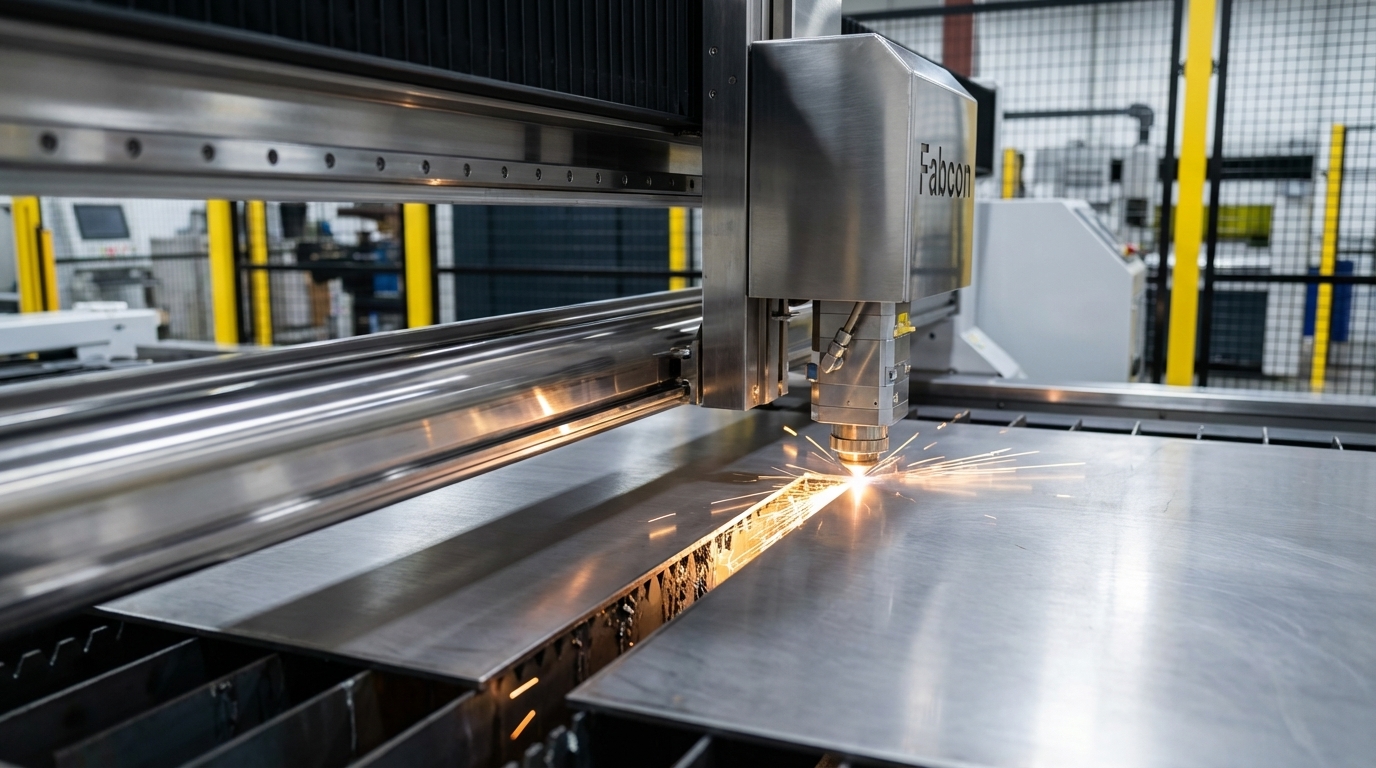
Fabcon applies fiber laser systems across sheet and structural applications daily, feeding cut parts directly into in-house press brake forming, certified welding and finishing. This structure removes vendor handoffs that erode schedule and quality.
Industrial Laser Brands and U.S. Support Strength
The major fiber laser platform manufacturers include Trumpf, Bystronic, Mazak, Prima Power, Amada and a growing field of Asian-origin brands such as Bodor, HSG and Hymson. These manufacturers compete on beam quality, automation options, software integration and cutting envelope, which shape how well a system fits a given production mix.
For U.S. production environments, service response matters as much as the machine specification. Key factors to evaluate include:
- Domestic parts inventory depth and typical lead time for critical consumables
- U.S.-based field service technician coverage in the shop’s region
- Software support and remote diagnostics availability
- Training resources for operators and programmers
- Established install base in comparable U.S. fabrication environments
European and Japanese brands generally maintain stronger U.S. service infrastructure and longer domestic install histories. Some Asian-origin platforms offer competitive acquisition costs but carry longer parts lead times and thinner domestic technician networks, which increases risk when downtime costs are factored into total cost of ownership.
These service disparities disappear when a domestic fabricator already operates and maintains the systems. Fabcon owns and operates its laser platforms, absorbing maintenance risk and keeping production moving regardless of which machine runs a given job.
Get a quote and see how Fabcon’s integrated laser cutting capabilities support complex programs.
Total Cost of Ownership for Laser Systems
Acquisition price is the most visible line item but rarely the largest over a system’s life. For a mid-power industrial fiber laser, the primary five-year TCO components are initial purchase price, electricity consumption, assist gases, consumables, maintenance and repairs, downtime costs and resale value.
Energy represents a significant ongoing cost. A mid-power fiber laser draws substantially less wall power than an equivalent CO2 system, producing meaningful annual electricity savings at standard industrial rates. Assist gas, primarily nitrogen for stainless steel and aluminum and oxygen for mild steel, represents another operating cost that scales with cut volume and thickness. Nitrogen consumption rises with material thickness and cut speed, so gas management becomes a production planning consideration.
Consumables such as nozzles, protective windows, lenses and ceramic rings require scheduled replacement and add to operating cost. Downtime costs vary significantly between premium and entry-level systems, with expected annual downtime hours differing between tiers. That spread shows why machine quality and service access function as TCO variables, not just capital considerations.
Given the extended operational lifespan discussed earlier, fiber systems can deliver a decade or more of service with proper maintenance, spreading the initial investment across a longer horizon. Over that period, efficiency and maintenance advantages over CO2 systems accumulate into a substantial cost difference.
Outsourcing laser cutting to an integrated fabricator converts capital expenditure and operating risk into a predictable per-part cost. Fabcon’s vertically integrated model means customers receive laser-cut, formed, finished and assembled parts under one purchase order, with no separate machine investment, consumable management or service contracts to administer.
Decision Framework for Metal Fabricators
Effective laser system selection, or fabrication partner selection, starts with a clear view of the production environment. The relevant criteria include:
- Material mix: the range of metals, alloys and thicknesses in the production program
- Volume and mix variability: whether production runs are high-volume repetitive or high-mix with frequent changeovers
- Downstream integration: whether cut parts feed directly into bending, welding and finishing or travel to separate vendors
- Finishing and assembly requirements: powder coat, wet paint, hardware insertion and electromechanical assembly needs
- Quality and compliance requirements: certifications such as ISO 9001:2015, AS9100D or ITAR registration
- Service and support geography: proximity of qualified technicians and parts inventory
For mid-to-large OEMs and infrastructure manufacturers, the decision often reduces to a build-versus-buy question. Owning laser systems requires capital, trained operators, consumable management, service relationships and access to local technicians and parts. Partnering with a vertically integrated fabricator transfers that burden while providing access to current-generation equipment and integrated downstream processes.
Fabcon operates as that integrated fabricator model. Fabcon’s facilities span laser cutting through CNC machining, press brake forming, certified welding, in-house finishing and light electromechanical assembly. ISO 9001:2015 and AS9100D certification governs every stage. Programs scale from prototype through production without changing partners or purchase orders.
Frequently Asked Questions
What type of laser is best for cutting through metal?
Fiber lasers are the standard choice for industrial metal cutting in 2026. Their shorter wavelength is absorbed efficiently by metals including steel, aluminum, brass and copper, which enables fast, clean cuts with minimal heat-affected zones. CO2 lasers remain useful for non-metal materials but are outperformed by fiber systems on speed, energy use and reflective-metal compatibility. For production environments processing any combination of ferrous and nonferrous metals, fiber is the practical and economical choice.
What are the top industrial brands of laser cutting machines?
The leading industrial fiber laser platform manufacturers include Trumpf, Bystronic, Mazak, Amada and Prima Power, all of which maintain established U.S. service networks and domestic install bases. A growing number of Asian-origin brands, including Bodor, HSG and Hymson, compete on acquisition cost and are gaining share in cost-sensitive segments. Brand selection should weigh U.S. parts availability, regional service technician coverage and software support alongside machine specifications. For customers sourcing fabricated parts rather than purchasing equipment, the fabricator’s platform choice matters less than demonstrated uptime, quality systems and downstream integration capability.
What power level is recommended for cutting half-inch steel?
Half-inch steel sits in the mid-range of industrial fiber laser applications. Systems in the mid-power range handle this thickness reliably in production environments, delivering clean edges and consistent kerf width at commercially viable speeds. Thinner material, such as quarter-inch and below, can be processed efficiently at lower power levels. Heavier plate approaching one inch and above benefits from high-power systems, which maintain cut quality and speed at greater depths. The required edge finish, assist gas selection and nozzle configuration further refine the ideal power choice.
How do fiber lasers integrate with bending, welding and finishing?
Fiber laser cutting delivers the greatest value when it feeds directly into downstream processes without intermediate handling or vendor transfers. Laser-cut edges are typically smooth and dimensionally consistent, which reduces or eliminates the grinding and cleanup that precede forming and welding. Tube laser systems add the ability to cut slots, holes and notches in structural profiles in a single operation, so parts arrive at the weld cell with accurate fit-up geometry.
In a vertically integrated facility, cut parts move from the laser table to the press brake, then to welding and finishing, within a controlled quality system. This structure removes schedule variability and quality disputes that arise when separate vendors handle each step. Fabcon’s facilities follow this integrated flow, with laser cutting, forming, welding, powder coat, wet paint and electromechanical assembly operating under one roof and one quality management system.
Conclusion: Fiber Lasers and Integrated Fabrication
Fiber lasers are the practical platform for industrial metal fabrication in 2026. The advantages over CO2 systems detailed earlier are well established, and the market has moved accordingly. The remaining decisions, including power level, brand, service access and downstream integration, determine whether a laser investment or a fabrication partnership delivers the lowest total cost and the least supply chain risk.
For OEMs and infrastructure manufacturers that need precision sheet metal parts, enclosures and assemblies delivered on schedule, the integrated model reduces the variables that fragment supply chains and inflate costs. Fabcon has operated as that integrated partner since 1977, applying current-generation fiber laser systems within a full fabrication and assembly workflow governed by ISO 9001:2015 and AS9100D certification.
Get a quote for integrated laser cutting, fabrication and assembly from Fabcon.