
Key takeaways for infrastructure OEM sourcing
- Multi-vendor supply chains create scheduling risk, quality disputes and coordination overhead that reduce program predictability for infrastructure OEMs.
- An electronic contract manufacturer (ECM) provides integrated fabrication, finishing and light electromechanical assembly under one roof to remove handoffs and improve accountability.
- Key selection criteria include vertical integration, DFM collaboration depth, ISO 9001:2015 and AS9100D certifications, full traceability and flexible U.S.-based production cells.
- Vertically integrated U.S. partners deliver precision sheet metal fabrication, in-house finishing and engineering collaboration that reduce supplier count and post-production handling.
- Apply this checklist with a vertically integrated U.S. partner for the next enclosure, rack or assembly program.
EMS providers and OEMs in infrastructure programs
An OEM designs and markets a finished product under its own brand. An EMS provider manufactures that product or its subsystems under contract. This distinction shapes sourcing decisions for infrastructure buyers because most large EMS providers focus on PCB-level work at high volumes, not on the structural enclosures, racks and electromechanical assemblies that protect electronics in the field.
Hybrid and turnkey EMS models are growing because OEMs want single-invoice accountability for materials procurement, design verification and compliance paperwork. For infrastructure OEMs, that accountability must also cover the metal enclosure, the finishing and the integrated assembly, not only the board inside it. A partner that handles both the structural and electromechanical layers closes the coordination gap that standard EMS providers and basic job shops leave open.
Core services that matter in an ECM partner
Infrastructure OEMs benefit most from ECM partners that manage the full path from raw metal to finished assembly without passing work between vendors. That level of control supports predictable schedules, consistent quality and simpler communication. A capable partner for enclosures, racks and assemblies delivers the following services:
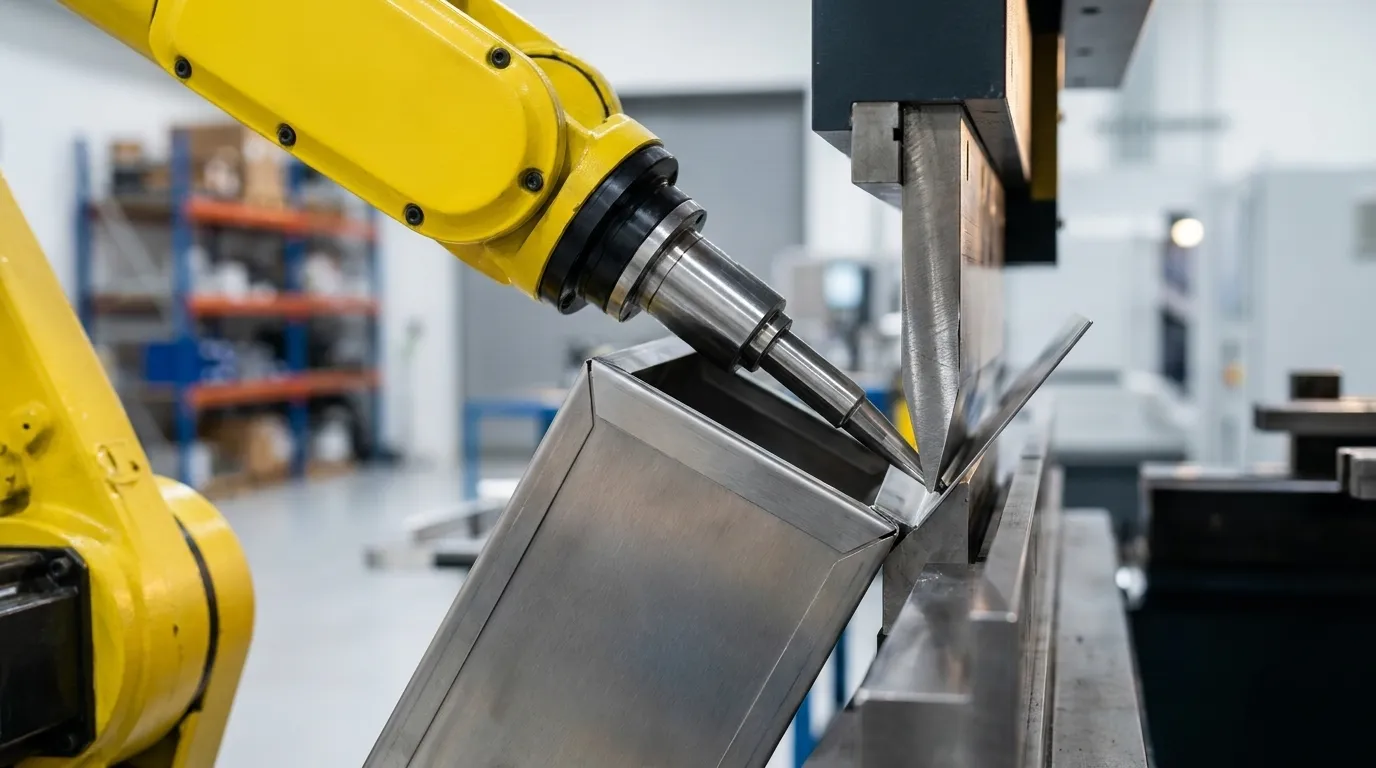
- Precision sheet metal fabrication. Laser cutting, CNC punching, forming and certified welding produce tight-tolerance enclosures, chassis and structural frames with repeatable quality from prototype through production.
- CNC machining. In-house machining supports fabricated assemblies that require dimensional accuracy for hardware insertion, pressure testing or complex fit requirements.
- In-house finishing. Powder coat, wet paint, CARC military-grade finishing and silkscreen applied internally maintain cosmetic standards and remove the scheduling variability of outside finishing vendors.
- Light electromechanical assembly. Wiring, component integration and hardware insertion performed under the same roof as fabrication reduce handoffs and improve system-level alignment.
- Engineering and DFM collaboration. Early engagement with fabrication experts allows relaxation of non-critical tolerances, adjustment of weld joint geometry and identification of weld access constraints before production begins, which avoids costly redesign delays.
- Fulfillment and logistics. JIT delivery, kitting and program-level logistics support reduce inventory carrying costs and simplify receiving operations for the OEM.
- Quality management and traceability. Certifications matter, but a strong partner also integrates defect tracking, root cause analysis and repeat-issue prevention into daily operations instead of treating quality as a separate end-of-line function.
How to choose an electronic contract manufacturing partner
Mid-volume infrastructure programs need partners that adapt without the minimums and rigidity of global CMs. The following criteria highlight partners built for that flexibility instead of high-volume stability:
- DFM collaboration before quoting. The DFM collaboration described above becomes a selection filter. Partners that review drawings only after purchase order issuance introduce preventable rework, while those that engage before quoting catch tolerance conflicts and weld access issues at the design stage.
- One-roof integration. Multi-vendor configurations for industrial enclosures complicate root cause analysis and warranty claims by creating multiple points of technical accountability instead of a single-source provider. A single accountable partner removes that risk.
- ISO 9001:2015 and AS9100D certification. ISO 9001:2015 is table stakes for serious EMS providers serving regulated industries, and AS9100 Rev D certification is mandatory for aerospace primes supply chains.
- Full traceability. Part-level traceability satisfies regulatory requirements in aerospace, medical and energy programs and supports audit readiness without manual data reconciliation across vendors.
- Flexible production cells. Agile cells that adapt to changing volumes, mixed SKUs and evolving BOMs support mid-volume programs that large global CMs cannot accommodate without high minimums and long onboarding cycles.
- ITAR registration. Defense and dual-use programs require a partner with documented ITAR compliance and enforceable IP controls under U.S. legal frameworks.
Industry applications for infrastructure and technology products
Vertically integrated U.S. precision metal fabrication and light assembly supports a wide range of infrastructure-intensive verticals. These sectors depend on reliable enclosures, racks and assemblies that protect electronics in demanding environments:
- Data centers. Hyperscale operators have increased orders for AI accelerator servers that integrate high-bandwidth-memory modules and liquid-cooling manifolds, which drives demand for North American box-build capacity with advanced thermal and power-delivery expertise.
- Aerospace and defense. Mission-critical assemblies require AS9100D certification, ITAR registration, full traceability and tight-tolerance fabrication from prototype through production.
- Medical devices. Fabricated assemblies, carts, lab equipment and medical furniture require precision assembly, full traceability and quality systems that satisfy regulatory requirements.
- Energy storage and power distribution. Weatherproof, customizable enclosures with electromechanical integration support commercial and public deployments where reliability under environmental stress remains non-negotiable.
- Electric vehicle infrastructure. Automotive OEMs are accelerating local sourcing because EV battery-management systems and ADAS modules require quick-turn prototypes that offshore megasites cannot supply within compressed design windows.
- Traffic safety and transportation. Durable, precision-fabricated metal solutions for infrastructure-grade components require compliance, consistency and reliability across production runs.
Request a quote for a data center, aerospace or energy infrastructure program.
Risks of electronic contract manufacturing and how to mitigate them
These applications share common failure modes when sourcing is fragmented across multiple vendors. Understanding those risks and their mitigations supports stronger program outcomes. Common risks in contract manufacturing programs and their mitigations include:
- Vendor handoff delays. Every interface between suppliers introduces communication delays, additional documentation, engineering rework and potential misalignment between production processes. Mitigation: consolidate fabrication, finishing and assembly with a single partner.
- Quality disputes with no clear owner. The quality ownership gap mentioned earlier becomes most acute during field failures, when warranty claims require rapid root cause analysis across vendors with competing incentives. Mitigation: require end-to-end quality ownership and integrated QA spanning the entire build.
- Design-to-manufacture disconnect. Engineering revalidation with each new supplier requires updated DFM reviews, revised tolerances, process adjustments and additional prototype iterations, which consumes engineering resources and delays production readiness. Mitigation: engage a partner with in-house engineering that collaborates before production begins.
- Scaling failures at volume. Vendor fragmentation often becomes most expensive during scale-up, as prototype programs that perform adequately with distributed suppliers see variability multiply and communication cycles lengthen when volumes increase. Mitigation: select a partner with flexible production cells designed for high-mix, variable-volume programs.
- IP exposure across multiple vendors. Each additional vendor in a fragmented supply chain adds another IP exposure point, while integrated U.S. manufacturers consolidate exposure and simplify ITAR compliance and NDA enforcement. Mitigation: consolidate with a U.S.-based, ITAR-registered partner operating under enforceable U.S. legal frameworks.
- Traceability gaps during audits. Traceability and compliance gaps across hundreds of components from disparate suppliers are difficult to document, which creates risk during audits and recalls when proof is hardest to assemble. Mitigation: require a partner with certified quality systems and part-level traceability spanning the full build.
U.S.-based advantages versus global CMs
Many of the risks above, including IP exposure, traceability gaps and scaling failures, stem from structural features of offshore sourcing. Domestic partners provide advantages that address those failure modes directly.
Reshoring momentum has accelerated across the electronics and precision metal fabrication sectors. In 2023 and 2024 combined, American companies and foreign investors announced more than 530,000 manufacturing jobs to be created on U.S. soil through reshoring and foreign direct investment, with computers, electronics and electrical equipment accounting for 64 percent of all reshoring and FDI job announcements in 2024.
The financial case for domestic sourcing has strengthened. An OEM doing the import-cost math in 2026 often finds that an offshore quote is more expensive landed than a U.S. quote because of Section 301 tariffs, ocean-freight volatility and CHIPS Act incentives, with cumulative duty on electronics-related HTS codes from China reaching up to approximately 42.5 percent due to stacked tariffs.
Lead-time reliability is a structural advantage of domestic production. Without ocean freight, customs clearance and multi-week shipping windows, domestic partners often achieve significantly shorter end-to-end times from Engineering Change Order release to validated parts.
For mid-volume programs, U.S.-based partners also provide agility that large global CMs cannot match. The North America EMS market is estimated at USD 120.71 billion in 2026 and is projected to grow substantially by 2031, driven by CHIPS Act incentives and AI-server demand, with box-build and electromechanical assembly expanding at a strong CAGR. Domestic partners positioned for mid-volume programs can capture that growth without the minimum-volume requirements and onboarding rigidity of global megasites.
Conclusion
Choosing an electronic contract manufacturing partner for enclosures, racks and assemblies requires evaluation of vertical integration scope, DFM collaboration depth, quality certifications, traceability systems, production cell flexibility and U.S.-based advantages. The six selection criteria outlined above provide a structured framework for evaluating any candidate partner.
Fabcon is a vertically integrated U.S. precision metal fabrication and electromechanical assembly partner that operates across 220,000 square feet of manufacturing space with ISO 9001:2015, AS9100D and ITAR registration. Fabcon supports programs from prototype through mid-volume production and combines fabrication, finishing and assembly under one roof to reduce supplier complexity and improve program predictability.
Evaluate Fabcon against these criteria for an upcoming program.
Frequently asked questions
What is the difference between a basic sheet metal job shop and a vertically integrated electronic contract manufacturer?
A basic sheet metal job shop is a build-to-print vendor that cuts, forms and welds metal parts but stops there. It typically lacks in-house finishing, engineering support and assembly capability. An OEM using a job shop must coordinate separate vendors for powder coating, wiring, hardware insertion and electromechanical integration, which multiplies handoffs, scheduling risk and quality disputes.
A vertically integrated electronic contract manufacturer handles fabrication, finishing and light assembly under one roof. It also provides DFM collaboration before production begins, which reduces rework and aligns designs to manufacturing realities. The result is fewer vendors, shorter lead times and a single accountable partner for the finished assembly.
What certifications should an electronic contract manufacturing partner hold for regulated industries?
ISO 9001:2015 is the baseline quality management certification required across most contract manufacturing programs. AS9100D is required for aerospace and defense supply chains. ITAR registration is mandatory for any program involving export-controlled defense work.
For medical device programs, ISO 13485 enforces traceability and risk management throughout production. Beyond certifications, a capable partner integrates quality into daily operations through defect tracking, root cause analysis and part-level traceability that supports audit readiness in regulated industries. Certifications confirm a quality system exists, while traceability records confirm it functions as intended.
How does early DFM collaboration reduce total cost of ownership for enclosure and rack programs?
Design-for-manufacturability collaboration before production begins allows fabrication engineers to identify tolerance conflicts, weld access constraints and material choices that would otherwise cause rework or first-article failures. Catching those issues at the design stage costs less than correcting them after tooling is set and production has started.
Early DFM also aligns the design to the actual capabilities of the fabrication floor, which improves repeatability at volume. For OEMs managing compressed launch timelines, DFM collaboration shortens quoting cycles, reduces prototype iterations and prevents redesign delays that erode time-to-market advantages.
Why do mid-volume programs struggle with large global contract manufacturers?
Large global contract manufacturers are optimized for high-volume, stable programs. They typically require high minimum order quantities, long onboarding processes and rigid production lines that cannot adapt quickly to evolving BOMs, mixed SKUs or volume changes.
Mid-volume infrastructure programs often involve high-mix configurations, frequent engineering changes and growth trajectories that do not fit those constraints. A purpose-built mid-volume partner uses flexible production cells that scale with program needs, supports prototype-to-production transitions without re-qualification overhead and maintains responsiveness that large CMs structurally cannot offer.
What are the primary supply chain risks of sourcing enclosures and assemblies from multiple vendors?
Fragmented sourcing creates several compounding risks. Staggered delivery schedules from multiple vendors complicate production planning and increase the likelihood of line stoppages when one component is delayed. Quality disputes arise because no single vendor owns the full assembly, which makes root cause analysis slow and accountability diffuse.
Engineering changes ripple unpredictably across suppliers and consume internal resources while extending change cycles. During material shortages, smaller customers lose priority at each supplier simultaneously. IP exposure multiplies with each additional vendor. Consolidating fabrication, finishing and assembly with a single U.S.-based partner addresses these risks through one accountable relationship, integrated quality ownership and enforceable IP controls.