
Key Takeaways for Mid-Volume Stamping Programs
- Mid-volume infrastructure and technology programs face a sourcing gap between low-complexity job shops and large contract manufacturers with rigid minimums.
- Integrated domestic providers that combine stamping, finishing and assembly under one roof reduce coordination overhead and quality risk.
- 2026 market pressures including reshoring, Buy America requirements and tightening traceability standards accelerate demand for domestic partners.
- Custom metal stamping has become an engineering-led discipline with automation, AI-driven quality systems and vertical integration defining leading providers.
- Evaluate whether an integrated domestic partner fits current program requirements.
Custom Metal Stamping’s Role in Today’s Supply Chains
Custom metal stamping services use dies and presses to form sheet metal into precise geometries through progressive, transfer or compound tooling sequences. The process converts flat coil or blank stock into brackets, enclosures, chassis, structural frames and complex multi-feature components at repeatable tolerances.
In modern supply chains, stamping rarely functions as a standalone operation. Infrastructure and technology programs require stamped components to move directly into finishing, assembly and fulfillment workflows. When those steps are fragmented across separate vendors, miscommunication between suppliers becomes common. That miscommunication leads to inconsistent tolerances and finishes, which then cause delays as parts move through freight and rework handoffs. The cumulative effect is higher total landed cost.
Integrated domestic providers address this by treating stamping as the first stage of a connected production system rather than a discrete transaction. That integrated approach aligns with the broader market forces reshaping sourcing decisions in 2026.
Review how Fabcon’s integrated model supports connected production workflows.
2026 Market Pressures Shaping Stamping Decisions
Several converging forces reshape how mid-volume buyers source custom metal stamping services in 2026.
Reshoring continues to accelerate. The Reshoring Initiative reports that 244,000 U.S. manufacturing jobs were announced through reshoring and foreign direct investment in 2024, with tariff-driven reshoring cases surging in early 2025. This activity reflects a broader shift toward domestic production for manufacturers serving U.S. demand or defense-critical capacity. Domestic production strengthens supply-chain control, protects intellectual property and supports fast response times.
Policy creates a domestic demand floor. Buy America provisions tied to the Infrastructure Investment and Jobs Act require that iron, steel and manufactured products for federally funded projects be produced in the United States. Shifting tariffs and eligibility-driven sourcing rules push supply chains to prioritize traceability and jurisdictional resilience. That shift increases the value of domestic processing configurations.
Quality and traceability requirements continue to tighten. End users expect tighter tolerances and advanced inspection technologies to address quality variations that affect assembly and product performance. Regulated industries including aerospace, medical devices and energy storage require full part traceability across every production stage.
Product complexity also increases. Programs now require stamped components that integrate wiring, coatings, hardware and subassemblies. Fragmented supplier bases struggle to manage that integration without added coordination overhead and higher quality risk.
Assess how an integrated domestic model addresses current sourcing pressures.
How Custom Metal Stamping Capabilities Have Evolved
Custom metal stamping has evolved from a build-to-print commodity into an engineering-led, integrated production discipline.
Early stamping operations focused on high-volume, single-material runs with manual die changes and offline quality sampling. Engineering involvement remained limited. Separate vendors typically handled finishing and assembly.
The next phase introduced progressive die tooling, which combines multiple forming steps into one continuous process. By reducing handling time between operations, progressive dies minimize errors that occur during part transfers. Fewer errors and less handling enable faster cycle times. Those faster cycles support consistent quality for complex parts with tight tolerances.
Vertical integration followed. Leading providers absorbed finishing, welding, hardware insertion and light assembly to reduce handoffs and improve dimensional consistency across mating components.
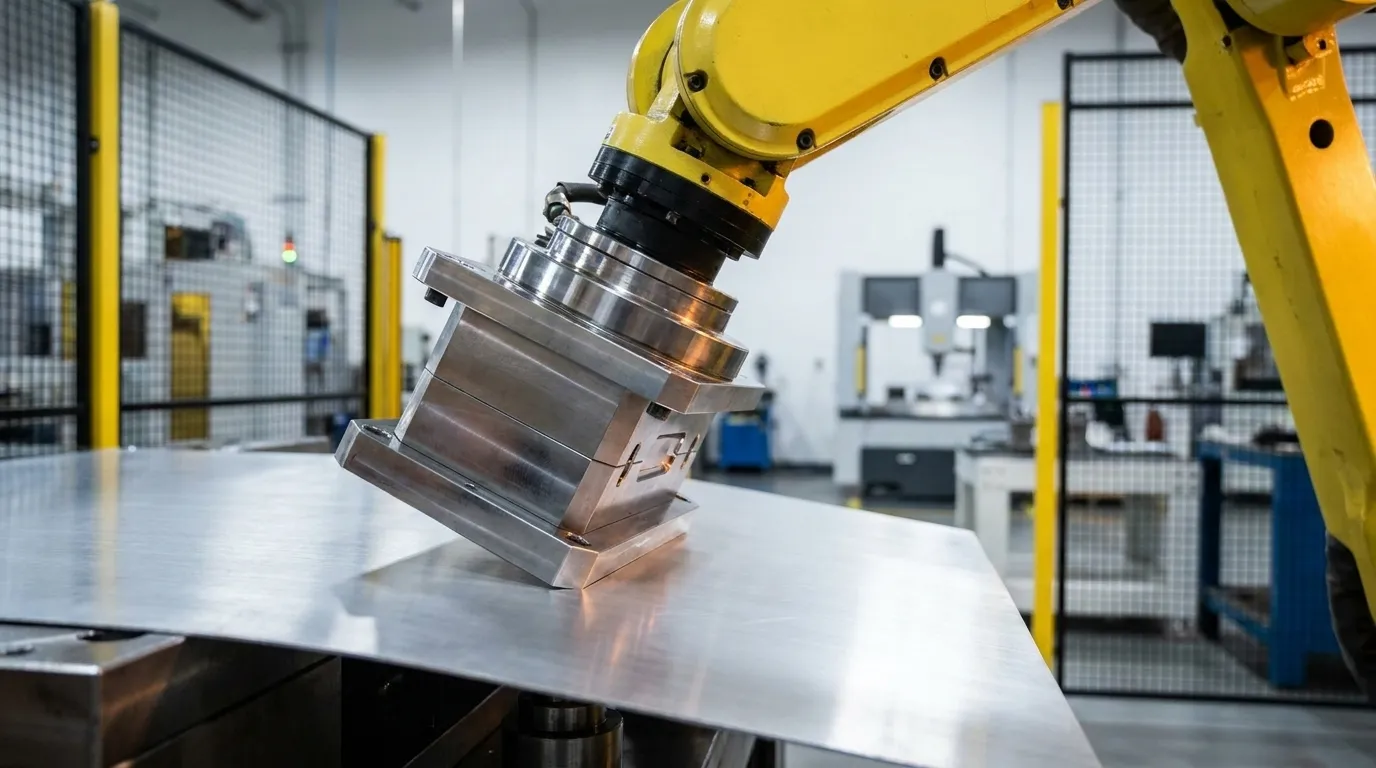
In 2026, automation and connected quality systems define the leading edge. Automation in precision metal stamping has moved beyond simple part handling to fully embedded robotic production cells that handle blank feeding, part transfer, trimming, welding, assembly, inspection and deburring. AI-driven pattern recognition, digital twin models and enhanced industrial connectivity now operate on production floors, informing real-time decisions on process adjustments and predictive maintenance.
Companies that integrate real-time IoT sensor data and AI-driven analytics into stamping presses report meaningful reductions in unplanned downtime. That reliability supports the uptime expectations of infrastructure and technology programs.
See how Fabcon’s production capabilities align with technical requirements.
Integrated Capability Areas from Design Through Delivery
An integrated custom metal stamping provider covers the full production arc from design through delivery. The core capability areas connect into a single workflow.
Design and engineering support begins before production. Design-for-manufacturability collaboration reviews drawings, tolerances and materials to refine geometry and reduce die stations. These reviews also eliminate features that add cost without function and align material selection with performance needs before tooling is committed.
Stamping production covers progressive, transfer and compound die operations across a range of material types and thicknesses. Investments in servo-driven presses, robotic automation and digital quality-control systems increase operational efficiency. These investments also improve consistency and support demanding requirements for quality and precision.
Finishing includes powder coating, wet paint, screen printing and mil-spec coatings. Keeping finishing operations in the same facility as forming and assembly creates a unified quality environment. That environment enables real-time process adjustments when issues appear, which improves finish consistency and reduces defects. With all operations under one roof, quality standards apply uniformly, traceability remains intact and audits become simpler because documentation follows a single chain of custody.
Assembly and integration covers hardware insertion, mechanical assembly and light electromechanical assembly including wiring and component integration. This capability separates integrated providers from basic stamping shops because it delivers assemblies that approach final product form.
Testing and quality assurance span the full build under a single quality management system. ISO 9001:2015 and AS9100D certification govern every stage and provide the traceability documentation that regulated industries require.
Fulfillment and logistics complete the workflow. Providers ship end-use-ready assemblies that move directly into final product builds without additional handling.
Integrated manufacturing creates one purchase order, one invoice, one quality system and one accountable partner. That structure reduces administrative friction and risk for procurement teams that manage multiple SKUs.
Facilities, Production Environment and Engagement Flow
Mid-tier integrated providers operate from dedicated manufacturing facilities that house stamping, finishing and assembly in a connected production environment. Fabcon operates across 220,000 square feet of manufacturing space in two Southern California locations, with production cells configured for flexibility across mixed SKUs and evolving bills of materials.
Equipment typically includes laser cutting systems, CNC punching and forming equipment, certified welding stations, stamping presses across a range of tonnages and in-house finishing lines. High-speed servo presses combined with flexible robotic feeders reduce manual retooling. These systems support faster changeovers for mixed or mid-volume runs.
Quality checkpoints sit throughout the production flow rather than at a single end-of-line inspection stage. IoT-connected systems detect deviations during the process and trigger immediate responses. This approach allows corrections before defective parts reach the next process stage.
The standard engagement flow moves through these stages:
- RFQ submission and technical review of drawings, tolerances and material requirements
- DFM collaboration and quoting with engineering and production input
- Prototype or first-article production with inspection documentation
- Production ramp with process validation and quality sign-off
- Ongoing production, fulfillment and program support
A single-source partner manages complexity within one coordinated engineering structure with shared process strategy, controls philosophy and project execution plan. That structure produces consistent documentation and a unified commissioning sequence.
Buyer Profiles, Use Cases and Decision Roles
The primary buyers of integrated custom metal stamping services are mid-sized to large North American enterprises in infrastructure-intensive and technology-driven industries. Common verticals include data centers, energy storage and power distribution, aerospace and defense, medical devices, traffic safety and transportation, and electric vehicle infrastructure.
Data center programs require modular rack-mounted enclosures and structural systems with consistent dimensional tolerances and fast production ramp capability. Energy storage programs need weatherproof enclosures with electromechanical integration. Aerospace and defense programs require AS9100D and ITAR-compliant manufacturing with full traceability. Medical device programs require precision assemblies supported by documented quality systems.
Decision-making involves multiple roles with distinct evaluation criteria.
Engineering and technical decision-makers evaluate DFM capability, tolerance achievement, prototype-to-production alignment and engineering collaboration depth. Supply chain and procurement evaluate vendor consolidation potential, delivery reliability, compliance documentation and total cost of ownership. Operations and program leads evaluate execution consistency, scalability, coordination simplicity and delivery predictability.
That single-partner model simplifies monitoring and auditing while consolidating capacity assurance, business continuity planning and sub-tier oversight under one supplier quality agreement.
How Provider Types Compare for Mid-Volume Needs
Three provider types serve the custom metal stamping market, each with distinct trade-offs in service breadth, volume fit and flexibility.
Low-complexity job shops handle build-to-print sheet metal work at low volumes. They offer low tooling investment and fast setup for simple geometries. These shops lack engineering depth for DFM, do not manage finishing or electromechanical assembly and require customers to coordinate multiple vendors for a finished product. This model suits one-off or low-volume work where integration is not required.
Mid-tier integrated providers such as Fabcon combine stamping with finishing, assembly and engineering support under one roof. They support mid-volume programs with flexible production cells, shorter onboarding timelines and a single accountable partner. Technician readiness and integrated capabilities now determine which reshoring projects in precision manufacturing succeed, which creates preference for established domestic partners. This model suits programs that require design collaboration, compliance documentation and supply-chain simplicity.
Large and global contract manufacturers offer broad scale and global logistics networks. They typically require high minimum volumes, involve long onboarding processes and lack the agility to support evolving bills of materials and high-mix programs. An experienced contract manufacturer can reach production readiness for a new product in less time than an in-house team. Large CMs apply that capability within rigid program structures that do not match mid-volume flexibility requirements.
The mid-tier integrated model addresses the gap between transactional job shops and rigid large CMs for programs that require both engineering depth and production flexibility.
Proof Points and Checklist for Provider Evaluation
Buyers evaluating custom metal stamping services review a consistent set of proof points before awarding programs. Quality certifications such as ISO 9001:2015 and AS9100D signal process discipline and traceability capability. Facility footprint and equipment range indicate production capacity and flexibility. Engineering team depth and DFM track record indicate prototype-to-production alignment capability. Finishing and assembly scope indicate whether the provider can deliver end-use-ready assemblies. Compliance documentation and audit history indicate readiness for regulated industries.
A practical evaluation checklist for mid-volume infrastructure and technology programs covers the following areas:
- Technical fit: Alignment between stamping capability, tooling range, tolerance achievement and the program’s part complexity and dimensional requirements.
- Assembly complexity: Ability to handle required finishing, hardware insertion and electromechanical integration without external handoffs.
- Compliance needs: Certifications and traceability documentation that match the program’s industry and end-use application.
- Geographic and logistics considerations: Domestic location that supports delivery reliability, engineering responsiveness and compliance with Buy America or ITAR requirements.
- Scalability: Production cells that accommodate volume changes, mixed SKUs and evolving bills of materials without high minimums or long re-onboarding.
- Internal resource constraints: Consolidation to a single integrated partner that reduces coordination burden on internal engineering, procurement and operations teams.
Apply this checklist to current programs with Fabcon as a reference model.
Frequently Asked Questions
What volume ranges are appropriate for an integrated mid-tier stamping provider?
Mid-tier integrated providers suit programs that fall between low-volume job-shop work and the high minimums required by large contract manufacturers. This range typically covers prototype runs through mid-volume production, including programs with mixed SKUs or evolving bills of materials. Fabcon supports customers from prototype through production without the rigid minimums or extended onboarding timelines associated with large CMs.
How does DFM collaboration affect prototype-to-production transitions?
DFM collaboration before tooling is committed reduces rework, improves cost efficiency and confirms that designs can be built at scale. When engineering and quoting teams review drawings, tolerances and materials together before production begins, design changes are resolved early rather than during production ramp. This approach shortens transition timelines and reduces the risk of costly tooling modifications after first article.
What quality certifications should a stamping provider hold for regulated industries?
Programs in aerospace, defense and medical devices require providers with documented quality management systems and full part traceability. ISO 9001:2015 certification covers general quality management across fabrication, finishing and assembly. AS9100D certification adds aerospace-specific requirements for configuration management and operational risk management. ITAR registration is required for programs involving defense-related technical data. Fabcon holds ISO 9001:2015 and AS9100D certifications and is ITAR registered.
How does an integrated provider reduce supply-chain risk compared with a fragmented vendor base?
A fragmented vendor base distributes accountability across multiple suppliers, each of whom can claim that their scope meets specification when a system-level issue appears. An integrated provider takes responsibility for the full production system from stamping through finishing and assembly under one quality management system. This structure eliminates many tolerance stack-up issues that arise when parts cross supplier boundaries, reduces freight and handling risk and gives procurement a single point of contact for scheduling, quality and delivery.
What finishing capabilities should be in scope for infrastructure and technology programs?
Infrastructure and technology programs commonly require powder coating for durability and cosmetic consistency, wet paint for specific color or texture requirements, screen printing for labeling and identification and mil-spec or CARC coatings for defense and outdoor applications. When finishing occurs in the same facility as stamping and assembly, quality standards apply uniformly across the build, traceability remains intact without documentation gaps and parts move directly from forming to finishing without external freight or handling.
Conclusion: Matching Providers to Program Requirements
The core challenge for mid-volume infrastructure and technology programs in 2026 is not finding a stamping vendor. The challenge is finding a domestic partner that combines stamping, finishing and assembly under one roof with the engineering depth, quality systems and production flexibility that complex programs require.
Fragmented supplier bases create coordination overhead, quality risk and delivery variability that compress margins and threaten launch timelines. Reshoring trends, Buy America requirements and tightening traceability standards accelerate the shift toward integrated domestic providers that manage the full production arc from design through fulfillment.
Fabcon has operated as a vertically integrated precision metal fabrication and assembly partner since 1977, maintaining the facility footprint and certifications described earlier. The combination of stamping, finishing, electromechanical assembly and engineering support under one roof positions Fabcon for programs that need domestic accountability, supply-chain simplicity and strong prototype-to-production alignment.
Explore whether Fabcon’s integrated domestic model aligns with current program goals.