
Key Takeaways for BESS Enclosure Programs
-
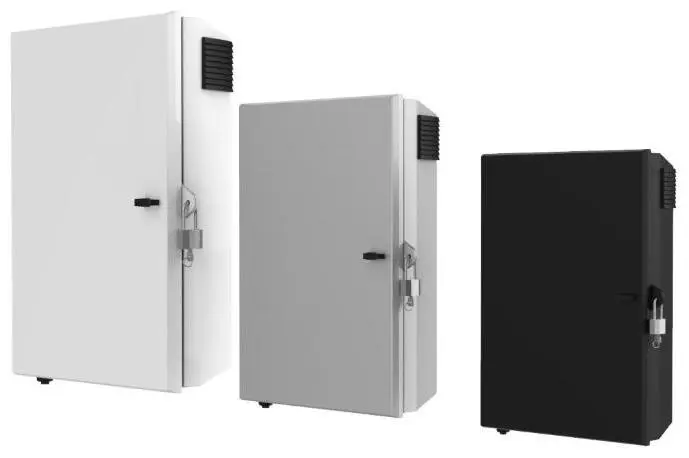
Energy storage sheet metal enclosures must meet strict NEMA/IP ratings, UL 9540A fire-propagation standards and corrosion-resistance requirements based on deployment environment.
-
Material and finish selection, such as 5052 aluminum, 304/316 stainless steel or hot-dip galvanized steel, must align with ISO 12944 corrosivity categories to prevent galvanic and crevice corrosion.
-
UL 9540A 6th Edition shifts safety validation to the system level and requires passive containment, deflagration testing and gas-release characterization from the earliest design stage.
-
Early DFM collaboration addresses weight, seismic and cable-entry loads while ensuring bend radii, hole placement and tolerance stack-ups support both manufacturability and compliance.
-
Fabcon serves as a single accountable U.S. partner for DFM review, precision fabrication, corrosion-rated finishing and light electromechanical assembly, and provides quotes for custom energy storage enclosures.
Material and Finish Selection for Corrosion and Fire Resistance
Material selection for BESS enclosures starts with the deployment environment. ISO 12944 defines six atmospheric corrosivity categories, C1 through CX, based on measurable annual steel mass loss. Matching the base metal and finish system to the actual corrosivity category drives long-term enclosure performance.
Three base materials dominate outdoor BESS enclosure fabrication.
-
5052 aluminum forms a stable oxide layer that resists corrosion in most outdoor and mild marine environments. It is lightweight and formable, though it can develop pitting under severe salt spray. A powder coat or anodized finish extends service life in C3–C4 conditions.
-
304 and 316 stainless steel serve different exposure tiers. 304 stainless is the reliable middle choice for general industrial outdoor use, while 316 stainless, with its added molybdenum content, is the default for coastal, roadside or chemically aggressive C4–C5 sites where chloride resistance is critical.
-
Hot-dip galvanized steel protects through both barrier and galvanic action, so surrounding zinc corrodes preferentially even at cut edges or welds. Duplex systems combining hot-dip galvanizing with powder coating increase service life compared with either treatment alone.
Finish system selection must match the corrosivity category. For C4–C5 atmospheric service, the recommended liquid coating system is zinc-rich primer plus high-build epoxy intermediate plus polyurethane topcoat, applied over near-white metal blast preparation per ISO 12944-5. When powder coating is preferred for cost or application reasons, polyester formulations, not epoxy powders that degrade under UV, provide durable outdoor performance at adequate film thickness.
Mismatched finishes create a common failure mode. Examples include specifying a C2-rated coating on a C4 site or using 304 stainless fasteners on an aluminum enclosure, which creates a galvanic couple. Galvanic corrosion, crevice corrosion at sealed joints and pitting of 304 stainless in chloride exposure are the most common failure modes in outdoor BESS enclosures. Preventing these issues requires specifying the structural material, coating system, fastener material and drainage geometry as a coordinated package.
Fabcon provides in-house powder coat and wet paint lines, so the material and finish system can be validated as an integrated decision before production begins. Request a quote to discuss material and finish selection for the target deployment environment.
NEMA/IP Ratings and Thermal Management Considerations
NEMA and IP ratings relate to each other but do not match directly. NEMA ratings include additional tests for corrosion, gasket aging and mechanical impact that IP ratings do not cover, so an IP66-rated enclosure does not automatically satisfy NEMA 4X requirements.
The three NEMA ratings most relevant to BESS installations differ in meaningful ways.
-
NEMA 3R protects against rain, sleet, snow, falling dirt and external ice formation. It offers no stated protection against windblown dust or hose-directed water. NEMA 3R meets or exceeds IP24 ingress requirements and suits sheltered outdoor installations with ordinary precipitation exposure.
-
NEMA 4 extends that protection to include windblown dust, splashing water and hose-directed water. It meets or exceeds IP66 and suits industrial outdoor environments where washdown or wind-driven contamination is credible.
-
NEMA 4X delivers the same ingress protection as NEMA 4 plus resistance to corrosive atmospheric agents such as salt, chemicals and aggressive humidity. NEMA 4X is commonly selected for BESS installations in coastal, marine-adjacent or wastewater environments where corrosive exposure accompanies hose-directed water and windblown dust.
Thermal management strategy must align with the enclosure rating. UL 9540A 6th Edition introduces a passive-first safety philosophy for outdoor ground-mounted BESS and requires validation of thermal runaway containment without reliance on active systems such as HVAC or suppression. Enclosure geometry, vent placement and passive thermal pathways must perform under loss-of-power conditions, not only under normal operating assumptions.
Ventilation openings, cable entries, HMI windows and field-installed hardware all affect the final NEMA rating of a completed assembly. Specifying the target rating early in the design process, before geometry is finalized, allows seam design, gasket selection, fastener spacing and door stiffness to be coordinated rather than retrofitted.
UL 9540A System-Level Integration Requirements
UL 9540A 6th Edition links enclosure design directly to system-level fire safety. UL Solutions published the 6th Edition of UL 9540A on March 13, 2026. The revision shifts safety evaluation from the individual product level to the system integration level and introduces several changes that affect enclosure design and fabrication.
The most significant structural change appears in Section 10. Section 10 now requires large-scale fire testing to demonstrate that fire will not propagate between ESS units. This requirement addresses spacing and fire propagation as system-level safety considerations within the certification framework. For non-residential BESS, the Unit Level Test no longer follows the Module Level Test. The Installation Level Large Scale Fire Test follows directly.
Additional 6th Edition requirements include the following items.
-
Passive containment validation: Systems must maintain structural integrity and prevent propagation under loss-of-power conditions, with active propagation-prevention systems disabled within the enclosure of origin during installation-level testing.
-
Annex C deflagration testing: Annex C was added for large-scale deflagration testing of BESS enclosures to address explosion testing and post-deflagration scenarios specified in NFPA 855 when no deflagration vents are designed. This annex transitions from informative to normative and requires empirical testing when enclosure design and gas composition present an explosion risk.
-
Gas release characterization: Manufacturers must validate gas release behavior, venting strategies and pressure relief systems through deflagration testing and early-stage CFD modeling.
-
NFPA 855 alignment: UL 9540A is the only fire and explosion testing method referenced in the 2026 edition of NFPA 855, including in Annex G.11 for large-scale fire test guidance.
Enclosure design decisions such as wall thickness, vent placement, structural frame geometry and passive containment features must reflect these test requirements from the earliest design stage. A fabricator that participates in DFM review before drawings are released can flag compliance risks before they become costly rework. Fabcon’s engineering and quoting teams engage at that stage, not after the design is locked.
DFM Checklist for Weight, Seismic and Cable-Entry Loads
Design-to-manufacture disconnects often drive rework and schedule slippage in BESS enclosure programs. A structured DFM review before drawing release removes most avoidable fabrication problems.
The following checklist outlines the highest-impact items for BESS enclosures subject to battery weight, seismic loads and cable-entry requirements.
-
Bend radii: Inside bend radius of approximately 1T is the standard screening value for ductile low-carbon steels and 5052 aluminum, though harder grades and tempers often require larger radii. Consistent bend radii across the enclosure reduce tooling changes and improve repeatability.
-
Hole-to-bend distances: Hole-to-bend distance should be at least 2.5–3T plus inside radius to avoid deformation during forming. Holes placed too close to bend lines cause fastener misalignment and assembly quality problems.
-
PEM hardware placement: PEM hardware uses manufacturer-recommended hole tolerances for reliable installation and thread engagement in thin stock. Installation-tool clearance must be confirmed before finalizing hardware locations near bends or walls.
-
Return flanges and panel stiffness: Rigidity is improved more effectively by adding bent flanges, reinforcing ribs, embosses or grooves than by increasing gauge alone. Continuous return flanges prevent oil-canning on large panels subject to battery weight or seismic loading.
-
Tolerance stack-up: General fabrication tolerances for laser cutting are typically ±0.1–0.3 mm, per ASME Y14.5 principles. Across-bend stack-ups loosen further. Tight tolerances should apply only to functional interfaces such as connector alignments, mating flanges and cable-entry datums, not to every dimension.
-
Cable-entry geometry: Cutout size, edge treatment and grommet or conduit fitting compatibility must be defined before fabrication. Undersized or mislocated entries require rework that affects NEMA sealing performance.
-
Self-locating features: Tabs and slots allow parts in welded assemblies to nest into correct positions without relying on operator judgment. These features improve consistency for load-bearing or seismic-rated enclosures.
-
Weld minimization: Welding should be used only where necessary for structural frames, sealed corners, permanent assemblies or continuous enclosure seams. Alternatives such as tabs, fasteners, rivets or hems should be considered where they meet load and sealing requirements.
Fabcon’s engineering team reviews drawings against this checklist before quoting and catches problems at the lowest-cost stage of the program. Submit drawings for a DFM review and quote on the BESS enclosure program.
Integrated Fabrication, Finishing and Assembly Under One PO
Fragmented vendor chains introduce compounding risk. Projects involving multiple external vendors often face higher risk of delivery slippage, since each vendor operates on independent production cycles that can cascade delays through the build sequence. Each handoff also creates a quality accountability gap, where a problem at assembly leads to finger-pointing between the fabricator, coater and assembler.
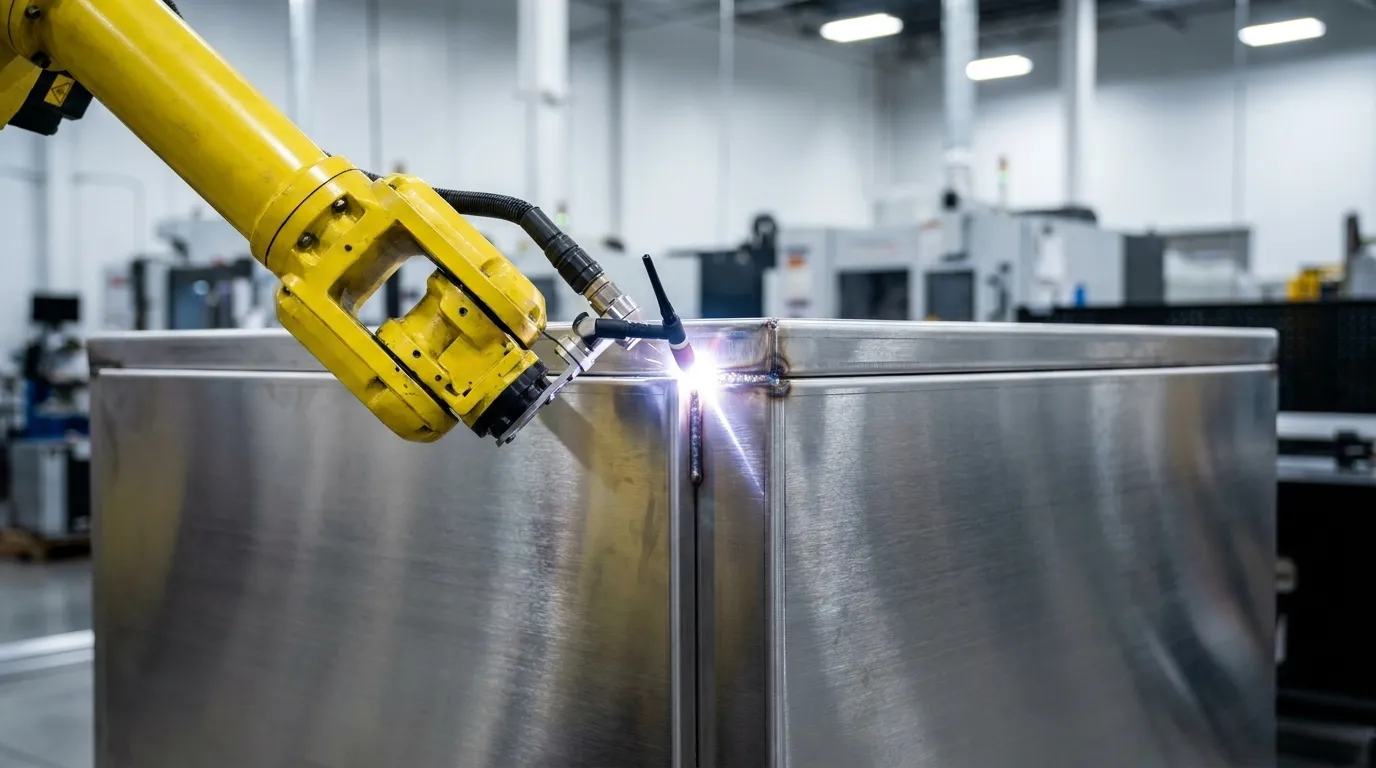
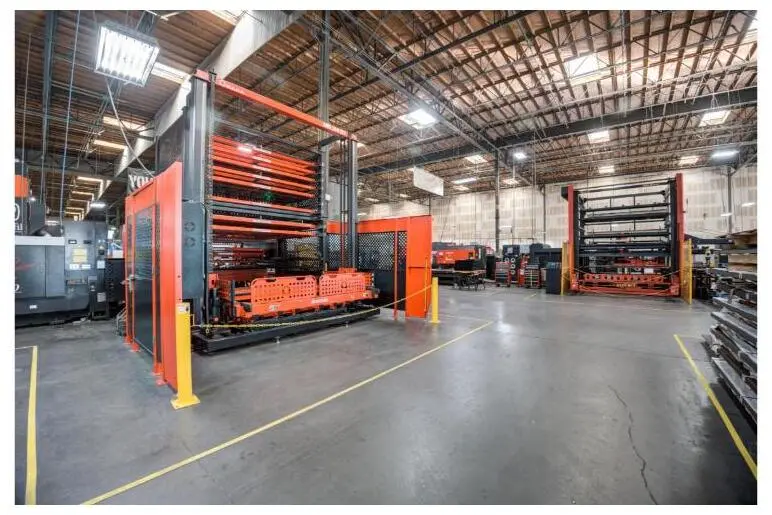
Fabcon replaces that fragmented structure with a single accountable workflow. Under one purchase order, Fabcon manages the complete fabrication sequence. Laser cutting and CNC punching produce tight-tolerance sheet metal components, which move directly to CNC bending and certified welding for structural assembly.
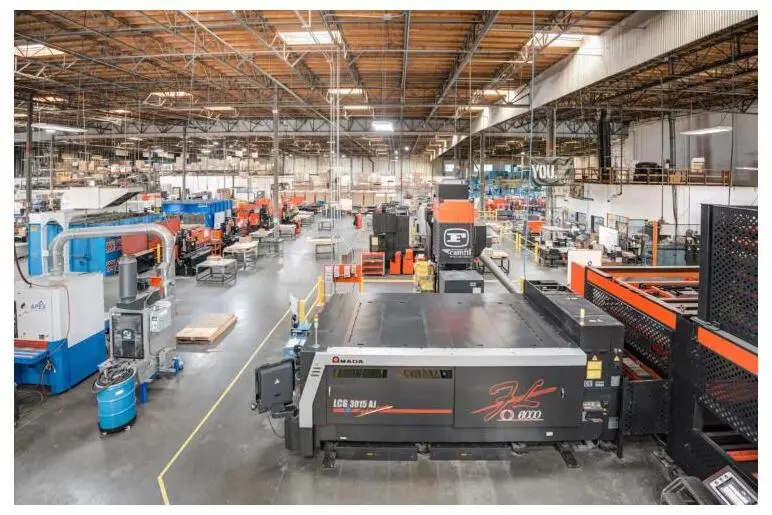
Completed fabrications transfer in-house to powder coat, wet paint or specialty finishing for corrosion and environmental protection, then proceed to light electromechanical assembly for wiring, hardware insertion and component integration. ISO 9001:2015 and AS9100D quality management governs every stage and maintains full traceability from raw material through final assembly.
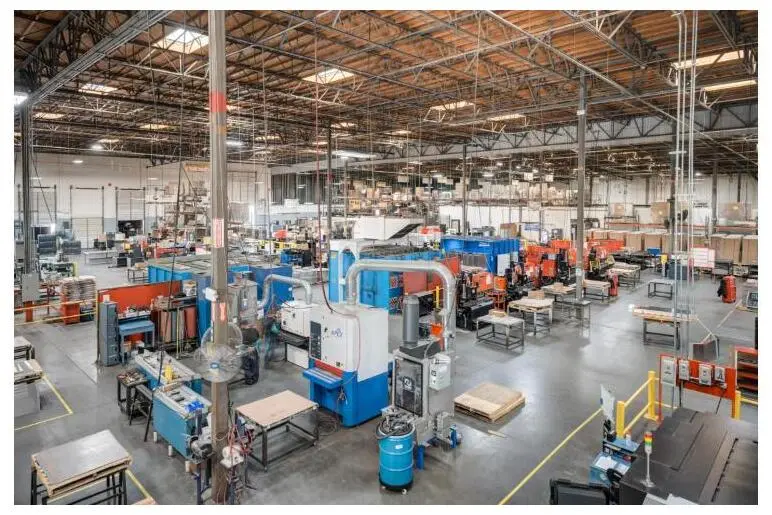
Vertically integrated shops that handle multiple processes under one roof reduce process-transfer time compared with fragmented vendor chains, where each handoff between vendors adds shipping, handling and inspection time. Fabcon’s internal integration keeps fabrication, finishing and assembly on a coordinated schedule instead of three separate vendor queues.
ISO 9001:2015 and AS9100D certification apply across fabrication, finishing and electromechanical assembly, which supports AHJ approval and UL 9540 compliance documentation.
Scaling Realities for Mid-Volume U.S. Programs
Mid-sized BESS OEMs and integrators face a structural problem in the contract manufacturing market. Job shops handle simple sheet metal but lack the engineering depth and assembly capability for complex BESS enclosures. Large contract manufacturers have the infrastructure but impose high minimum volumes, long onboarding timelines and rigid production structures that cannot accommodate evolving bills of materials or mixed-SKU programs.
Fabcon occupies the space between those extremes. Agile production cells support prototype-to-mid-volume flexibility without the overhead constraints of large contract manufacturers. When program volumes shift, as they often do in energy storage programs tied to project-based deployment cycles, Fabcon’s cell structure adapts without a new onboarding process or volume renegotiation.
U.S.-based fabrication also reduces supply chain exposure. Raw material deliveries have extended significantly in recent years, which increases risk for programs that depend on multiple external vendors operating across different supply chains. Domestic single-source manufacturing shortens the exposure window and provides tighter quality control backed by certifications that offshore or fragmented arrangements often cannot match.
Fabcon’s manufacturing space across two Southern California facilities supports programs from initial prototype through sustained mid-volume production through a single integrated facility and quality system. Discuss program volume trajectory and production requirements with Fabcon’s team.
Frequently Asked Questions
What certifications are required for BESS enclosures?
The primary certification pathway for battery energy storage systems is UL 9540, the system-level safety standard that evaluates integrated components as a complete system rather than individual parts. For non-residential electrochemical ESS above certain capacity thresholds, UL 9540A testing, which evaluates thermal runaway fire propagation, supports UL 9540 compliance and satisfies NFPA 855 installation requirements. As noted earlier, NFPA 855 2026 and the International Fire Code both mandate UL 9540A testing for ESS installations. Enclosure fabricators operating under ISO 9001:2015 and AS9100D provide the quality management and traceability documentation that supports AHJ approval and UL certification processes.
How does early DFM collaboration affect UL 9540A compliance?
UL 9540A 6th Edition requires that large-scale fire testing replicate the final installation configuration of the BESS, including module arrangement, unit configuration, enclosure construction and separation distances. Enclosure geometry decisions such as vent placement, wall thickness, passive containment features and structural frame design directly affect test outcomes. When DFM review happens before drawings are released, engineers can identify compliance risks at the lowest-cost stage of the program. Changes made during fabrication or after testing cost significantly more than changes made during design. Early collaboration between the fabricator’s engineering team and the OEM’s mechanical engineers aligns the enclosure design with manufacturability requirements and UL 9540A test configuration requirements at the same time.
What is the difference between job shops, integrated fabricators and large contract manufacturers?
Job shops are transactional, build-to-print vendors. They handle basic sheet metal fabrication but typically lack the engineering depth for DFM collaboration and cannot manage finishing, wiring or electromechanical assembly. Customers using job shops must manage separate vendors for coating, assembly and integration, which creates handoff delays and quality accountability gaps. Large contract manufacturers have the infrastructure for complex programs but impose high minimum volumes, long onboarding processes and rigid production structures that do not accommodate the evolving bills of materials and mixed-SKU programs common in energy storage. Integrated fabricators such as Fabcon occupy the middle ground and provide DFM collaboration, fabrication, finishing and light electromechanical assembly under one roof, with the agility to support programs from prototype through mid-volume production without the constraints of large contract manufacturers.
Which NEMA rating is appropriate for coastal energy storage sites?
NEMA 4X is the standard specification for BESS installations in coastal, marine-adjacent or chemically aggressive environments. NEMA 4X combines NEMA 4 ingress protection with corrosion resistance for salt spray and aggressive humidity, which makes it the standard choice for coastal BESS sites. NEMA 3R, which protects against ordinary precipitation but not windblown dust or hose-directed water, does not meet the needs of coastal deployments where salt deposition and corrosive exposure are present. The enclosure material must also match the rating, since NEMA 4X is typically achieved through stainless steel or fiberglass construction, and fastener materials must be specified to avoid galvanic corrosion at hardware interfaces. Cable entries, ventilation devices and field-installed hardware can all compromise the final NEMA rating of a completed assembly if not specified and validated as part of the complete enclosure design.
Conclusion
Specifying energy storage sheet metal enclosures across fragmented vendors, including separate fabricators, coaters and assemblers, introduces compounding risk at every handoff. Material and finish mismatches, DFM disconnects, UL 9540A compliance gaps and scaling inflexibility often appear as downstream consequences of a fragmented supply chain.
Fabcon provides a single accountable U.S. partner for the full scope, including DFM collaboration, precision sheet metal fabrication, corrosion-rated finishing and light electromechanical assembly, all under ISO 9001:2015 and AS9100D certification. One PO. One quality system. One partner from concept to compliant production.
Discuss requirements and request a quote for a custom BESS enclosure program.