
Key Takeaways for EV Enclosure Sourcing
- EV enclosure sheet metal consists of precision-fabricated housings that protect electronics in chargers, battery storage and power systems from weather and heat.
- A five-dimension evaluation framework covering technical capabilities, integration scope, quality and compliance, scalability and flexibility, and supply-chain performance supports objective partner comparisons.
- Vertically integrated U.S. partners reduce vendor handoffs, lower total landed cost and improve quality consistency by managing fabrication, finishing and assembly in one facility.
- Regulations such as Buy America and IRA domestic-content thresholds make U.S.-based fabrication partners a strategic requirement for many EV infrastructure programs.
- Request a capabilities assessment and DFM review to evaluate how vertical integration can reduce EV enclosure program risk.
EV Infrastructure Manufacturing Landscape in the U.S.
The sheet-metal fabrication market for EV infrastructure spans a wide spectrum. At one end, low-complexity job shops operate as transactional, build-to-print vendors. They handle simple metal parts but lack the engineering depth for Design-for-Manufacturability collaboration and cannot manage complex integrations such as wiring, electromechanical assembly or multi-stage finishing. At the other end, large global contract manufacturers offer scale but impose high minimum volumes, lengthy onboarding and limited agility for high-mix programs with evolving bills of materials.
U.S. reshoring trends are reshaping where EV infrastructure components get made. The Reshoring Initiative reported 244,000 U.S. manufacturing jobs announced from reshoring and foreign direct investment in 2024, with 88% of those jobs in high-tech and medium-high-tech sectors. The Inflation Reduction Act has driven more than $115 billion in announced U.S. manufacturing investments tied to clean energy, batteries and electric vehicles. This investment surge is being reinforced by regulatory pressure that is accelerating domestic sourcing requirements.
The U.S. Transportation Department proposed in February 2026 an increase in Buy America domestic content requirements for federally funded EV charging stations from 55% to as much as 100% and a requirement that chargers be manufactured in the United States. For program managers and sourcing directors, this regulatory trajectory makes domestic fabrication partners a strategic necessity rather than a preference.
The energy storage and EV infrastructure sectors also face tightening traceability requirements. IRA critical minerals and battery component requirements under Section 30D can put up to $7,500 in credit at risk per vehicle if percentage thresholds are not met.
Strategic Trade-offs in EV Enclosure Partner Selection
Mid-volume, high-mix EV enclosure programs involve trade-offs that neither job shops nor large global contract manufacturers handle well. These programs need engineering collaboration, flexible capacity and controlled integration under one roof.
Cost versus integration depth is the central tension. A basic fabrication vendor may offer a lower unit price on sheet metal alone. Total program cost rises when finishing, assembly and quality management are sourced separately. OEMs relying on separate vendors for fabrication, finishing and sub-assembly face miscommunication between suppliers, inconsistent tolerances and finishes, delays from freight or process handoffs and higher total landed cost.
Local versus offshore production involves more than unit economics. Localized supply chains cut new model launch timelines by removing transoceanic lead times from critical schedules. For programs subject to Buy America requirements or IRA domestic-content thresholds, offshore sourcing introduces compliance risk that can jeopardize program funding.
Flexibility versus standardization matters most during NPI and early production. Large contract manufacturers require standardized, high-volume programs to justify onboarding investment. Mid-volume programs with evolving BOMs and mixed SKUs need a partner whose production cells adapt without penalty. Product changes can be tested against manufacturing realities more quickly when design, manufacturing engineering and infrastructure sit close together under vertical integration.
Design complexity and assembly scope also influence partner selection. EV charger pedestals and battery enclosures require NEMA and IP-rated housings, thermal management integration and sometimes light electromechanical assembly. A partner without in-house finishing and assembly capabilities forces the customer team to manage those handoffs independently. That structure introduces quality risk and schedule exposure at every transfer point.
Best Practices for EV Enclosure Design and Sourcing
DFM collaboration delivers the strongest impact in any precision enclosure program. Early ECAD-MCAD collaboration reduces PCB re-spins, iteration cycles and ramp-to-volume risk by embedding manufacturability constraints into design decisions. Engaging a fabrication partner before drawings are finalized allows the manufacturing team to flag tolerance stack-up issues, material trade-offs and assembly access problems before they become costly engineering changes.
Material selection for outdoor EV enclosures should match alloy and finish to the deployment environment. For corrosion protection, NEMA 4X enclosures are the appropriate upgrade over NEMA 4 in coastal areas within five miles of the ocean or regions with heavy winter road salt application, as they add corrosion resistance to prevent premature rust and internal short circuits. For thermal performance, aluminum offers superior thermal conductivity compared to stainless steel, making it the stronger choice for heat spreading and dissipation in enclosures with internal heat loads. Site-specific environmental classification, thermal requirements and total cost of ownership over the product life should guide material decisions.
Thermal management must be integrated into enclosure design from the start. Heat dissipation demands for industrial IGBT modules in charging stations have risen over the past decade, so thermal design needs to be part of the enclosure architecture. For battery enclosures, thermal management is a primary design constraint that shapes cell selection, module architecture, pack enclosure geometry and BMS control strategy.
Documentation discipline and change-management processes protect program integrity across the prototype-to-production transition. Clear revision control, manufacturing routers and work instructions aligned to the production floor reduce rework and preserve design intent as volumes scale. ISO 9001:2015 and AS9100D certification provide a quality management framework that supports full traceability and consistent process execution across every build stage.
Security features belong in procurement-level specifications for public-facing EV infrastructure. Procurement specifications for new EVSE pedestals should mandate IK10-rated enclosures, indicating the housing can withstand 20 joules of impact, to resist vandalism and blunt-force damage.
Start a DFM collaboration with Fabcon’s engineering team to embed manufacturability into enclosure design before drawings are finalized.
Five-Dimension Readiness and Opportunity Assessment
A structured checklist across five evaluation dimensions helps identify capability gaps before committing to a precision sheet-metal partner. These dimensions align with technical capabilities, integration scope, quality and compliance, scalability and flexibility, and supply-chain and logistics performance.
For technical capabilities, assess whether the partner performs laser cutting, CNC punching, forming, welding and CNC machining in-house. Confirm that the partner can hold the tolerances required for mating components and hardware insertion without relying on external machine shops.
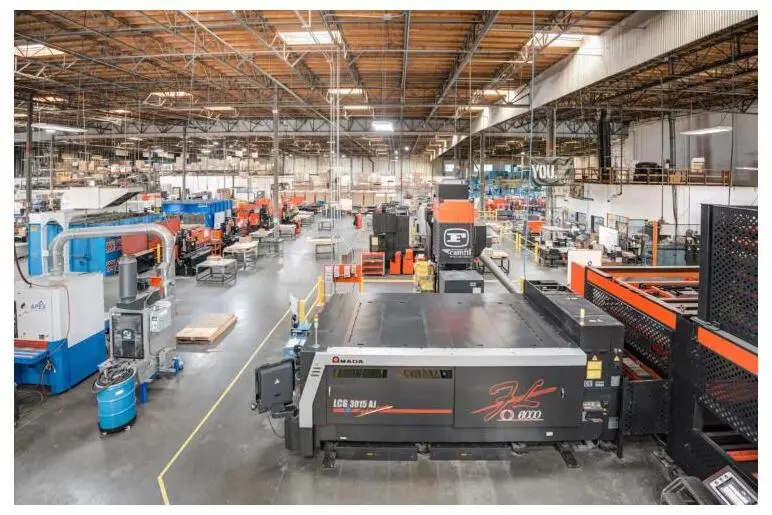
Technical capabilities alone are insufficient if those capabilities are fragmented across multiple facilities. For integration scope, determine whether fabrication, finishing and light electromechanical assembly are performed under one roof. A partner that manages powder coating, wet paint, hardware insertion, wiring and component integration internally eliminates vendor handoffs that create schedule risk and quality disputes.
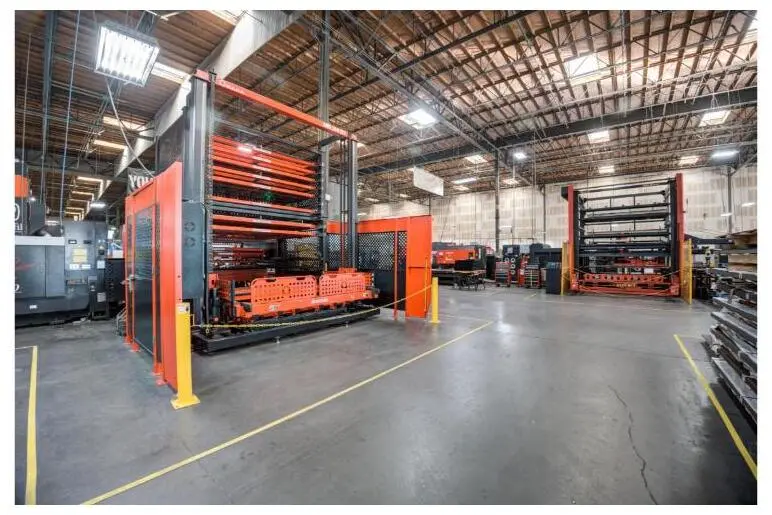
For quality and compliance, verify ISO 9001:2015 and AS9100D certification status. Confirm that the quality management system spans the full build, from incoming material inspection through final assembly and functional testing. For programs subject to UL or CSA compliance, confirm that the partner’s processes support those standards.
For scalability and flexibility, assess whether the partner uses flexible production cells that accommodate changing volumes, mixed SKUs and evolving BOMs without high minimum order quantities or extended re-onboarding. Confirm prototype-to-production alignment so that the same engineering and quality systems govern both phases.
For supply-chain and logistics performance, evaluate whether the partner offers JIT delivery, fulfillment and logistics support. A single purchase order covering fabrication, finishing and assembly reduces administrative overhead and provides a single point of accountability for program execution.
Common Pitfalls in EV Enclosure Programs
Fragmented vendor networks are the most common source of program delays in EV enclosure programs. When fabrication, finishing and assembly are split across multiple suppliers, each handoff introduces a potential quality dispute and schedule dependency. Consolidating metal forming, finishing and sub-assembly under a single vertically integrated supplier provides a single point of accountability, tighter process control, reduced coordination time and improved part consistency. Selecting a partner whose integration scope covers the full build before program kickoff mitigates this risk.
Inadequate DFM input during the design phase creates rework cycles that compress launch timelines. Designs not reviewed against manufacturing constraints before release often require tolerance changes, material substitutions or geometry modifications after tooling has been committed. Engaging the fabrication partner’s engineering team during the design phase, not after drawings are finalized, serves as the standard mitigation.
Unclear specifications for NEMA and IP ratings create compliance gaps in the field. OEMs should combine IP, NEMA and IK ratings based on site-specific factors including climate, usage intensity, vandalism risk and maintenance access rather than defaulting to a single specification. Procurement documents should specify exact ratings and reference the applicable IEC or NEMA test standards rather than using generic terms such as “outdoor rated.”
Misaligned lead-time expectations between design and manufacturing teams create bottlenecks at the NPI-to-production transition. Partners who control fabrication, finishing and assembly internally can compress quoting and production cycles because they are not dependent on third-party schedules or inter-facility freight. Confirming that a partner’s internal integration directly supports lead-time performance should be part of program planning.
Schedule a capabilities review with Fabcon’s engineering team to confirm integration scope and manufacturing constraints before program kickoff.
Frequently Asked Questions
What distinguishes precision sheet-metal fabrication from basic job-shop work for EV enclosures?
Precision sheet-metal fabrication for EV enclosures involves tight-tolerance laser cutting, CNC punching, forming, welding and finishing governed by a certified quality management system. Basic job shops typically operate as build-to-print vendors without DFM engineering support, in-house finishing or electromechanical assembly capability. For EV charger and battery enclosures, this distinction matters because these products require multi-stage integration, including metal fabrication, NEMA or IP-rated finishing, thermal management provisions and sometimes wiring and component integration, that a basic job shop cannot deliver under one roof.
What do ISO 9001:2015 and AS9100D certifications mean for an EV enclosure program?
ISO 9001:2015 is an internationally recognized standard for quality management systems that requires documented processes, consistent execution and continuous improvement across production stages. AS9100D is the aerospace-sector extension of ISO 9001 that adds requirements for risk management, configuration control and full traceability of parts and processes. For EV infrastructure programs, these certifications mean that every stage of the build, from incoming material inspection through final assembly, is governed by documented quality controls and supported by traceability records for audits, warranty claims or field investigations.
How does integrated finishing and assembly affect program cost and risk?
When powder coating, wet paint, hardware insertion and light electromechanical assembly are performed in-house by the same partner handling fabrication, the program benefits from direct process control across every stage. Finish consistency is easier to maintain when parts flow from forming to coating without leaving the facility. Assembly alignment is tighter when the team building the sub-assembly also fabricated the components. Risk decreases because vendor handoffs, which often cause quality disputes, schedule delays and accountability gaps, are removed. Total program cost reflects unit price plus the cost of coordination, rework and schedule recovery, all of which increase with vendor fragmentation.
What volume ranges does an agile U.S. fabricator typically support for EV enclosure programs?
Agile U.S. fabricators using flexible production cells support programs from prototype through mid-volume production without high minimum order quantities or rigid onboarding requirements common at large global contract manufacturers. This structure suits EV infrastructure programs that begin with engineering prototypes, move through NPI validation and then scale to production volumes as deployment ramps. The key capability to confirm is whether the partner’s production cells handle changing volumes and mixed SKUs without a full re-onboarding process at each phase transition.
What NEMA and IP ratings are standard for outdoor EV charger enclosures?
For fully exposed outdoor EV charger installations, NEMA 4 or IP65 is the recognized minimum. NEMA 4X is the appropriate specification for coastal environments or regions with heavy road salt use, as discussed in the material selection section above. IK10 impact resistance is recommended for public or high-traffic locations to protect against vandalism and vehicle impact. For battery enclosures in demanding environments, higher IP ratings may be required depending on site classification. Procurement specifications should reference the applicable IEC 60529, IEC 62262 and NEMA standards explicitly rather than relying on general terms.
Conclusion and Next Steps for EV Enclosure Programs
Selecting a precision sheet-metal partner for EV charger and battery enclosure programs affects launch speed, compliance posture and total supply-chain risk. The five-dimension evaluation framework covering technical capabilities, integration scope, quality and compliance, scalability and flexibility, and supply-chain and logistics performance provides a repeatable structure for objective partner comparisons.
The evidence from reshoring trends, Buy America developments and vertical integration research points in the same direction. When a single company manages every production stage, standardized processes can be enforced from incoming materials inspection through final testing, producing more consistent quality and fewer defects. As the vertical integration research cited earlier demonstrates, consolidating production stages under one roof reduces defects and improves consistency. For mid-volume EV infrastructure programs, a vertically integrated U.S. partner that combines fabrication, finishing and assembly in one facility reduces the handoffs, disputes and schedule dependencies that fragmented vendor networks create.
Recommended next steps for engineering, sourcing and operations teams include an internal needs assessment against the five evaluation dimensions, followed by a capabilities discussion and DFM review with shortlisted partners. A site visit to confirm manufacturing footprint, certification status and production cell flexibility provides final validation before program commitment.
Fabcon operates as a vertically integrated U.S. precision sheet-metal fabrication and assembly partner, with ISO 9001:2015 and AS9100D certified quality systems, in-house finishing and light electromechanical assembly across 220,000 square feet of manufacturing space in two Southern California facilities. Connect with Fabcon’s engineering team to begin a capabilities assessment and DFM review.