
Last updated: July 26, 2026
What Precision Sheet Metal Programs Need to Succeed
- Precision sheet metal fabrication turns flat metal stock into critical enclosures, racks and assemblies for data centers, energy storage, medical devices and transportation.
- The seven-step process, from design review through assembly, works best as a coordinated system that limits rework and protects quality.
- Early DFM collaboration with a fabricator’s engineering team uncovers cost savings before tooling or first articles lock in expense.
- Realistic tolerance expectations account for variation from material thickness, springback and multiple bends to avoid excess inspection and quoting time.
- Partner with Fabcon for vertically integrated U.S. fabrication, finishing and electromechanical assembly backed by ISO 9001:2015, AS9100D and ITAR registration.
7-Step Precision Sheet Metal Fabrication Process Overview
A complete precision sheet metal program moves through seven connected stages that function best as one system. Coordinated planning across these stages reduces rework, shortens lead times and protects quality for the full build.
- Design and DFM review: Engineering teams evaluate geometry, tolerances, material selection and assembly strategy before production begins. Design decisions made during the CAD phase determine most of a product’s manufacturing cost.
- Material selection: Aluminum, stainless steel and mild steel are evaluated against structural, environmental and cost requirements for the target application.
- Cutting: Laser cutting and CNC punching convert flat sheet stock into precise blanks. Laser cutting suits a wide range of volumes and geometries, while CNC punching becomes competitive for high-repetition hole patterns at larger runs.
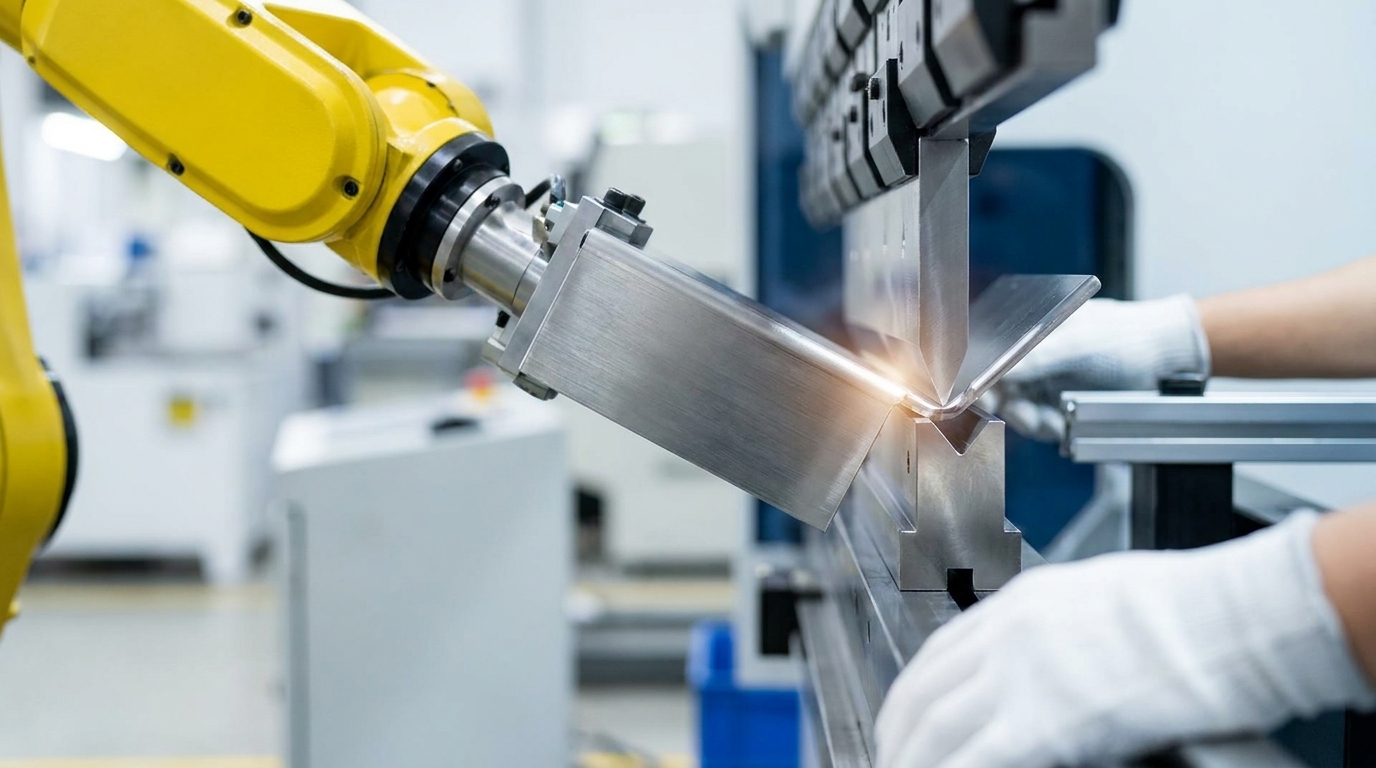
- Forming: Press brake operations bend blanks to specified angles and flange dimensions. Springback, grain direction and tooling variation all influence dimensional outcomes across multiple bends.
- Joining: Certified welding and hardware insertion create structural connections and integrate fasteners, standoffs and inserts into the fabricated assembly.
- Finishing: Powder coating, wet paint, screen printing and mil-spec coatings protect surfaces, meet compliance standards and satisfy cosmetic requirements.
- Assembly and inspection: Electromechanical integration, functional verification and dimensional inspection confirm that the completed assembly meets specifications before shipment.
Sheet Metal DFM: Early Collaboration Prevents Costly Rework
DFM collaboration with a fabricator’s engineering team before drawings are released is the highest-leverage phase for reducing fabrication cost and preventing downstream rework. Manufacturing input at the design stage surfaces issues that remain simple to fix in CAD and expensive to correct after tooling or first articles.
Key decision points in a DFM review include:
- Confirming that bend radii, flange lengths and hole-to-bend distances align with the fabricator’s process capabilities
- Identifying features that create unnecessary tolerance stack-up across multiple bends
- Evaluating material selection against structural requirements, availability and finishing compatibility
- Reviewing weld joint accessibility for robotic or semi-automated processes
- Flagging masking requirements that add manual labor during finishing
A practical DFM checklist for precision sheet metal programs addresses three related areas: material consistency, forming feasibility and assembly efficiency. Material consistency starts with uniform thickness wherever possible, since thickness changes complicate tooling and add cost.
- Maintain uniform material thickness throughout the part where possible
- Use a minimum inside bend radius of 0.5T–1T for soft alloys such as 5052-O aluminum, and increase to 1.5T–2T or more for hard tempers or thick stock
- Maintain sufficient hole-to-bend distance to prevent hole deformation during forming
- Include bend relief where bends run to the edge of a feature
- Specify tolerances only on features that affect fit, function or assembly
- Use standard gauges and hole sizes to simplify sourcing and reduce tooling cost
- Design self-locating tabs and slots to reduce fastener count and simplify assembly
At Fabcon, in-house engineering and quoting teams collaborate with customer technical teams before production begins. They review drawings, tolerances and materials, then build manufacturing routers tuned to the production floor.
Precision Sheet Metal Tolerances Across Multiple Bends
Tolerance planning must account for cumulative variation from material thickness, springback, grain direction and tooling wear. Recommended default tolerances for formed sheet metal parts within a 12-inch envelope include plus or minus 0.005 inches for sheared edge to hole, plus or minus 0.010 inches for formed edge to hole or sheared edge to bend, plus or minus 0.015 inches across two bends and plus or minus 0.030 inches across four bends or for overall formed parts.
Stainless and other sheet stock thickness typically varies by approximately ±0.002–0.007 inches, often around ±0.003 inches for 15–19 gauge depending on alloy, gauge and mill standards. That variation accumulates with each additional bend. Tight tolerances across an entire part when only a few features require them add inspection time, quoting complexity and cost without improving performance. Collaboration with a fabricator to identify truly critical dimensions keeps parts functional and budgets controlled.
Material Choices for Infrastructure-Focused Sheet Metal Programs
Material selection shapes part cost, lead time, formability and finishing options. The three most common materials in precision sheet metal fabrication for infrastructure applications each bring distinct trade-offs.
Aluminum offers a favorable strength-to-weight ratio and natural corrosion resistance. It suits data center enclosures, EV infrastructure components and portable medical equipment where weight reduction matters. Aluminum is more sensitive to deformation than steel, so bend radii and forming force require careful control.
Stainless steel provides strong corrosion resistance and surface finish quality for medical device assemblies, food-grade equipment and energy storage enclosures in harsh environments. Stainless steel requires higher forming force than mild steel or aluminum, which affects tooling selection and press brake capacity.
Mild steel delivers structural strength at lower material cost for transportation infrastructure, industrial frames and high-volume enclosures where finishing provides corrosion protection. Carbon steel may need additional corrosion protection to avoid variation that finishing cannot correct after fabrication.
U.S. tariffs on steel and aluminum rose to 50 percent in June 2025, which increased pricing and supply pressure. That environment favors domestic sourcing for programs subject to Buy American Act and DFARS requirements. A U.S.-based fabricator with established domestic material sourcing reduces tariff exposure and simplifies compliance documentation.
Cutting and Forming Methods That Hold Tight Tolerances
Once material is selected, cutting and forming methods determine how those properties translate into dimensional accuracy. Choices at this stage set the foundation for every downstream operation, affecting tolerances, production speed and cost per part.
Laser cutting produces precise, clean-edged blanks across a wide range of geometries and volumes. It suits complex profiles, tight-tolerance cutouts and programs with frequent design revisions, since programming changes remain internal and do not require new hard tooling.
CNC punching works well for designs with repetitive hole patterns at larger production runs. It can emboss, lance and form features in a single operation, which reduces secondary processing steps for certain geometries.
Press brake forming converts laser-cut or punched blanks into three-dimensional parts through sequenced bends. Consistent bend orientation allows parts to be formed with fewer reorientations, which reduces handling time, improves repeatability and lowers the risk of dimensional variation. Consistent bend radii across a part also avoid tooling changes between setups.
AI-driven optimization, machine learning for production flow and real-time monitoring are now baseline requirements for fabricators. These tools deliver measurable gains in cycle times and defect rates. Fabcon provides laser cutting, CNC punching and press brake forming in one facility, which removes inter-vendor shipping and scheduling gaps.
Joining and Hardware Insertion for Durable Assemblies
Joining operations turn individual components into structural assemblies that hold alignment over time. The joining method influences structural integrity, dimensional stability and downstream assembly effort.
Certified welding, including MIG, TIG and spot welding, creates permanent structural connections for frames, enclosures and chassis. Welding introduces heat that distorts material and affects alignment. Fixtures for positioning, sequenced welds and in-process inspection checks help control that distortion.
Weld joints designed for robotic access reduce labor cost compared with manual welding in confined spaces. Intermittent welds instead of continuous welds, where structural analysis supports the change, further reduce welding cost without sacrificing performance.
Hardware insertion installs PEM fasteners, standoffs, studs and inserts into fabricated parts before finishing. This sequence keeps threaded features correctly positioned and torque-rated for the assembly. Performing hardware insertion before powder coating or painting removes the need for post-finish tapping and limits coating contamination in threads.
Sheet Metal Finishing That Supports Compliance and Fit
Finishing functions as part of the dimensional system, not just a cosmetic step. Processes such as powder coating can affect final dimensions and fit if coating thickness, curing conditions and surface preparation are not controlled, so finishing must align with tolerance planning.
Fabcon’s in-house finishing capabilities include:
- Powder coating: Electrostatically applied and oven-cured for durable, uniform corrosion and impact resistance across enclosures, racks and structural components
- Wet paint: Applied for complex geometries, multi-color requirements or surfaces where powder coating does not suit the design
- Screen printing: Used for labeling, branding and instructional markings on panels and enclosures
- CARC and mil-spec coatings: Chemical agent resistant coatings and military-specification finishes for defense and aerospace programs with defined performance standards
Finishing operations represent a meaningful share of total fabrication cost, so specifying finishes only on functional surfaces reduces expense. Masking for threaded holes, precision surfaces or electrical contacts adds manual labor. Locating sensitive features on one side of a part can lower masking time when the design allows it.
In-house finishing removes scheduling delays, freight costs and quality handoff risks that arise with outside coating vendors. Fabcon’s integrated finishing operations support programs that require UL and CSA documentation alongside cosmetic and protective performance.
Integrated Electromechanical Assembly in a Single Facility
For data center infrastructure, energy storage systems, medical devices and transportation equipment, the metal enclosure or chassis forms the starting point. Electromechanical assembly then integrates wiring, cable harnessing, panel components and mechanical subassemblies into a production-ready system.
In fragmented supply chains, minor dimensional variations accumulate across vendors into tolerance stack-up, which can block clean assembly of multi-panel boxes and installation of components such as PCB boards or card guides. Consolidated fabrication and assembly under one roof maintains dimensional accountability through every stage.
Outsourcing fabrication and assembly to separate vendors adds cost in a typical hardware program through double-handling freight, custom export packaging and multiple receiving inspections. A single integrated partner removes these layers while providing one purchase order, one quality system and one point of accountability.
Fabcon’s electromechanical assembly capabilities include light wiring, component integration and functional verification in the same facility that handles fabrication and finishing. ISO 9001:2015 and AS9100D certified quality systems govern every stage, with full traceability from raw material to finished assembly. ITAR registration supports defense and aerospace programs.
Contact Fabcon to discuss integrated assembly for a specific program.
How to Evaluate a Precision Sheet Metal Partner
Partner selection for a precision sheet metal program extends beyond price comparison. OEM sourcing teams weigh process breadth, quality systems, geographic proximity, financial stability and current equipment investment when selecting a fabricator for complex work.
A structured evaluation framework covers five dimensions:
- Technical depth: The partner should provide DFM collaboration, tolerance analysis and engineering support before production. They must handle the geometry, material and volume requirements of the program.
- Integration scope: The strongest partners perform fabrication, finishing and assembly under one roof rather than relying on subcontractors for key operations. When cutting, forming and welding are engineered together, bend allowances, springback and weld distortion are planned earlier, which reduces scrap and fit issues.
- Quality systems: ISO 9001:2015, AS9100D or other relevant certifications should be in place. The quality system must provide traceability across fabrication, finishing and assembly.
- Scalability: The partner needs capacity for prototype quantities and mid-volume production without high minimums or long onboarding. Flexible production cells support this better than rigid dedicated lines.
- Supply chain simplicity: A single accountable partner for fabrication, finishing and assembly reduces vendor count, coordination effort and the risk of quality disputes across suppliers.
The primary reasons OEM customers reshored manufacturing were quality and rework concerns, delivery time and reduced risk of supply chain disruptions, according to the 2025 USA Reshoring Survey. A vertically integrated U.S. partner addresses all three.
Precision manufacturing companies with diversified exposure to data centers, aerospace and defense and medical devices have outperformed peers in the industrials sector in 2026. Selecting a partner with proven capabilities in these sectors reduces program risk and supports long-term growth.
Frequently Asked Questions
What is the difference between a job shop and a vertically integrated precision sheet metal fabricator?
A job shop typically handles build-to-print fabrication only, which includes cutting, bending and welding to a drawing, without DFM support, in-house finishing or electromechanical assembly. A vertically integrated fabricator such as Fabcon manages the entire program under one roof, from design review through fabrication, finishing and integrated assembly. This structure removes vendor handoffs, lowers coordination effort and provides a single point of accountability for quality and delivery.
How does DFM collaboration reduce total program cost?
As noted in the DFM section above, early design review identifies fabrication complexity before committing to tooling. Common issues include overly tight tolerances on non-critical features, bend geometries that require extra setups, material selections that increase forming difficulty and weld joint locations that block robotic access. Addressing these items during design costs less than correcting them after first articles or during production. Early DFM collaboration also improves cost predictability by aligning the design with the fabricator’s actual process capabilities.
Can a precision sheet metal partner support both prototype and mid-volume production?
A precision sheet metal partner can support both when it uses flexible production cells rather than rigid dedicated lines. Fabcon supports programs from quick-turn prototypes through mid-volume production runs without high minimum order quantities or extended onboarding. Agile cells adapt to changing volumes, mixed SKUs and evolving bills of materials, which suits technology-driven programs that iterate during the transition from prototype to production. This flexibility removes the need to qualify a separate production vendor after prototyping.
What certifications should a precision sheet metal partner hold for regulated industries?
ISO 9001:2015 serves as the baseline quality management certification for precision sheet metal fabrication, covering process control, traceability and continuous improvement. AS9100D extends these requirements for aerospace and defense programs, adding risk management, configuration control and first-article inspection. ITAR registration is required for programs that involve defense-related technical data or hardware. For medical device programs, full traceability from raw material to finished assembly supports regulatory compliance. Fabcon holds ISO 9001:2015 and AS9100D certifications and is ITAR registered, with quality systems that support UL and CSA documentation.
How does consolidating fabrication, finishing and assembly with one partner affect lead times?
Consolidation removes scheduling gaps, freight transit time and receiving inspection delays that occur when parts move between separate vendors for fabrication, coating and assembly. When one facility performs all operations in sequence under a unified production schedule, the program moves at the pace of manufacturing instead of inter-vendor logistics. This matters most for programs with tight launch timelines or frequent engineering changes, where redistributing updated drawings across multiple vendors can create compounding delays.
Ready to Consolidate a Precision Sheet Metal Supply Chain
Precision sheet metal programs perform best when every stage, from DFM review through integrated electromechanical assembly, runs under one U.S. roof with a single accountable partner. Fragmented vendor chains introduce handoff delays, tolerance stack-up and compliance gaps that raise total program cost and extend time to market.
Fabcon has operated as a vertically integrated U.S. precision sheet metal fabrication and assembly partner since 1977. The company serves data centers, energy storage, medical devices, transportation and aerospace and defense programs from 220,000 square feet of manufacturing space across two Southern California facilities. ISO 9001:2015, AS9100D and ITAR registration support programs with demanding quality and traceability requirements.