
Last updated: July 16, 2026
Key Takeaways for Selecting a Laser Cutting Partner
- Laser cutting and engraving services support tight-tolerance metal components for data centers, aerospace, medical devices and EV infrastructure.
- Domestic fiber laser capacity improves speed to market, reduces tariff exposure and supports Buy American compliance for federally funded projects effective October 2026.
- Vertical integration that combines laser processing with CNC machining, finishing and assembly reduces hidden costs, coordination time and quality risk.
- Effective evaluation criteria include technical capabilities, material and thickness handling, quality certifications such as ISO 9001:2015 and AS9100D and DFM collaboration.
- Partner with Fabcon for vertically integrated U.S. laser cutting and engraving services backed by full-scope certifications and agile prototype-to-production support.
Why Laser Cutting and Engraving Drive Precision Metal Fabrication
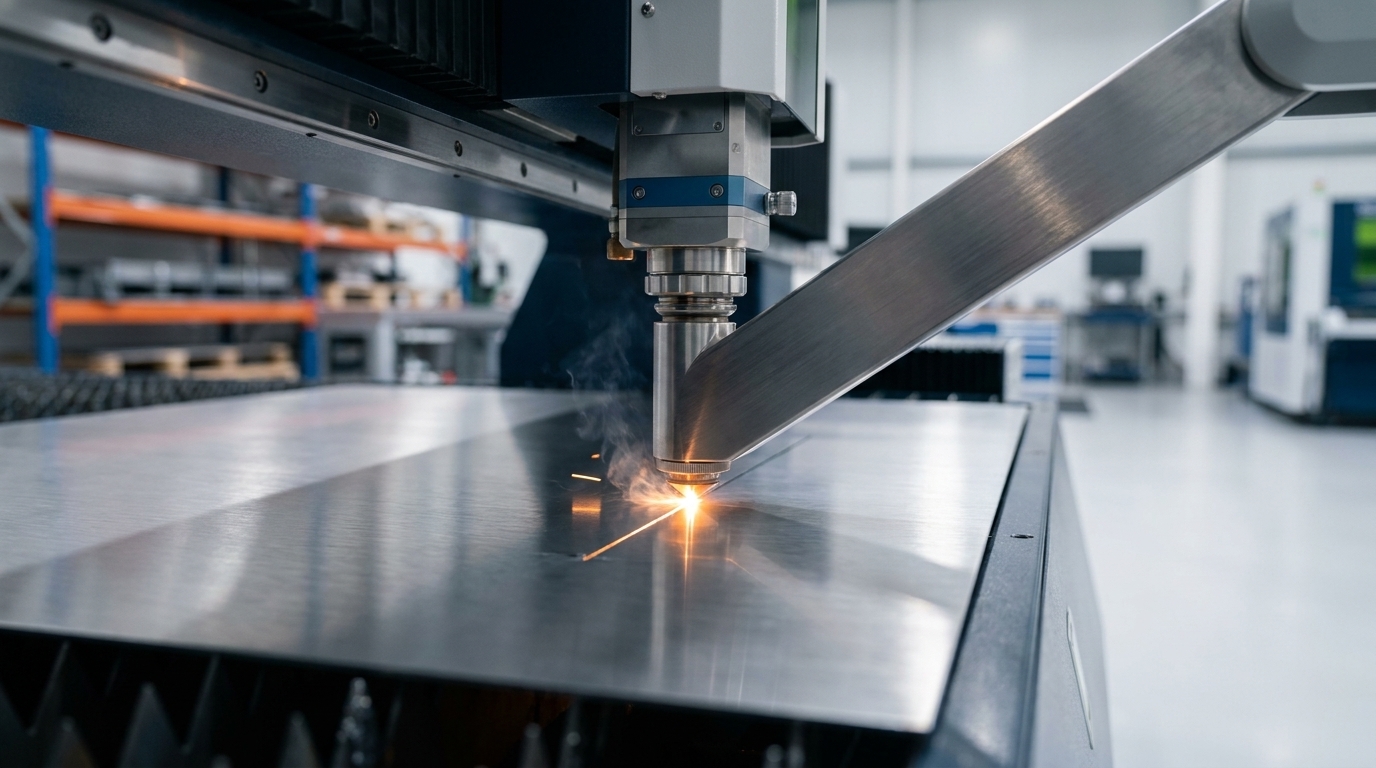
Laser processing delivers the dimensional accuracy and edge quality that infrastructure and technology programs require. Fiber laser systems have become the dominant technology for metal fabrication, replacing older CO2 systems due to higher cutting speeds, improved energy efficiency and stronger performance on reflective metals such as aluminum and copper.
Domestic laser cutting capacity strengthens program resilience and cost control. More than 2,100 manufacturing facilities reshored or expanded in North America between 2025 and early 2026, driven by speed-to-market requirements and supply-chain security. As of mid-2025, the United States imposed 50% tariffs on steel and aluminum from nearly all trading partners, which reinforced the cost and compliance advantages of domestic sourcing. Domestic partners with vertical integration eliminate multi-vendor handoffs and support Buy American compliance requirements that take effect for federally funded projects in October 2026.
Material and Thickness Capabilities for Fiber Laser Cutting
Industrial fiber laser systems process a broad range of metals, including mild steel, stainless steel, aluminum, brass and copper. The thickness each system can cut depends primarily on its laser power rating, which sets the practical limit for penetration depth. For mild steel and stainless steel, an operational sweet spot balances speed, edge quality and cost while meeting durability and reliability expectations.
Cutting outside that sweet spot remains possible but slows production and raises cost per part. Modern fiber laser systems extend this viable range beyond older CO2 technologies. They deliver improved beam quality, faster acceleration, better cutting stability and lower maintenance requirements, which support consistent throughput across common industrial thicknesses.
Laser engraving on metal uses the same fiber laser platform to produce serial numbers, logos, data matrix codes and regulatory markings. Fiber lasers operating near 1064 nm suit bare metals because metals absorb near-infrared wavelengths efficiently. That absorption enables clean ablation and high-contrast marks across steel, stainless, aluminum, brass and titanium. A qualified partner operates production-grade fiber laser equipment that matches required material grades and thicknesses.
Cost Drivers for Laser-Cut Metal Parts and Assemblies
Clear understanding of cost drivers supports accurate quote evaluation and reduces hidden expenses from fragmented vendor bases.
Material often represents a large share of the total quoted price for laser-cut metal parts. Machine time, operator labor, assist gas, facility overhead and setup fees make up the remaining portion. Nitrogen assist gas, used for stainless steel and aluminum to produce oxide-free edges, carries a higher cost than oxygen used for mild steel cutting.
Volume acts as the most significant lever on per-part cost because setup and programming costs remain fixed regardless of quantity. Larger batches spread those fixed costs across more parts and improve sheet nesting efficiency. This volume sensitivity is less severe than with stamping because laser cutting requires no custom tooling and has short setup time, which keeps it economical across a wide range of production volumes.
Vertical integration reduces total cost of ownership beyond per-part pricing. When fabrication, finishing and assembly sit with separate vendors, each handoff introduces coordination time, freight cost and quality risk. A single partner that manages the full workflow removes those handoffs, compresses timelines and simplifies purchasing.
Connect with Fabcon’s engineering and quoting team for detailed pricing.
DFM Guidelines for Laser-Cut Metal Designs
Design-for-manufacturability collaboration before production reduces rework, improves scalability and lowers total program cost. The following checklist covers common design rules for laser-cut metal parts.
- Minimum hole diameter: Set minimum hole diameter at least equal to material thickness to maintain edge quality and dimensional accuracy. Smaller holes trap heat and increase taper.
- Hole-to-bend-line distance: Place holes at least twice the material thickness away from any bend line to prevent distortion during forming.
- Bend reliefs: Extend bend relief notches at least 1.5 times the material thickness past the bend line and keep width approximately equal to material thickness to prevent tearing.
- Minimum feature width: Maintain minimum web width between cut features at least 1.5 times material thickness, especially for stainless steel and aluminum.
- Consistent bend radii: Standardize bend radii to one or two values across a part to reduce press brake setup time and tooling changes, which lowers cost on medium- and high-volume runs.
- Internal corner radii: Use internal corner radii at least equal to material thickness to improve edge quality and reduce stress concentration.
- Standard material gauges: Select standard gauge sheet metal thicknesses to reduce material costs and avoid special orders and high minimum order quantities.
- File preparation: Submit a 2D flat pattern (DXF or DWG), a 3D model (STEP or IGES) and a dimensioned PDF with material grade, decimal thickness, general tolerance, inside bend radii and finish specifications.
Early DFM review by the fabricator’s engineering team catches these issues before production. Fabcon’s in-house engineering and quoting teams review drawings, tolerances and materials, then create manufacturing routers aligned with the production environment.
Managing Prototype-to-Production Transitions
The transition from prototype to mid-volume production often carries the highest risk when multiple vendors share responsibility. Each handoff between a laser cutting shop, a finishing vendor and an assembly house introduces scheduling dependencies, freight delays and gaps in quality accountability.
Vertically integrated shops that perform laser cutting, bending, welding and finishing under one roof reduce process-transfer time compared with multi-vendor workflows. A single partner that manages the full build compresses timelines, simplifies purchase order management and creates one point of accountability for quality.
Fabcon supports programs from prototype through mid-volume production without rigid minimums or lengthy onboarding. Agile production cells adapt to changing volumes, mixed SKUs and evolving bills of materials, which gives engineering and operations teams flexibility to iterate while keeping one supplier relationship in place.
Quality Certifications, Traceability and Regulatory Compliance
Regulated industries require more than dimensional accuracy. Medical device, aerospace and defense and energy infrastructure programs depend on documented traceability, certified quality systems and compliance with applicable standards.
Fabcon holds ISO 9001:2015 and AS9100D certifications and is ITAR registered. Every stage of the build follows these quality systems, which support stringent testing, full traceability and compliance with UL and CSA standards. Integrated QA across fabrication, coating and assembly keeps quality data with the part through the entire process rather than isolating it at individual vendors.
The Buy America regulations mentioned earlier mandate component traceability for federally funded manufactured products, which makes certified domestic fabricators with documented quality systems a compliance requirement.
For aerospace and defense programs, AS9100D certification and ITAR registration remain mandatory. Fabcon’s certifications cover fabrication, finishing and electromechanical assembly, which provides a single compliant partner instead of separate compliance checks across multiple vendors.
Information Checklist for Accurate Laser Cutting Quotes
Accurate quoting depends on complete information. Incomplete submissions create assumptions that inflate pricing or trigger revision rounds that delay timelines. Prepare the following before requesting a quote for laser cutting and engraving services.
- 2D flat pattern files in DXF or DWG format with closed vectors and no overlapping paths
- 3D model files in STEP or IGES format
- Dimensioned PDF drawing with general tolerance callout and any critical tolerances flagged
- Material grade and decimal thickness, such as 304 stainless at 3 mm or A36 mild steel at 1/8 inch
- Finish requirements, such as powder coat color, wet paint specification, CARC, anodize or bare
- Quantity by revision or SKU, including prototype and production volumes if known
- Assembly requirements, including hardware insertion, wiring or electromechanical integration
- Applicable certifications or compliance standards, such as AS9100D, ITAR, UL or CSA
- Target delivery date or program milestone
Submit specifications to Fabcon’s engineering team for a detailed quote.
Addressing Common Procurement Concerns
Procurement managers evaluating a new laser cutting and engraving partner often focus on cost, scalability and existing supplier relationships.
Cost versus total value. A lower per-part price from a job shop that stops at sheet metal often increases total program cost through rework, inter-vendor freight, quality escapes and coordination overhead. As discussed in the cost section, vertical integration reduces these hidden expenses by consolidating fabrication, finishing and assembly under one purchase order.
Scaling limitations. Fabcon’s agile production cells scale from prototype to mid-volume production without high minimums or rigid onboarding timelines. Programs with evolving bills of materials and mixed SKUs remain supported across volume changes without restarting the supplier relationship.
Existing supplier relationships. Many metal fabrication shops focus only on sheet metal. A partner that also manages powder coating, wiring and light electromechanical assembly reduces vendor count, accelerates launch schedules and supports system-level alignment that a basic fabrication shop cannot match.
Conclusion: Choosing a Vertically Integrated Laser Cutting Partner
Effective evaluation of laser cutting and engraving services looks beyond machine specifications to integration depth, quality systems and supply-chain simplification. The framework in this guide covers technical capabilities, cost drivers, DFM collaboration, prototype-to-production workflow, quality certifications and quote preparation.
Downstream fabricators and precision manufacturers with engineering complexity, automation and diversified end markets exhibit more predictable performance profiles than transactional job shops. The right partner combines the technical depth of a large contract manufacturer with the responsiveness and accountability of a domestic, vertically integrated facility.
Fabcon operates 220,000 square feet of vertically integrated manufacturing space across two U.S. facilities, combining laser cutting and engraving with CNC machining, certified welding, in-house finishing and light electromechanical assembly. ISO 9001:2015, AS9100D and ITAR registration cover the full production scope. Programs run from prototype through mid-volume production under one roof with one purchase order and one accountable partner.
Start an evaluation of Fabcon’s vertically integrated laser cutting and engraving capabilities.
Frequently Asked Questions
What materials can industrial laser cutting and engraving process?
Industrial fiber laser systems process a broad range of metals used in precision fabrication, including mild steel, stainless steel, aluminum, brass, copper and specialty alloys. Material selection depends on structural, thermal and corrosion requirements for the application. Laser engraving on the same fiber laser platform produces high-contrast marks on these metals, including anodized aluminum and coated surfaces. A qualified fabrication partner reviews material grade and thickness requirements during DFM consultation to confirm process suitability before production.
How does vertical integration affect total cost of ownership?
When laser cutting, finishing and assembly are managed by separate vendors, each handoff introduces freight cost, scheduling dependencies and gaps in quality accountability. A single vertically integrated partner manages the full workflow under one roof. This structure compresses lead times, reduces purchase order complexity and creates one point of accountability for quality across fabrication, coating and assembly. Programs that previously required multiple vendor relationships can consolidate into one, which reduces coordination overhead and the risk of quality escapes between process steps.
What certifications support regulated-industry laser cutting programs?
The certifications discussed earlier, including ISO 9001:2015 for general quality management, AS9100D for aerospace and defense and ITAR for defense-related programs, should cover the full scope of fabrication, finishing and assembly. For medical device and energy infrastructure programs, UL and CSA compliance documentation supports regulatory submissions and safety verification.
What information supports accurate custom laser cutting quotes?
Accurate quoting requires complete design and specification documentation. This includes 2D flat pattern files in DXF or DWG format, 3D model files in STEP or IGES format and a dimensioned PDF drawing with general tolerance callouts and any critical tolerances flagged. Material grade and decimal thickness, finish requirements, quantity by SKU or revision, assembly requirements, applicable certifications and target delivery dates all affect pricing and lead time. Submitting complete information at the time of quote request removes assumption-based pricing and reduces revision rounds that delay program timelines.
How does DFM collaboration support scalable laser-cut enclosures and assemblies?
Design-for-manufacturability review before production identifies features that increase cost or create quality risk at scale. Common issues include hole diameters smaller than material thickness, insufficient bend relief geometry, inconsistent bend radii that require multiple press brake setups and feature spacing that causes distortion in stainless steel or aluminum. Catching these issues at the prototype stage prevents rework and redesign cycles that compress timelines and raise costs when programs move to mid-volume production. A fabrication partner with in-house engineering capability can review drawings, flag issues and suggest geometry changes that improve manufacturability while preserving design intent.