
Last updated: August 31, 2026
Key Takeaways
- Custom sheet metal data center racks are precision-built frames and enclosures that house servers, networking equipment and cabling while maintaining EIA-310 compliance.
- Engineering and procurement teams face sourcing challenges in a fragmented vendor landscape where job shops lack design depth and large manufacturers demand high minimums, which creates extra purchase orders and delays.
- Effective custom rack sourcing depends on material selection, standards compliance, design-for-manufacturability collaboration and supplier evaluation so designs scale from prototype to production.
- High-density AI and GPU racks require specific planning for load capacity, depth, cooling interfaces, airflow and cable management as average rack density climbs across the industry.
- Explore Fabcon’s vertically integrated rack fabrication with in-house engineering, fabrication, finishing and electromechanical assembly.
Data Center Rack Types and How Customization Helps
Custom fabrication tailors each rack style for cable management, cooling integration and unique facility dimensions.
Open-frame racks are exposed 4-post or 2-post frames without doors or side panels. They suit controlled environments where airflow and front and rear access are priorities. Open-frame racks are typically less expensive than equivalent enclosed cabinets, but they lack physical security and dust protection.
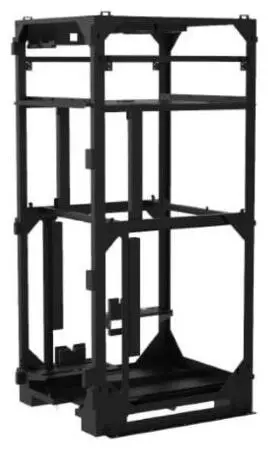
Enclosed racks are fully enclosed with locking doors and removable side panels. They serve multi-tenant facilities, colocation sites and environments that require physical security. Perforated doors need sufficient open area to maintain airflow, and higher-density racks require greater perforation.
4-post racks are heavy-duty frames with four vertical mounting rails. 4-post racks are required for safely mounting any device over about 30 pounds that hangs on slide rails. They have become the standard for deep server chassis and storage arrays.
Seismic-rated racks are reinforced frames engineered to meet earthquake safety standards. They involve additional engineering and testing but provide verified structural integrity under seismic loads for data centers in qualifying zones.
Fabcon’s in-house engineering team adapts these base configurations for cable management channels, liquid cooling manifold mounting, busbar integration and nonstandard dimensions. Request a custom data center rack quote that matches project requirements.
Rack Materials and Tradeoffs
Material selection balances strength, weight, thermal performance, corrosion resistance and cost. Each option carries clear tradeoffs for data center use.
Carbon steel (ASTM A36 / A1008) is the default choice for structural framing and weldments. Carbon steel offers the highest strength-to-cost ratio among common rack materials but needs powder coating or galvanizing for corrosion protection. Its higher density makes it the heaviest option, which increases shipping and installation weight.
Stainless steel (304 / 316) provides strong corrosion resistance through its passive oxide layer. Stainless steel fabrication costs are typically higher than equivalent carbon steel parts because of work hardening and weld requirements. It suits harsh, humid or coastal environments.
Aluminum (6061-T6) delivers a strong strength-to-weight ratio and high thermal conductivity, which supports heat dissipation in high-density racks. Aluminum has limited natural corrosion resistance, and anodizing significantly improves that resistance. Careful design protects load-bearing performance where steel’s structural margin is helpful.
Fabcon’s in-house finishing capabilities, including powder coating, wet paint and silkscreen, support consistent quality and remove the need to coordinate with third-party coaters.
EIA-310 Compliance and Dimensional Control
EIA-310 is the industry standard that defines 19-inch rack mounting dimensions and is maintained by the Electronic Components Industry Association.
Key specifications include:
- 19-inch (482.6 mm) front panel width
- 1.75-inch (44.45 mm) rack unit (U) height
- 18.312-inch (465.1 mm) horizontal spacing between mounting rail centers
- Three mounting holes per U in the vertical hole pattern
- 10-32 threaded or M6 cage nut attachment points
EIA-310 does not define rack depth, load capacity, cooling or material specifications. Engineering teams evaluate those factors separately for each application.
Beyond dimensional compliance, quality certifications support traceability and consistency. Fabcon holds ISO 9001:2015 and AS9100D certifications, maintains ITAR registration and complies with UL and CSA standards across fabrication, finishing and assembly.
Design-for-Manufacturability for Custom Racks
Early design-for-manufacturability collaboration reduces rework, improves cost efficiency and shortens time to market.
Common DFM considerations for custom racks include:
- Bend radii and forming sequences for complex transitions
- Hole sizes and spacing aligned with standard tooling
- Tolerance stack-ups across mounting rails and frame members
- Weld joint design and fixture requirements
- Masking requirements for powder coating on bonding surfaces
- Hardware insertion placement for cage nuts and PEM inserts
In high-density AI data centers, manufacturability, maintainability and thermal performance work as an integrated system. Airflow paths, cooling interfaces and structural components interact, and misalignment can reduce efficiency or create failure points.
Fabcon’s engineering and quoting teams collaborate with clients before production begins. They review drawings, tolerances and materials to create manufacturing routers and work instructions tuned for the production floor. This early DFM input reduces rework and keeps designs production-ready from the first prototype. Request a DFM-focused custom rack quote from Fabcon.
High-Density AI and GPU Rack Requirements
AI and GPU workloads are driving unprecedented rack density. Average rack density jumped from 16 kW in 2024 to 27 kW in 2025, the largest year-over-year increase recorded, according to the AFCOM 2025 State of the Data Center report. A single 42U cabinet with eight GPU servers can reach 25 to 30 kW, and engineering analyses describe densities near 130 kW for full HGX-class clusters. These density levels demand specific rack design choices.
A specification checklist for high-density AI and GPU racks includes:
- Load capacity: Verify static and dynamic load ratings. GPU servers concentrate weight above the rack centerline, which increases rail reaction loads and tip-over risk.
- Depth: Specify deeper cabinets to accommodate liquid cooling manifolds, rear-door heat exchangers and cable bend radii.
- Cooling interfaces: Design for direct-to-chip liquid cooling, including manifold mounting brackets, hose routing channels and leak-detection hardware.
- Airflow: Direct-to-chip liquid-cooled hardware still rejects residual heat via air from internal power supplies, memory and networking components, so perforated doors and airflow provisions remain necessary.
- Cable management: Separate power and data cable paths and keep the center of the rack rear open for airflow. Thoughtful layout preserves cooling performance.
- Power distribution: Plan for busbar mounting, PDU brackets and higher-voltage distribution. An 800 VDC architecture is gaining adoption to reduce current, copper use and conversion losses.
Fabcon focuses on high-density and AI data center racks with in-house fabrication, finishing and electromechanical assembly that support liquid cooling integration, reinforced frames and custom cable management.
Cost Drivers for Custom Data Center Racks
Custom rack pricing depends on several clear factors. Understanding these cost drivers helps procurement teams budget and compare quotes on equal terms.
Key cost factors include:
- Material choice: Carbon steel is the most economical structural option. Stainless steel carries higher fabrication costs because of work hardening and weld requirements. Aluminum often falls between the two depending on grade and form.
- Complexity: Bend count, weld requirements, hole patterns and hardware insertion all add setup and labor time.
- Volume: Blanket orders can reduce per-release lead time. After the first batch, later releases often ship faster because tooling, materials and process documentation are already in place.
- Finishing: Powder coating adds time for prep, coating and curing, along with material and labor costs. Masking requirements for bonding surfaces increase complexity.
- Assembly: Electromechanical assembly, including wiring, component integration and hardware installation, adds labor but reduces line-side work for the buyer.
A quote normally combines several cost components: purchased material and yield loss, one-time engineering and setup, machine and labor cycle time, outside processing, inspection and documentation, packaging and logistics, plus supplier overhead and margin. In contrast, vertical integration reduces total cost by eliminating third-party markups, minimizing rework through early DFM and consolidating the supply chain under one purchase order.
How to Select a Custom Rack Fabricator
A structured supplier evaluation reduces risk and confirms that the selected partner can support programs from prototype through production. This checklist helps teams vet custom rack fabricators:
- Certifications: ISO 9001:2015, AS9100D, ITAR registration and UL or CSA compliance
- Vertical integration: In-house fabrication, finishing and assembly under one roof
- DFM support: Engineering collaboration before production begins
- High-density experience: Proven capability with AI and GPU rack requirements
- Scalability: Capacity to support prototype through mid-volume production without rigid minimums
- Lead time reliability: Internal control over all production stages
Fabcon meets these criteria. The company operates 220,000 square feet of U.S.-based manufacturing space across two locations, including Santa Ana, California. It maintains in-house engineering, fabrication, finishing and electromechanical assembly. Agile production cells scale from prototype to production without the overhead rigidity of large contract manufacturers. Request a custom sheet metal data center rack proposal from Fabcon.
Frequently Asked Questions
Who builds the racks for data centers?
Specialized sheet metal fabricators and contract manufacturers build data center racks. The market includes low-complexity job shops that handle basic metal parts, large global contract manufacturers that require high minimum volumes and vertically integrated mid-tier fabricators like Fabcon that provide engineering support, finishing and assembly under one roof. The right partner depends on program complexity, volume requirements and the level of DFM collaboration required.
What is the average cost of a data center rack?
Standard unloaded enclosed cabinets from established vendors fall within a defined price range. Fully cooling-ready, seismic-anchored cabinets configured for AI workloads start at higher price points. Custom fabrication costs depend on material, complexity, volume, finishing and assembly requirements. Procurement teams benefit from itemized quotes that separate one-time setup costs from recurring unit costs and identify the volume basis for each price break.
What are the racks in data centers called?
Data center racks are commonly called server racks, equipment racks, 19-inch racks or EIA-310 racks. Specific types include open-frame racks, enclosed cabinets, 4-post racks and seismic-rated racks. In hyperscale AI deployments, the Open Compute Project Open Rack, a 21-inch alternative standard, is gaining adoption for its integrated power busbar and liquid cooling support.
What should procurement teams look for in a DFM review?
A meaningful DFM review covers bend radii and forming sequences, hole sizes aligned with standard tooling, tolerance stack-ups across mounting rails and frame members, weld joint design, masking requirements for powder coating on bonding surfaces and hardware insertion placement. The review should occur before production begins, not after the first article fails inspection. Fabricators that engage DFM early reduce rework cycles, compress lead times and deliver designs that scale from prototype to production without redesign.
How does vertical integration affect rack quality and lead times?
Vertical integration, which combines fabrication, finishing and assembly under one roof, removes handoff delays and quality disputes that arise when multiple vendors share responsibility for a single finished product. When a fabricator controls its own powder-coating line, its production schedule does not depend on outside finishers, so delivery timelines become more reliable. Quality control spans the full build rather than stopping at the sheet metal stage, which allows teams to catch fit issues and cosmetic defects before parts ship. For data center rack programs, this structure reduces purchase orders, improves first articles and speeds response when designs change.
Conclusion: Fabcon as a Vertically Integrated Rack Partner
Custom sheet metal data center racks call for more than a build-to-print vendor. These programs benefit from a partner with engineering depth, vertical integration and proven experience with high-density AI and GPU requirements. Fabcon delivers that combination with 220,000 square feet of U.S.-based manufacturing and in-house fabrication, finishing and electromechanical assembly that reduce vendor handoffs and accelerate time to market.