
Key Takeaways for Scalable Metal Enclosure Programs
- Scalable metal enclosure fabrication starts with early definition of functional, environmental and compliance requirements to prevent late-stage redesigns.
- DFM practices applied at the prototype stage lock in manufacturability and avoid costly rework as volumes increase.
- Fabrication and finishing processes selected for long-term viability support smooth growth into mid-volume production without mid-program transitions.
- Consolidated fabrication, finishing and light electromechanical assembly under one roof reduce vendor handoffs, delays and quality risks.
- Partnership with a vertically integrated U.S. supplier such as Fabcon supports quality systems, traceability and production flexibility from prototype through mid-volume runs.
Step 1: Build a Requirements Baseline for Scalable Enclosures
Requirements definition forms the foundation of a scalable program. Engineering, supply chain and operations teams align on mechanical performance, environmental exposure, regulatory certifications and interface constraints before any geometry is committed to CAD.
Key inputs include operating environment (temperature range, ingress protection rating, vibration loads), applicable standards (UL, CSA, ITAR, AS9100D) and downstream assembly requirements such as hardware insertion points and wiring access. These inputs feed directly into two critical outputs, a formal requirements document and a compliance matrix that travel with the design through every production phase.
Cost-versus-complexity tradeoffs surface at this stage. A higher IP rating demands tighter seam tolerances and gasket features. These choices affect forming complexity and finishing sequence. Resolving tradeoffs during requirements definition prevents late engineering changes that force requalification at volume.
Connect with a vertically integrated U.S. fabrication partner to align requirements with production-ready design from day one.
Step 2: Use Early DFM to Protect Manufacturability at Scale
Design for manufacturability at the prototype stage prevents the most common cause of scaling failure. Designs that work at low volume often require rework or requalification as quantities increase.
Applying DFM means making specific design choices that preserve manufacturability as volumes grow. A practical DFM checklist for sheet metal enclosures includes the following actions. Start by reducing part count to simplify sourcing, assembly and quality control. Extend this simplification to hardware selection by using off-the-shelf components to avoid custom-part minimum order quantities and tooling costs. On the forming side, set inside bend radius equal to material thickness to maintain structural strength and avoid failure points during forming. Minimize welding, because each weld adds secondary processing such as grinding and polishing. Finally, incorporate PEM inserts to improve assembly efficiency and reduce misalignment risk.
Tolerance management plays an equally critical role. Specifying finished hole-to-bend or edge-to-bend dimensions on the formed part, rather than flat-pattern geometry, keeps fit-critical features consistent from prototype through mid-volume production. Noting whether inspection occurs after coating, hardware insertion or welding further stabilizes results. Specifying exact alloy and temper with minimum inside bend radius on drawings prevents RFIs and supports repeatable forming without design changes.
DFM review works best when the fabricator’s engineering team participates before drawings are released. Early collaboration reduces rework, improves cost efficiency and confirms that the design can be built at scale.
Step 3: Choose Fabrication and Finishing Processes That Scale
Process selection determines whether a design can scale without a mid-program transition that forces redesign or requalification.
Laser cutting and CNC bending support flexible manufacturing from single parts to thousands of units at relatively low cost with zero or minimal tooling. These methods often serve as the default choice for prototype through mid-volume enclosure programs. They avoid process-driven redesigns that arise when a program outgrows its original fabrication method.
Stamping typically enters consideration only when order volumes reach the mid-thousands per production run, because tooling costs scale rapidly with enclosure size. Programs that anticipate reaching that threshold benefit from stamping-compatible designs from the start. They should delay stamping tooling commitments until volume is confirmed.
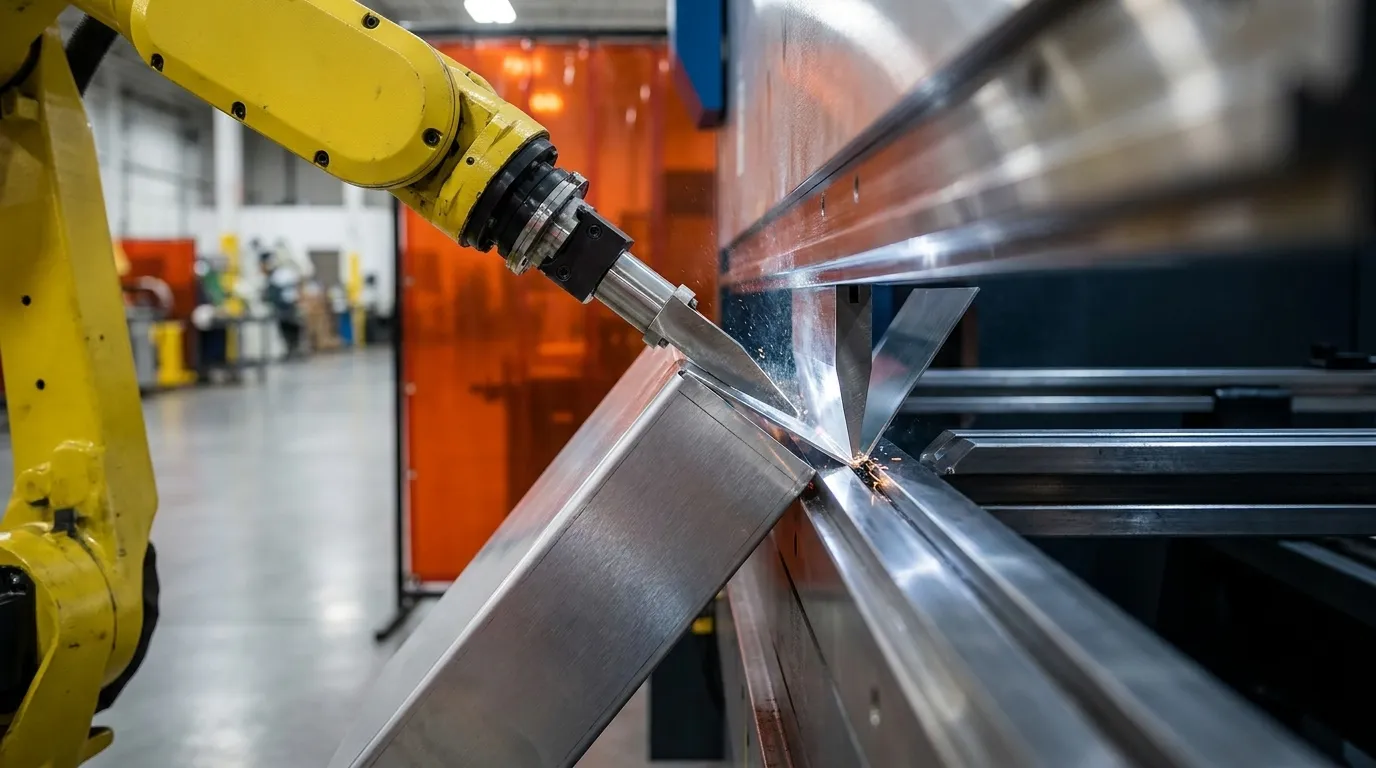
Automated bending cells occupy the middle ground. They reduce per-unit forming time compared with manual bending while preserving the flexibility of CNC-based processes. This balance makes automated cells well suited for scalable sheet metal enclosure manufacturing in the mid-volume range.
Finishing process selection follows similar logic. Powder coat, wet paint and mil-spec coatings each carry different throughput and masking requirements. Selecting a finishing process compatible with the anticipated volume range avoids a secondary transition that disrupts quality controls.
Step 4: Consolidate Fabrication, Assembly and Testing in One Operation
Fragmented vendor handoffs between fabrication, finishing and assembly create delays, quality escapes and cost overruns in mid-volume enclosure programs. Consolidating these steps under one roof removes coordination overhead and quality disputes that arise when separate suppliers share responsibility for a finished product.
A strong contract manufacturing assembly partner maintains vertically integrated in-house capabilities including sheet metal fabrication, welding, mechanical assembly, electrical assembly, electromechanical assembly, finishing support, inspection, final testing, packaging and logistics coordination. More of the build stays in one controlled system instead of moving between multiple vendors.
The integrated process flow for a finished enclosure typically moves through fabrication, finishing, hardware insertion, wiring and cable harness integration, functional testing and final packaging. Evaluation criteria include whether the fabricator provides turnkey services that cover system-level integration, electrical, mechanical and pressure-leak-flow testing, documentation and final packaging rather than partial manufacturing only.
Supply chain simplification follows from this model. One purchase order, one accountable partner and one quality record replace multi-vendor coordination that slows programs and obscures root cause when defects occur.
Explore how integrated fabrication, finishing and assembly can reduce vendor complexity on the next enclosure program.
Step 5: Build Quality and Traceability Systems for Growth
Engineering and supply chain teams confirm a documented quality management system aligned to product and industry requirements before committing to a fabrication partner. Relevant certifications include ISO 9001, AS9100 and ITAR registration.
The standards identified in Step 1, ISO 9001:2015 and AS9100D, govern how quality systems scale. ISO 9001:2015 establishes process control, corrective action and continual improvement across the full build. AS9100D adds aerospace-specific requirements for risk management, configuration control and first-article inspection that many defense, energy storage and data center programs now adopt.
Traceability through serialization, lot tracking, first article inspection reports and certificates of conformance provides the documentation chain required for regulatory audits and engineering-change management.
Revision control becomes a scaling-specific requirement as volumes increase. Engineering changes must propagate through drawings, work instructions and inspection criteria at the same time. A quality system without structured revision control allows production to drift from design intent and creates tolerance stack-up that compounds across assemblies.
First-pass yield serves as the primary production metric. Tracking it by operation, not just at final inspection, identifies specific process steps that generate rework and supports targeted corrective action before defects reach the customer.
Step 6: Design Production Cells and Logistics for Volume Flexibility
Rigid production lines optimized for a single SKU at fixed volume do not fit the high-mix, evolving-BOM programs common in infrastructure and technology-driven industries. Agile production cells address this by organizing equipment, tooling and labor around product families rather than individual part numbers.
Suppliers should demonstrate the ability to scale as demand increases. This capability includes handling production transfer, managing mixed-SKU runs and absorbing demand fluctuations without requiring customer capital investment or staffing changes.
Just-in-time logistics planning reduces finished-goods inventory risk for programs with variable demand. Coordinating fabrication cell output with fulfillment and logistics under one roof shortens the response window when demand signals change. This approach avoids the lead-time variability that arises when shipping parts between separate vendors.
Step 7: Qualify Suppliers Using Clear Scalability Criteria
Supplier qualification for scalable mid-volume enclosure programs benefits from a structured scorecard that goes beyond price and basic capability. The following criteria reflect an evaluation framework used by engineering and supply chain teams at infrastructure and technology companies.
Vertical integration: Confirm the fabricator maintains fabrication, finishing and assembly capabilities in-house rather than outsourcing critical steps. This factor aligns with the consolidation strategy described in Step 4.
NPI and DFM support: Confirm the supplier can support prototype or pilot builds, assembly sequence planning, work instructions, test procedures, production readiness reviews and early supplier planning.
Quality system and certifications: Verify ISO 9001:2015, AS9100D and ITAR registration as applicable to the program’s compliance requirements.
Assembly and integration experience: Confirm assembly expertise in cable and wire harness fabrication to IPC/WHMA standards, enclosure and hardware assembly, control panel integration and box build assembly for programs requiring light electromechanical integration.
BOM and revision management: Suppliers should demonstrate BOM validation, sourcing, supplier qualification, long-lead component handling, revision control and inventory planning capabilities.
Financial stability and long-term fit: Contract manufacturing programs require upfront investment in materials, capacity, tooling and training. The partner must support repeat production, engineering changes and demand fluctuations beyond the first build.
Fabcon is one example of a vertically integrated U.S. partner that meets these criteria, operating across fabrication, finishing, machining, light electromechanical assembly and logistics from two Southern California facilities under ISO 9001:2015 and AS9100D certification.
Measuring Success: Three Core Metrics for Scalable Production
Three metrics define program health for scalable enclosure production. First-pass yield measures the percentage of units completing production without rework or rejection. On-time delivery measures schedule adherence against committed ship dates. Engineering-change frequency measures how often design revisions enter the production system after initial release.
High engineering-change frequency after production launch signals insufficient DFM work at the prototype stage. Root-cause mitigation involves tracing each change to the requirements, DFM or process-selection step where the gap originated and closing it before the next program phase.
On-time delivery degradation typically traces to the vendor handoff delays discussed in Step 4, material lead-time variability or production cell capacity mismatches. Consolidating fabrication, finishing and assembly under one roof removes inter-vendor scheduling dependencies that often drive delivery variance.
Connect with a Fabcon program team to discuss production metrics and scalability planning for the next enclosure program.
Frequently Asked Questions
Typical Timeline from Prototype to Mid-Volume Production
The transition timeline depends on design complexity, compliance requirements and the amount of DFM work completed during the prototype phase. Programs that enter production with a fully reviewed design, confirmed material specifications and established quality documentation move faster than programs that carry open engineering questions into the production stage. Engagement with a fabrication partner that provides in-house engineering support during the prototype phase compresses the transition by resolving manufacturability issues before they become production delays.
Primary Cost Drivers When Scaling Sheet Metal Enclosures
Part count, material selection, finishing complexity and assembly integration serve as the primary cost drivers. Designs with high part counts require more sourcing, more assembly labor and more inspection touchpoints. Finishing processes with masking requirements or multi-step application sequences add time and cost per unit. Consolidated fabrication, finishing and assembly under one partner reduce coordination overhead and eliminate margin stacking that occurs when multiple vendors each add handling and logistics costs to the same build.
Impact of ISO 9001:2015 and AS9100D on Scaling
These certifications establish process controls, documentation requirements and corrective-action systems that make production repeatable at volume. ISO 9001:2015 governs the quality management system across all production stages. AS9100D adds configuration control, risk management and first-article inspection requirements that are standard in aerospace and defense programs and increasingly adopted in energy storage, data center and medical device applications. Work with a certified fabricator means quality controls already sit inside the production system instead of appearing as a separate compliance layer during scaling.
Triggers for Part or Process Requalification in Mid-Volume Runs
Requalification becomes appropriate when a material substitution changes forming or finishing behavior, when a process change affects dimensional output or surface condition or when an engineering change modifies a fit-critical feature. It also makes sense when first-pass yield data indicates a systematic shift in process output that standard corrective action cannot resolve. Structured revision control and a quality management system with documented change procedures allow teams to assess requalification scope quickly and limit production disruption.
Conclusion: Align Prototype and Production for Stable Growth
Scaling a custom metal enclosure from prototype to mid-volume production without redesigns, vendor switches or quality drops follows a seven-step sequence. Teams define requirements, apply DFM early, select scalable processes, integrate assembly and finishing, establish quality systems, plan agile production cells and qualify suppliers against objective scalability criteria. Each step builds on the previous one, and gaps at any stage compound into delays and cost overruns at volume. Programs that engage a vertically integrated U.S. fabrication partner early in the NPI cycle resolve manufacturability, compliance and supply-chain questions before they become production problems. Start the conversation with Fabcon about prototype-to-production alignment for the next enclosure program.