
Key Takeaways from the Metal Cabinet Build Process
- The metal cabinet manufacturing process follows an eight-step sequence from DFM review through final inspection that shapes cost, lead time and field performance.
- Early DFM collaboration identifies costly features such as tight tolerances and unsupported hole patterns, which reduces rework and prevents downstream quality issues.
- Material selection, nesting, laser cutting, forming, welding, finishing and assembly each include specific quality criteria and DFM checkpoints that keep production aligned with performance requirements.
- Vertically integrated manufacturing under one roof eliminates vendor handoffs, reduces transit damage risk and provides a single coherent quality record for regulatory or audit programs.
- Contact Fabcon to start a DFM review and apply end-to-end ownership on the next metal cabinet program.
Step 1: Requirements and DFM Review for Metal Cabinets
The process starts with a structured review of customer-supplied drawings, specifications and performance requirements. The manufacturing team examines tolerances, hardware callouts, weld symbols, grain direction and finish requirements before any part is cut.
The primary output of this step is a manufacturing router, a documented sequence of operations with work instructions tuned for the production floor. DFM collaboration at this stage identifies features that are difficult or costly to produce, such as tight tolerances across bends, unsupported hole patterns or wall thicknesses that distort under welding heat. Resolving these issues before production reduces rework and prevents downstream quality escapes.
End-to-end ownership of this review by the same team that executes fabrication removes interpretation gaps that arise when design and manufacturing sit in separate organizations.
Step 2: Material Selection and Nesting Strategy
Material selection aligns cabinet performance with the service environment, structural requirements, weight targets, EMI shielding needs and compliance standards. The primary decision factors are corrosion exposure, impact risk and regulatory requirements, not appearance alone.
Carbon steel suits general industrial indoor use and mild outdoor environments when protected by coatings. Grade 304 stainless steel fits washdown and sanitary applications, while 316 stainless steel supports coastal, marine or chloride-exposed environments. For aggressive environments that require NEMA 4X, 3X or 6P ratings, stainless steel or non-metallic materials resist saltwater, acids, alkaline solutions and harsh cleaning agents.
With material type and thickness confirmed, the next priority is yield from each sheet. Nesting software arranges flat patterns on sheet stock to minimize scrap and reduce material cost per unit. The output is a set of cut-ready nest files and a confirmed bill of materials. A partner with integrated engineering and procurement oversight keeps these material and nesting decisions aligned with both performance and program economics.
Step 3: Laser Cutting and CNC Punching Execution
Laser cutting and CNC punching convert nested flat patterns into cut blanks with precise hole locations, slots and edge profiles. Laser cutting delivers fine edge quality and supports complex geometries, while CNC punching works well for high-volume hole patterns and formed features such as louvers and knockouts.
Inspection criteria at this step include edge squareness, burr height, hole diameter, location accuracy and part-to-part repeatability. Parts that fall outside these criteria are flagged before moving to forming so tolerance stack-up does not compound across later operations.
Keeping cutting and inspection in the same facility allows nonconformances to be caught and corrected at the lowest-cost point in the process.
Step 4: Forming and Bending Controls
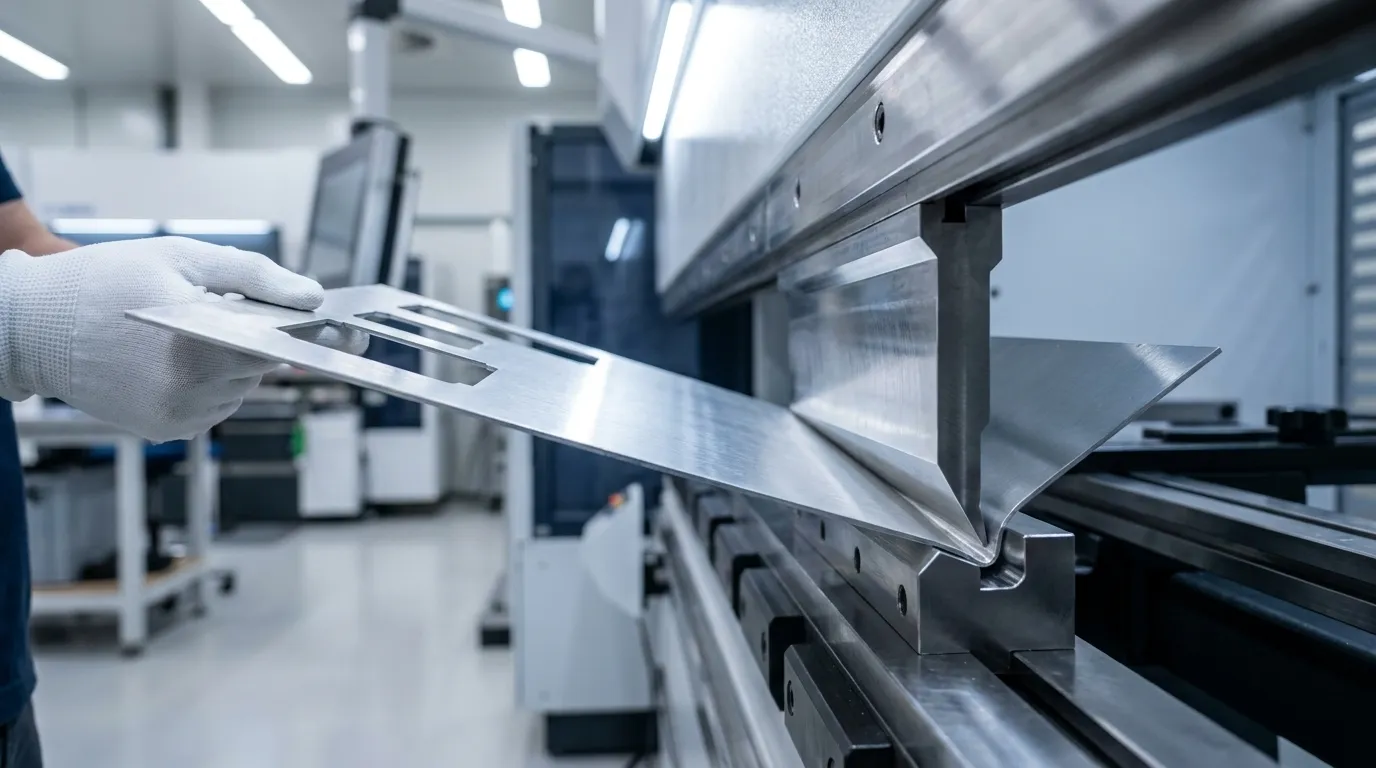
Press brake forming converts flat blanks into three-dimensional enclosure panels, doors and structural members. Bend sequence planning is critical because the order of bends determines whether the part can be formed without tooling colliding with previously formed flanges.
The 4T rule governs minimum bend radius relative to material thickness and serves as a primary DFM checkpoint at this step. Violating this rule increases the risk of cracking at the bend line. Equally important is tolerance stack-up, which is the cumulative effect of dimensional variation across multiple bends. Each bend introduces a small deviation from nominal, and these deviations compound when mating features span several formed surfaces. Engineers should model this cumulative variation during design so parts fit together as intended.
Forming outputs are inspected against first-article dimensions before the full run proceeds. Any tooling adjustments are documented in the manufacturing router to maintain consistency across production lots.
Step 5: Joining and Welding for Cabinet Structures
Welding joins formed components into a complete cabinet structure. Common processes include MIG, TIG and spot welding, selected based on material type, joint geometry and cosmetic requirements. Stainless steel welding requires qualified weld procedures and controlled heat input to prevent sensitization of the heat-affected zone and to maintain corrosion resistance.
Interlocking tab designs hold parts in place during welding, increase strength and remove the need for complex fixtures or extensive post-weld correction. This DFM recommendation can be introduced during the Step 1 review by fabricators with strong engineering support.
Beyond the physical weld, this step generates the documentation trail that proves process control. Traceability at this step includes welder qualification records, weld procedure specifications and inspection records tied to the job traveler. For aerospace and defense programs, AS9100D-governed quality systems require this documentation to remain complete and retrievable throughout the product lifecycle. The same end-to-end ownership established in Step 1 keeps these records consistent.
Step 6: In-House Finishing and Coating Controls
Finishing protects the cabinet structure and prepares it for its service environment. Common processes include powder coating, wet paint, anodizing and military-grade coatings such as CARC. Surface preparation through cleaning, degreasing and pretreatment drives coating adhesion and long-term durability.
Powder coating on carbon steel and anodizing on aluminum improve corrosion resistance and surface durability when the base material suits the environment. For enclosures in corrosive environments, NEMA 4 enclosures that rely on painted or powder-coated carbon steel can rust if the coating is scratched or worn, which exposes the underlying steel. That risk informs both material selection in Step 2 and coating specification at this stage.
In-house finishing removes transit time and handling risk associated with outside coating vendors and keeps cosmetic and dimensional inspection within the same quality management system that governs the rest of the build.
Step 7: Light Electromechanical Assembly Integration
Light electromechanical assembly integrates hardware, wiring and components into the finished cabinet structure. This step covers hardware insertion, wire harness installation, connector termination and subassembly integration. Work instructions reference the bill of materials and assembly drawings, and each operation is documented on the job traveler.
Many sheet metal job shops stop at the fabricated enclosure and require customers to manage a separate assembly vendor. When assembly takes place in the same facility that fabricated and finished the cabinet, the handoff disappears, transit damage risk drops and the assembly team works under the same quality management system. For data center, energy storage and medical device programs, this integration reduces supplier complexity and program risk.
The output of this step is a functionally complete cabinet ready for final inspection.
Step 8: Final Inspection, Traceability and Packaging
Final inspection confirms that the completed cabinet meets dimensional, cosmetic, functional and documentation requirements before shipment. Typical checks include dimensional verification, visual inspection against cosmetic standards, functional checks for hardware and assembly, and review of the complete job traveler.
Traceability records such as material certifications, weld records, inspection data and revision history are compiled and archived under the applicable quality management system. For ISO 9001:2015 and AS9100D programs, these records must remain complete, legible and retrievable. Packaging specifications in the work instructions protect the finished cabinet from damage during transit to the customer facility or end-use site.
A vertically integrated partner that owns every step from DFM review through final packaging provides a single, coherent quality record for the entire build, which benefits programs with regulatory or audit requirements.
Request a quote from Fabcon to apply this eight-step process on the next cabinet build.
4T Rule Definition in Sheet Metal Bending
The 4T rule states that the minimum inside bend radius for a sheet metal part should be at least four times the material thickness when bending across the grain direction. Bending inside this minimum radius increases the risk of cracking at the bend line, particularly in harder alloys and work-hardened stock.
In practice, the minimum safe bend radius varies by material type, temper and grain orientation relative to the bend line. Bending with the grain direction rather than across it allows tighter radii but can increase cracking risk in some materials. Thick aluminum sections often require a large radius to bend properly, which must be reflected in the flat pattern and tooling selection.
Engineering teams should confirm minimum bend radius requirements with the fabricator during DFM review before drawings release to production. Specifying bend radii that match standard tooling reduces setup time and cost.
Build vs. Buy Considerations for Metal Cabinets
The build-versus-buy decision for metal cabinets depends on internal manufacturing capability, available capital equipment, workforce expertise, program volume and the cost of managing a multi-vendor supply chain compared with a single integrated partner.
Organizations with high-volume, stable designs and dedicated sheet metal infrastructure may find in-house production cost effective. Programs with evolving designs, mixed SKUs or requirements that span fabrication, finishing and assembly often benefit from an external vertically integrated partner that reduces coordination overhead, lowers rework from handoff errors and compresses lead times.
The same multi-factor logic that guides material selection in Step 2 also applies to sourcing strategy. The lowest per-unit fabrication price rarely reflects the total cost of a fragmented supply chain.
Scaling from Prototype to Mid-Volume Production
Scaling from prototype to mid-volume production requires a documented, repeatable process that can absorb volume increases without quality loss. Agile production cells support this shift by using flexible configurations that handle changing volumes, mixed SKUs and evolving bills of materials without rigid line changeovers.
During the prototype phase, the manufacturing router, work instructions and inspection criteria are developed and validated. First-article inspection confirms that the process produces conforming parts before the full production run begins. As volume increases, the same documented process scales with it, and design changes flow through a formal engineering change process that updates the router and work instructions.
Partners that support prototype and production in the same facility maintain process continuity across the program lifecycle and reduce the risk of quality regression during volume ramps.
Frameworks and Tools for Process Control
Several structured frameworks support quality and process control across the metal cabinet manufacturing process. DFM checklists formalize the review of tolerances, bend radii, material selection, hardware callouts and weld requirements before production. Process Failure Mode and Effects Analysis (PFMEA) identifies potential failure modes at each manufacturing step, assigns risk priority numbers and drives preventive controls into the process.
First-article inspection (FAI) provides formal dimensional and functional verification of the first production part against the engineering drawing. For aerospace programs governed by AS9100D, FAI documentation is a contractual requirement. For other industries, FAI serves as a best practice that confirms process capability before committing to a full production run.
These frameworks deliver the strongest results when applied by a team with end-to-end visibility into the build, from design intent through final inspection.
Common Challenges and Troubleshooting in Cabinet Builds
Tolerance stack-up across multiple formed and welded features is a frequent source of fit and function failures in metal cabinet programs. The mitigation is to model cumulative tolerances during DFM review and design datum structures that limit the number of features contributing to the stack.
Weld distortion presents another persistent challenge, particularly in thin stainless steel. Stainless steel conducts heat more slowly than carbon steel, so weld sequencing techniques such as balanced welding, alternating sides, back-stepping and skip welding, combined with custom fixturing, help control distortion. Interlocking tab designs reduce the need for complex external fixtures and improve weld consistency.
Vendor handoff failures, where a part is fabricated to print but damaged, mislabeled or incorrectly assembled during transfer between suppliers, disappear when fabrication, finishing and assembly occur under one roof with a single quality management system.
Objective Success Metrics for Metal Cabinet Programs
First-pass yield measures the percentage of parts that pass inspection without rework or scrap on the first attempt and serves as a primary indicator of process capability and DFM effectiveness. On-time delivery performance reflects the reliability of the manufacturing schedule and the absence of upstream bottlenecks caused by vendor handoffs or material delays. Defect rate, measured as defects per unit or defects per million opportunities, tracks quality consistency across production lots.
For programs governed by ISO 9001:2015 or AS9100D, these metrics are tracked, trended and reviewed as part of the quality management system continuous improvement process. Customers evaluating a manufacturing partner should request historical performance data on these metrics during qualification.
Frequently Asked Questions
What certifications should a metal cabinet manufacturer hold for aerospace or defense programs?
Aerospace and defense programs typically require AS9100D certification, which is the quality management standard for the aviation, space and defense industries. AS9100D builds on ISO 9001:2015 and adds requirements for risk management, configuration control, first-article inspection and traceability that apply to mission-critical hardware. ITAR registration is required for manufacturers handling technical data or hardware subject to the International Traffic in Arms Regulations. Programs with electrical components may also require compliance with UL or CSA standards. Customers should verify that manufacturer certifications are current and that the scope of certification covers the specific processes being sourced.
What are the primary cost drivers in a custom metal cabinet program?
Material selection is one of the largest cost variables. Stainless steel alloys carry a significant cost premium over carbon steel, and specialty alloys used in corrosive or high-temperature environments increase that premium further. Geometry complexity, including the number of bends, weld joints and hardware insertions, drives labor and setup time. Finishing requirements, particularly multi-coat systems or military-grade coatings, add process steps and material cost. Tolerance tightness affects scrap rate and inspection time. Volume also plays a major role because higher quantities spread setup and tooling costs across more units. DFM collaboration early in the program is the most effective way to reduce cost without sacrificing performance, because design changes after production starts cost more than changes made during review.
How does a vertically integrated manufacturer reduce lead time compared with a fragmented supply chain?
In a fragmented supply chain, each vendor handoff introduces scheduling dependency, transit time and the risk of damage or miscommunication. A part fabricated by one shop must ship to a coating vendor, then to an assembly house, with each transfer adding days or weeks to the timeline. A vertically integrated manufacturer controls fabrication, finishing and assembly internally, so work moves between operations on the same floor instead of between facilities. This structure removes transit time, reduces damage risk between steps and allows the production schedule to run as a single continuous workflow rather than a series of dependent vendor commitments, which shortens and stabilizes lead times.
What volume range fits a precision metal cabinet program at a contract manufacturer?
Precision metal cabinet programs span a wide range, from single prototypes through mid-volume production runs. The appropriate partner depends on the volume profile, design maturity and SKU mix. Large global contract manufacturers often require high minimum order quantities and long onboarding processes that do not fit evolving designs or moderate volumes. Small job shops can handle low-volume work but often lack the engineering depth, finishing capability and assembly integration needed for complex programs. A mid-tier vertically integrated manufacturer with agile production cells can support prototype builds, new product introduction and production ramps within the same facility and quality system, which provides continuity without the rigidity or minimums of large contract manufacturers.
What information is needed to get an accurate quote for a custom metal cabinet?
An accurate quote requires a complete set of engineering drawings with tolerances, material specifications, hardware callouts, weld symbols, grain direction requirements and finish specifications. Native CAD files in a sheet metal format allow the quoting team to verify flat patterns and identify DFM issues before pricing. The bill of materials should list all purchased components to be installed during assembly. Volume requirements, including prototype quantity, initial production quantity and anticipated annual volume, affect material pricing, tooling amortization and production planning. Delivery requirements and any applicable certification or traceability requirements should be stated upfront. Providing complete documentation at the time of inquiry accelerates quoting and reduces the likelihood of scope changes after award.
Get a quote from Fabcon and put end-to-end ownership to work for the program.