
Key Takeaways for Program Teams
- Precision electromechanical assembly integrates sheet metal fabrication, wiring, hardware insertion and functional testing under one quality system to maintain traceability and reliability for infrastructure-critical programs.
- Core processes include DFM review, precision fabrication, CNC machining, surface finishing, wire harnessing, hardware insertion and rigorous electrical and mechanical testing governed by IPC and mil-spec standards.
- AS9100D and ISO 9001:2015 certifications, along with ITAR registration, form the baseline for aerospace, defense, medical and energy programs that require full material traceability and configuration management.
- Vertical integration eliminates vendor handoffs, reduces lead times and creates a single point of accountability, which protects programs when tolerance stack-up, documentation gaps or scaling challenges appear.
- Partner with Fabcon for vertically integrated U.S. precision electromechanical assembly backed by decades of experience and the certifications infrastructure-critical programs require.
Core Electromechanical Assembly Processes in Practice
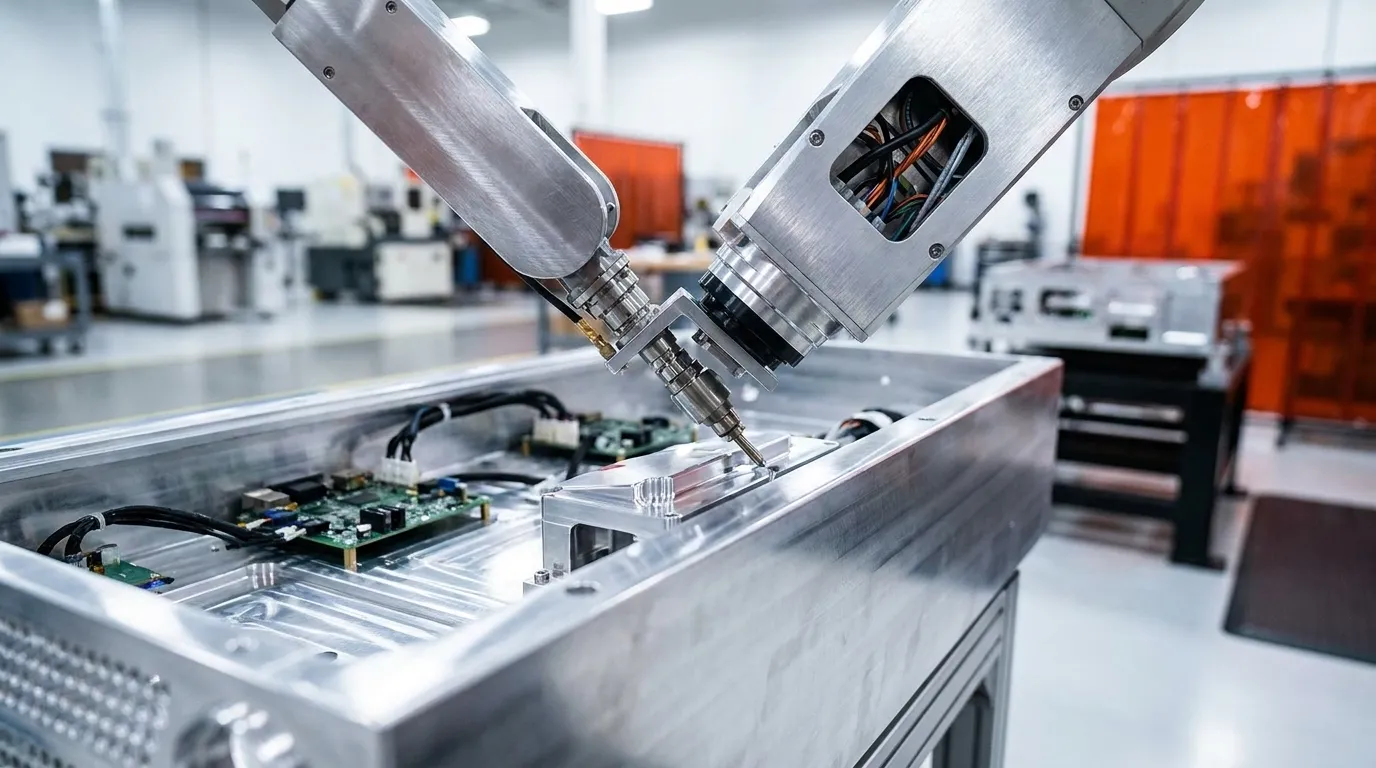
Each stage of precision electromechanical assembly builds on the last. Integrating these processes with in-house sheet metal fabrication removes handoff delays and keeps quality accountability with one supplier.
- Design for Manufacturability (DFM) review. Engineering and quoting teams review drawings, tolerances and BOMs before production begins. Early DFM collaboration aligns datum structures with functional requirements and prevents late-stage changes.
- Precision sheet metal fabrication. Laser cutting, CNC punching, forming and welding produce enclosures, chassis, brackets and structural frames. Controlled flatness, consistent hole-to-hole location and predictable thermal interfaces keep enclosures ready for reliable electrical integration.
- CNC machining. In-house machining creates tight-tolerance features that support fabricated assemblies, improve fit and remove coordination with separate machine shops.
- Surface finishing. Powder coat, wet paint, CARC military-grade finishing and mil-spec coatings are applied in-house. Surface finishing processes can alter final dimensions, so teams review tolerances before and after finishing on critical features.
- Wire harnessing and cable assembly. Wire harness production follows a documented sequence, including cutting, stripping, terminal crimping, connector insertion, form board routing, bundling and electrical testing, governed by IPC/WHMA-A-620 quality criteria.
- Hardware insertion and light electromechanical assembly. Box build assembly integrates boards, cables and mechanical components using documented work instructions, grounding plans and cable routing standards.
- Functional testing and inspection. Core testing methods include continuity testing, hi-pot/dielectric withstand testing, insulation resistance testing and crimp pull-force testing, which verify electrical integrity and mechanical robustness before shipment.
Quality Requirements and Certifications for Critical Programs
Infrastructure-critical programs in aerospace, medical and energy require sector-specific quality frameworks with full traceability at every production stage. General quality systems do not cover these demands.
ISO 9001:2015 functions as the common QMS foundation that sector-specific standards build upon. It governs process control, customer requirements, corrective action and calibration of measurement equipment traceable to national standards. Many infrastructure programs treat ISO 9001 as a starting point, not an endpoint.
AS9100D adds aerospace-specific requirements to ISO 9001, including configuration management, AS9102 First Article Inspection, foreign object debris prevention and counterfeit parts prevention under clause 8.1.4. Aerospace primes including Boeing, Airbus, Lockheed Martin and Raytheon require AS9100D for flight-critical assemblies. AS9100D certification demonstrates repeatable processes for quality management, documentation, traceability and continuous improvement across aerospace production programs.
These processes only deliver reliable results when governed by a unified quality framework. When fabrication, finishing and assembly occur in one facility under one quality system, traceability records link every part to its raw material source, production operator, inspection result and finishing batch. This structure satisfies the forward and backward traceability requirements of AS9100D and the lot-level documentation mandated for medical programs.
Fabcon holds ISO 9001:2015 and AS9100D certifications and is ITAR registered, providing the compliance infrastructure that aerospace, defense and energy programs require from a single accountable U.S. partner.
Where Vertically Integrated Assembly Delivers Value
The same vertically integrated model supports multiple infrastructure-critical sectors without separate vendor relationships for each discipline.
Data centers. Hyperscale operators require liquid-cooling manifolds and precision enclosures with thermal and power-delivery expertise. Modular, rack-mounted enclosures and structural systems built to tight tolerances simplify cooling, cable management and integration for hyperscale and edge deployments.
Aerospace and defense. Electronics contracts move to domestic EMS plants certified for controlled unclassified information handling, with Department of Defense Trusted Supplier rules barring foreign assembly for many avionics and communications systems. AS9100D and ITAR registration function as baseline requirements.
Medical devices. The FDA Quality Management System Regulation harmonizes 21 CFR Part 820 with ISO 13485:2016, which compels medical-device OEMs to work with contract manufacturers whose quality systems support the new audit rules. Full traceability and documented work instructions are mandatory.
Energy storage and power distribution. EV penetration, fast-charging infrastructure and energy storage systems increase demand for high-voltage assembly processes with full traceability from component lot to finished box. Weatherproof, customizable enclosures with electromechanical integration support commercial and public deployments.
Transportation and traffic safety. Durable, precision-fabricated metal components engineered for compliance and consistency support traffic barriers, guardrails and infrastructure-grade systems that must perform reliably in demanding environments.
Required Technician Skills for Reliable Assemblies
Delivering these infrastructure-critical assemblies across diverse sectors requires technicians who combine mechanical aptitude with electrical knowledge and disciplined documentation practices. O*NET occupational data from the U.S. Department of Labor identifies the following core competencies for electromechanical equipment assemblers:
- Blueprint and schematic reading to determine assembly sequences and component placement
- Precision measurement using calipers, micrometers and verniers to verify tolerances
- Wire stripping, terminal crimping and connector termination per IPC/WHMA-A-620 standards
- Soldering proficiency aligned with IPC J-STD-001 to eliminate cold joints and defects
- Functional testing using multimeters, oscilloscopes and continuity testers
- Troubleshooting ability to isolate problems during wiring verification and sensor calibration
- Good Documentation Practices (GDP) for production records, nonconformance reports and work instructions
- Attention to detail and dependability, rated at the highest importance level for electromechanical technician roles
Fabcon’s integrated U.S. production cells bring these skills together within a single facility, where technicians work across fabrication, finishing and assembly under unified quality oversight. This structure removes the communication gaps that appear when separate shops handle separate scopes.
Common Program Challenges and DFM-Based Fixes
Precision electromechanical programs encounter predictable failure points. Most trace back to fragmented vendor relationships or designs that did not receive manufacturability review before production.
- Tolerance stack-up across components. Even when each part meets its individual tolerance, worst-case total variation can cause misalignment or functional failure in connector systems and precision assemblies. The DFM review described earlier prevents these issues before tooling is committed.
- Over-specified tolerances on non-critical features. Tight tolerances increase machining time, inspection requirements, scrap risk and lead time when applied to features that do not control fit, sealing or alignment. A manufacturable design applies tight controls only where functional requirements demand them.
- Vendor handoff delays and quality finger-pointing. When fabrication, finishing and assembly occur at separate facilities, each transition introduces scheduling risk and diffuses accountability. A single integrated partner removes inter-vendor handoffs and owns the full build.
- Wire harness defects from manual assembly steps. Wire harness defects originate during manual assembly steps including connector insertion, form board routing and bundling. Calibrated crimping tooling, crimp force monitoring and 100 percent continuity testing address these failure modes.
- Incomplete BOMs and unclear drawings. Missing dimensions, vague notes and inconsistent revisions delay quoting, inspection and production transfer. DFM collaboration resolves documentation gaps before they reach the production floor.
- Prototype designs that do not scale. Designs that rely on manual adjustments or engineering oversight during prototyping often fail at pilot build or production volume. Fabcon’s engineering team reviews designs for scalability from the first engagement.
Connect with Fabcon’s engineering team to review designs for manufacturability before production begins.
How to Choose a Precision Electromechanical Assembly Partner
Choosing the right partner requires evaluation of five criteria that determine whether a supplier can deliver at the system level, not just the component level.
Technical capabilities. The partner must demonstrate proficiency across fabrication, machining, finishing, wire harnessing and functional testing. Gaps in any discipline force the customer team to manage additional vendors.
Integration scope. Vertical integration, with fabrication, finishing and assembly under one roof, eliminates handoff delays, compresses lead times and creates a single point of accountability for quality. These advantages explain why contract manufacturers cite quality, rework and warranty concerns as a primary driver for customers reshoring work, followed by delivery time and supply chain risk reduction. A vertically integrated U.S. partner directly addresses all three reshoring motivations.
Quality and compliance. ISO 9001:2015 serves as the baseline. Programs in aerospace, defense and energy require AS9100D with full traceability to lot and serial level. AS9100D certification ensures the supplier meets the configuration management and traceability requirements discussed earlier. Teams should verify that a supplier’s certification scope covers fabrication, finishing and assembly, not just one discipline.
Scalability and flexibility. Mid-volume programs benefit from a partner that can move from prototype to production without the high minimums and rigid onboarding of large contract manufacturers. Agile production cells that adapt to changing volumes and evolving BOMs support high-mix programs.
Supply chain simplicity. Domestic U.S. contract manufacturers provide functionally easier regulatory access for programs subject to ITAR or DFARS requirements compared to offshore facilities. One PO, one partner and one quality system reduce coordination overhead and improve program visibility.
Fabcon’s model maps directly to each criterion. Operating from 220,000 square feet across two Southern California facilities, Fabcon delivers in-house fabrication, CNC machining, finishing, light electromechanical assembly and fulfillment under the quality framework established earlier.
Evaluate Fabcon as a vertically integrated U.S. partner for precision electromechanical assembly programs.
Conclusion: Building Reliable Infrastructure-Critical Systems
Precision electromechanical assembly succeeds when fabrication, finishing and light assembly occur under one accountable roof. The evaluation framework remains straightforward: assess technical capabilities, integration scope, quality and compliance credentials, scalability and supply chain simplicity. A partner that satisfies all five criteria removes the fragmented vendor base that slows infrastructure-critical programs and creates traceability gaps.
Fabcon has delivered vertically integrated precision metal fabrication and electromechanical assembly since 1977. The certifications and agile production cells purpose-built for mid-volume programs position Fabcon as an accountable U.S. partner for data center, aerospace, medical, energy and transportation programs that cannot afford supply chain fragmentation.
Start a conversation with Fabcon’s engineering and quoting team to align designs, quality requirements and production plans.
Frequently Asked Questions
What is the difference between light electromechanical assembly and full contract manufacturing?
Light electromechanical assembly refers to the integration of wiring, hardware and electrical components into a fabricated enclosure or chassis, typically stopping short of complex PCB assembly or system-level software integration. Full contract manufacturing extends that scope to include engineering support, material sourcing, fabrication, finishing, assembly, testing, fulfillment and logistics under one program. Fabcon operates across both scopes, supporting customers from build-to-print light assembly through end-to-end contract manufacturing with DFM collaboration, in-house finishing and functional verification.
Why does vertical integration matter for precision electromechanical assembly programs?
When fabrication, finishing and assembly occur at separate facilities, each handoff introduces scheduling risk, quality ambiguity and traceability gaps. If a dimensional issue appears at final assembly, identifying whether it originated in fabrication, finishing or assembly requires coordination across multiple vendors, each with separate records and incentives. Vertical integration places all production stages under one quality system, one set of work instructions and one accountable partner. Traceability remains continuous, corrective actions move faster and program visibility improves because no inter-vendor communication chain requires management.
What certifications should a precision electromechanical assembly partner hold for aerospace and defense programs?
Aerospace and defense programs require AS9100D as the baseline quality management standard. AS9100D builds on ISO 9001:2015 and adds configuration management, First Article Inspection per AS9102, counterfeit parts prevention, foreign object debris prevention and enhanced risk management. ITAR registration is mandatory for programs involving defense-related technical data or hardware subject to U.S. export control regulations. Buyers should verify that a supplier’s certification scope explicitly covers sheet metal fabrication, finishing and electromechanical assembly, not just a subset of operations. Fabcon maintains these credentials across its integrated manufacturing operations.
How does DFM collaboration reduce risk in precision electromechanical programs?
Design for Manufacturability review identifies features that require tight tolerances, materials that may create sourcing or process challenges and assembly sequences that could introduce variation before production begins. Without DFM input, designs optimized for engineering performance often carry over-specified tolerances on non-critical features, incomplete BOM documentation or assembly geometries that slow repeatable production. Fabcon’s engineering and quoting teams engage with customer technical teams before production begins, reviewing drawings and tolerances to create manufacturing routers and work instructions tuned for the production floor. This approach reduces rework, compresses development timelines and ensures that what is designed can be built consistently at scale.
What industries does Fabcon’s electromechanical assembly capability serve?
Fabcon serves mid-sized to large enterprises across data center infrastructure, aerospace and defense, medical devices, energy storage and power distribution, traffic safety and transportation, electric vehicle infrastructure, telecommunications and industrial OEM manufacturing. Each vertical has distinct compliance and traceability requirements, such as AS9100D and ITAR for aerospace and defense, full lot traceability and documented work instructions for medical and weatherproof enclosure integration for energy storage. Fabcon’s certified quality system provides the foundation for all of them. The same vertically integrated production model, from fabrication through finishing and light electromechanical assembly, serves each sector without separate vendor relationships for each discipline.