
Last updated: August 22, 2026
Key Takeaways for Custom Server Rack Enclosures
- Standard 19-inch racks cannot meet the power density, depth, seismic and compliance demands of modern AI and infrastructure deployments.
- Fragmented sourcing across multiple vendors creates delays, quality gaps and compliance risk for custom server rack enclosure programs.
- Integrated U.S. fabricators combine engineering, fabrication, finishing and electromechanical assembly under one quality system to eliminate handoffs.
- Key evaluation criteria include ISO 9001:2015 and AS9100D certifications, in-house finishing, traceability and electromechanical assembly capabilities.
- Partner with Fabcon for vertically integrated U.S. fabrication that delivers compliant, scalable enclosures from prototype through production.
The Sourcing Headaches Facing Infrastructure Teams
Infrastructure leaders at technology companies face a consistent issue: standard rack catalogs stop where modern requirements begin. Power density, depth and compliance needs outpace off-the-shelf designs.
Average rack power density reached 27 kW in 2026, up from 16 kW the prior year. AI training clusters commonly require even higher densities per rack. Standard 42U enclosures were not designed for those loads. Structural, cooling and power delivery gaps cannot be closed with catalog accessories.
Compliance pressure compounds the challenge. HIPAA Security Rule 45 CFR 164.310 and PCI DSS 4.0 require cabinet-level physical safeguards and access auditing that mechanical locks alone cannot satisfy. TIA-942 revision C (2024) mandates minimum cabinet widths and strict separation between data and power cabling pathways. Telcordia GR-63-CORE Zone 4 seismic certification requires cabinets to survive significant acceleration events without tipping or ejecting hardware.
Fragmented sourcing magnifies these risks. When teams source metal fabrication, finishing, wiring and assembly from separate vendors, each handoff introduces delay, quality ambiguity and finger-pointing. Reshoring Initiative data shows that reshoring and FDI job announcements in U.S. manufacturing remain at record pace in 2026. That trend reflects broad recognition that offshore and fragmented supply chains create unacceptable lead-time and compliance risk for infrastructure-critical programs.
Integrated U.S. fabricators address these coordination and compliance challenges by consolidating the supply chain under one quality system. Discuss program requirements with Fabcon’s engineering team.
Why Common Sourcing Options Fall Short
Two common supplier models fail custom enclosure programs. Low-complexity job shops handle sheet metal but lack the engineering depth for DFM collaboration and cannot manage wiring, finishing or electromechanical assembly. Procurement teams then manage multiple purchase orders for a single finished enclosure, which multiplies coordination risk.
Large contract manufacturers offer scale but impose high minimum order quantities and long onboarding cycles. Their rigid production lines cannot adapt to evolving bills of materials or mid-volume programs. That structure does not serve infrastructure OEMs that need compliant, tested enclosures on compressed timelines.
Integrated U.S. precision fabrication and assembly partners sit between those extremes. They combine in-house laser cutting, forming, welding, CNC machining, finishing and electromechanical assembly under one quality system. Many new enclosure orders in the United States now include preinstalled cooling, filtration or heat-exchange subsystems. Job shops and catalog vendors cannot support that requirement.
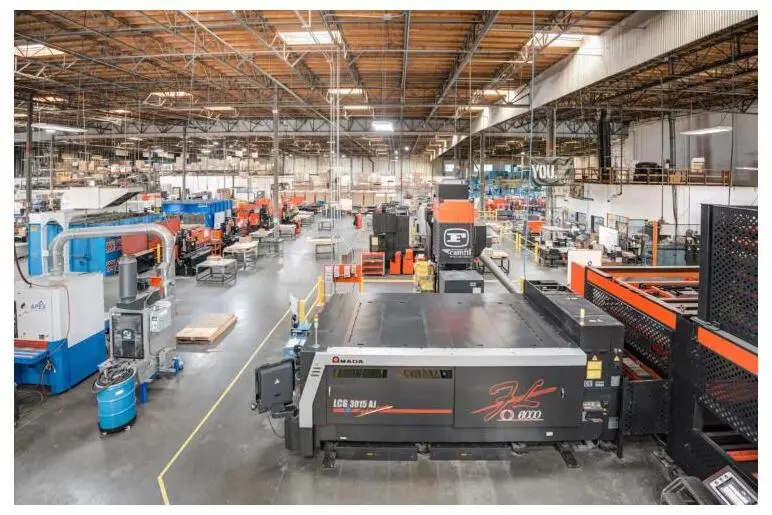
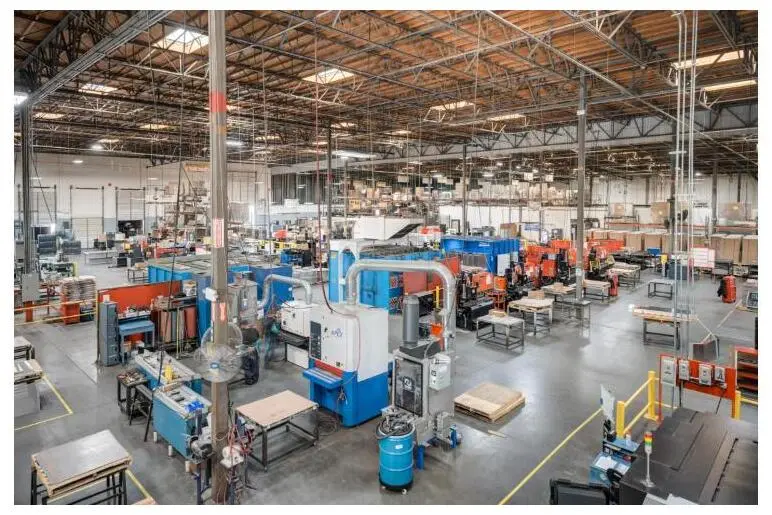
Fabcon operates from 220,000 square feet of vertically integrated manufacturing space across two U.S. facilities. Engineering, fabrication, finishing and assembly share the same roof, which removes vendor handoffs that generate delays and quality disputes on custom server rack enclosure programs.
Start a DFM-focused quote with Fabcon.
Evidence and Validation Signals for Integrated Fabricators
Procurement and operations teams benefit from a structured approach when evaluating integrated fabrication partners. The strongest signals fall into three categories: quality foundation, manufacturing completeness and compliance readiness.
Quality foundation starts with certifications and traceability:
- ISO 9001:2015 certification and, for regulated programs, AS9100D aerospace standard
- Full material traceability from raw stock through final inspection that supports audit readiness for HIPAA, PCI DSS and SOC 2 programs
Manufacturing completeness focuses on in-house capabilities:
- Finishing capabilities including powder coat, wet paint and mil-spec coatings that remove external finishing handoffs
- Electromechanical assembly capability covering wiring, hardware insertion and component integration
Compliance readiness covers regulated and certified builds:
- Compliance with UL and CSA standards for finished enclosures
- ITAR registration for defense or export-control programs
- Documented prototype-to-production transition process with clear DFM review steps
Fabcon holds ISO 9001:2015 and AS9100D certifications and is ITAR registered. Its integrated quality system spans every stage of the build and provides the traceability that infrastructure procurement teams require for high-stakes programs.
Request a capability overview and detailed quote.
Custom Dimensions and Form Factor Constraints
The EIA-310-E standard defines rail spacing and rack unit height but not cabinet outer depth, width or structural capacity. Standard depths of 600–1,000 mm are insufficient for modern GPU servers. These systems often need greater depth plus rear clearance for power connectors and cable bend radius.
High-density network environments need wider cabinets because narrow enclosures force cable bundles into airflow paths and raise server inlet temperatures. Standard static load ratings also fall short for liquid-cooling distribution units and dense GPU trays.
An integrated fabricator addresses these issues through DFM collaboration before any part is cut. Engineering teams review equipment dimensions, cable arm requirements, door swing clearance and structural loads together. That process produces a design that fits the actual deployment rather than a catalog assumption.
Custom tooling and engineering review add upfront time compared with ordering a stock enclosure. Early engagement with the fabrication partner keeps schedules on track.
Request a custom form factor assessment.
Cooling and Thermal Management for High-Density Racks
ASHRAE TC 9.9 recommends server inlet temperatures of 18–27°C. Standard enclosed cabinets require door perforation of at least 60% open area for racks up to 8 kW and 70–80% for 10–30 kW. Below those thresholds, airflow restrictions cause recirculation and inlet temperature violations.
Air cooling becomes physically inadequate above 30–40 kW per rack. At that point, liquid cooling integration becomes necessary. NVIDIA’s GB200 NVL72 rack reaches 132 kW peak power density, and next-generation systems target even higher densities.
Integrated fabricators design rear-door heat exchanger mounting provisions, liquid manifold attachment points and airflow geometry into the enclosure from the start. Hot- and cold-aisle containment in enclosed cabinets can reduce cooling power consumption compared with open-aisle designs. That benefit depends on correct enclosure geometry at fabrication.
Liquid-cooling provisions require close coordination between the enclosure fabricator and the cooling system supplier. Integrated partners are positioned to manage that coordination within one program structure.
Start a thermally integrated enclosure review.
Security, Access Control and Compliance-Driven Features
The compliance requirements described earlier, including HIPAA and PCI DSS cabinet-level controls, cannot be met with mechanical locks alone. Mechanical or basic combination locks do not provide the access auditing needed when building-level controls cannot correlate events to specific cabinets.
Open-frame racks provide no physical security, dust barrier or hot/cold aisle containment. That profile makes them unsuitable for multi-tenant, regulated or non-clean-room environments. Custom server rack enclosures address these gaps through lockable door systems, tamper-evident hardware, gasketed cable entries and provisions for electronic access control integration.
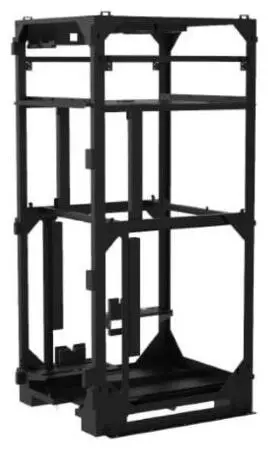
An integrated fabricator builds these features into the enclosure rather than adding them later. That approach preserves structural integrity and maintains the environmental rating of the finished cabinet. Security hardware specifications must be defined early in the design process to avoid rework.
Review a compliance-ready enclosure design with Fabcon.
Environment Ratings and Seismic Certification Requirements
Standard indoor rack cabinets are typically rated NEMA 1 / IP20. That rating provides basic protection against contact with live parts but no resistance to dust, dripping liquids or hose-directed water. Deployments in dusty industrial facilities, outdoor edge locations or washdown environments require NEMA 12, NEMA 4 or higher ratings per NEMA 250 and IEC cross-reference tables.
Telcordia GR-63-CORE Zone 4 seismic certification, described earlier, demands that cabinets survive significant acceleration events without tipping or ejecting hardware. Cabinets rated only for standard static loads may provide significantly reduced dynamic load capacity in seismic Zone 4. Movement during tremors can damage equipment and create safety hazards.
Meeting the Zone 4 seismic requirements discussed earlier requires purpose-built anchoring geometry and structural reinforcement, not aftermarket bracing. Integrated fabricators design seismic anchoring, gasketing and structural reinforcement into the enclosure to meet zone-specific requirements.
Demand for NEMA 4X and IP66/IP67 rated enclosures in the United States is growing at 7–9% annually. Growth comes from food and beverage, pharmaceutical and outdoor telecom applications. Higher environmental ratings require tighter fabrication tolerances and more complex gasketing, which increases per-unit cost relative to standard enclosures.
Explore NEMA-rated and seismic-certified enclosure options.
Load Capacity, Cabling and PDU Integration
Poor cable management in server racks blocks airflow paths. That blockage raises rack temperatures above recommended levels and increases cooling energy consumption. Mixing power and data cables in the same bundle induces electromagnetic interference and violates TIA-569 pathway separation requirements.
Cable management in production cabinets includes vertical managers on each side, horizontal managers at regular intervals, separate copper and fiber pathways and color-coded slack management loops. PDU integration requires vertical mounting provisions, dedicated power pathways and sufficient rear depth to close doors after PDU installation.
An integrated fabricator designs cable management and PDU mounting provisions into the enclosure structure. Vertical and horizontal cable managers plus brushed cable entry panels improve internal airflow efficiency while maintaining environmental protection.
PDU specifications and cable routing plans must be defined before fabrication begins. That requirement calls for close coordination between the enclosure design team and the electrical engineering team.
Request an enclosure design with integrated PDU and cable management.
Provider Comparison: Job Shops, Mid-Tier Fabricators and Large CMs
Infrastructure procurement teams evaluating custom server rack enclosure suppliers typically encounter three provider categories. These distinctions affect compliance, scalability and total cost of ownership.
Low-complexity job shops offer the following profile:
- Engineering support: Build-to-print only, no DFM collaboration
- Service scope: Sheet metal fabrication, no finishing, wiring or assembly
- Flexibility: High for simple parts, limited for complex system integration
- Volume fit: Low-volume prototype work
- Compliance maturity: Typically no ISO or AS9100D certification
- Cost model: Low per-part cost, high total cost when finishing and assembly are sourced separately
Large and global contract manufacturers offer the following profile:
- Engineering support: Available but tied to long onboarding processes
- Service scope: Broad but standardized, limited flexibility for evolving BOMs
- Flexibility: Low, with rigid production lines and high minimum order quantities
- Volume fit: High-volume programs, with mid-volume programs underserved
- Compliance maturity: Strong but focused on standard programs
- Cost model: High overhead with minimums that exclude many mid-volume buyers
Integrated mid-tier U.S. fabricators such as Fabcon offer the following profile:
- Engineering support: DFM collaboration from quoting through production
- Service scope: Fabrication, finishing, machining and electromechanical assembly under one roof
- Flexibility: Agile production cells that adapt to changing volumes and mixed SKUs
- Volume fit: Prototype through mid-volume production without large-CM minimums
- Geographic proximity: U.S.-based with domestic supply chain advantages
- Compliance maturity: ISO 9001:2015, AS9100D, ITAR, UL and CSA compliance
- Cost model: Higher per-part cost than job shops, lower total cost of ownership through reduced vendor count and rework
While the integrated model offers clear advantages over job shops and large CMs, procurement teams still need to understand its constraints before committing.
Compare the integrated model with a Fabcon-led quote.
Realistic Constraints of the Integrated Model
The integrated fabrication model introduces specific constraints that procurement and operations teams should weigh during selection.
- Capacity limits: Mid-tier fabricators serve mid-volume programs, and very high volumes may exceed their optimal range
- Onboarding effort: DFM collaboration and engineering review require upfront time investment from both customer and fabricator
- Regional concentration: U.S.-based facilities reduce offshore risk but concentrate production geographically, so globally distributed manufacturing needs additional planning
- Single-partner dependence: Consolidating fabrication, finishing and assembly with one partner reduces vendor count but increases exposure to that partner’s capacity and schedule
- Specification readiness: Custom enclosures require finalized equipment dimensions, cooling specifications, compliance requirements and PDU plans before fabrication, and incomplete specifications delay production
A focused due-diligence checklist helps teams evaluate integrated partners effectively:
- Verify ISO 9001:2015 and relevant certifications such as AS9100D and ITAR with current certificates.
- Confirm in-house finishing capabilities match the required coating or environmental rating.
- Review the DFM collaboration process and request a sample engineering review output.
- Assess electromechanical assembly capability against wiring and integration requirements.
- Evaluate prototype-to-production transition documentation and change management processes.
- Confirm traceability systems cover raw material through final inspection.
- Assess production cell flexibility against expected volume range and BOM evolution.
Begin an integrated-partner due-diligence review with Fabcon.
Frequently Asked Questions
Program Triggers for Custom Server Rack Enclosures
A program needs a custom enclosure when catalog dimensions, load ratings, environmental ratings or cooling provisions cannot meet deployment requirements. Common triggers include power densities beyond what standard perforated-door enclosures can manage with air cooling alone and equipment depths that exceed standard cabinet internal dimensions.
Additional triggers include NEMA or IP ratings above NEMA 1/IP20, seismic certification requirements under Telcordia GR-63-CORE and compliance mandates under HIPAA, PCI DSS or SOC 2 that require integrated physical access controls. Programs involving AI or HPC workloads, liquid cooling integration, outdoor or industrial edge deployment or regulated data environments align with a custom enclosure starting point.
What DFM Collaboration Includes for Enclosure Programs
DFM collaboration starts during the quoting stage before any material is cut. The fabricator’s engineering and quoting teams review drawings, tolerances, material specifications and assembly requirements. They identify features that create manufacturing difficulty, increase cost or reduce repeatability at scale.
The team then proposes modifications that preserve design intent while improving producibility. For server rack enclosures, this review typically covers structural geometry, weld joint accessibility, door hinge and latch placement, cable entry gasketing, PDU mounting provisions and finishing compatibility. The output is a manufacturing router and work instructions tuned for the production floor, which reduces rework and accelerates the prototype-to-production transition.
How Integrated Fabricators Support Prototype-to-Production
An integrated fabricator manages prototype and production builds within the same facility under one quality system. Engineering feedback from prototype builds flows directly into production work instructions without the delays that occur when separate vendors handle each phase.
Agile production cells allow volume to scale as program demand grows without forcing high minimum order quantities at the outset. Traceability systems that cover raw material through final inspection apply to prototype and production units, which supports compliance documentation from the first build.
Essential Quality and Compliance Documentation to Request
Buyers benefit from requesting current ISO 9001:2015 and, where applicable, AS9100D certificates with scope statements that cover relevant fabrication and assembly processes. Programs with defense or export-control requirements also require ITAR registration documentation.
Material certifications, first-article inspection reports and sample traceability records demonstrate coverage from raw material receipt through final inspection. For enclosures requiring UL or CSA compliance, the partner should provide documentation of compliance with those standards for the relevant product category. Audit readiness can be confirmed by asking about third-party audits and requesting the most recent audit summary.
Impact of Single-Partner Sourcing on Total Cost of Ownership
Fragmented vendor models create costs that do not appear on individual purchase orders. Coordination overhead across multiple suppliers, quality disputes at handoff points, rework from design-to-manufacturing disconnects and inventory carrying costs between vendors all add up.
An integrated partner consolidates fabrication, finishing and assembly under one purchase order and one quality system. That structure can reduce hidden costs when finishing, assembly, rework and coordination are included in the analysis. Domestic U.S. production also reduces inventory carrying requirements compared with offshore sourcing, where ocean freight lead times require larger safety stock.
Conclusion: Applying the Integrated Evaluation Framework
Standard 19-inch racks fail infrastructure programs when power density, depth, environmental rating, seismic certification or compliance requirements exceed catalog specifications. Fragmented vendor models compound that failure by spreading accountability across suppliers that cannot coordinate effectively under compressed timelines.
The integrated U.S. fabrication model fits programs that require custom dimensions or load ratings, NEMA or seismic certification, integrated cooling provisions, electromechanical assembly and full traceability under a single quality system. It fits less well for programs that align with catalog specifications, require production volumes beyond mid-tier capacity or need globally distributed manufacturing.
The evaluation checklist from the constraints section applies directly. Teams can verify certifications, confirm in-house finishing and assembly scope, assess DFM process maturity and confirm traceability coverage before selecting a partner.
Fabcon has operated as a vertically integrated U.S. precision metal fabrication and assembly partner since 1977. The company serves data center, energy storage, telecom and industrial OEM programs from prototype through production under ISO 9001:2015 and AS9100D certified quality systems.
Connect with Fabcon’s engineering team to review custom enclosure requirements.