
Last updated: August 6, 2026
Key Takeaways
- Metal stamping uses dies and presses to cut, form and shape sheet metal into precise, repeatable components at high volumes.
- Four primary stamping processes, progressive die, transfer die, four-slide and deep draw, each match specific part geometries, volumes and forming depths.
- Process selection depends on geometry, production volume, material properties and downstream finishing or assembly needs.
- Early DFM collaboration and integrated quality controls reduce rework, scrap and program delays when moving from prototype to production.
- Fabcon provides vertically integrated U.S. stamping, finishing and light electromechanical assembly under one roof, request a DFM review and quote.
Progressive Die Stamping for High-Volume Flat Parts
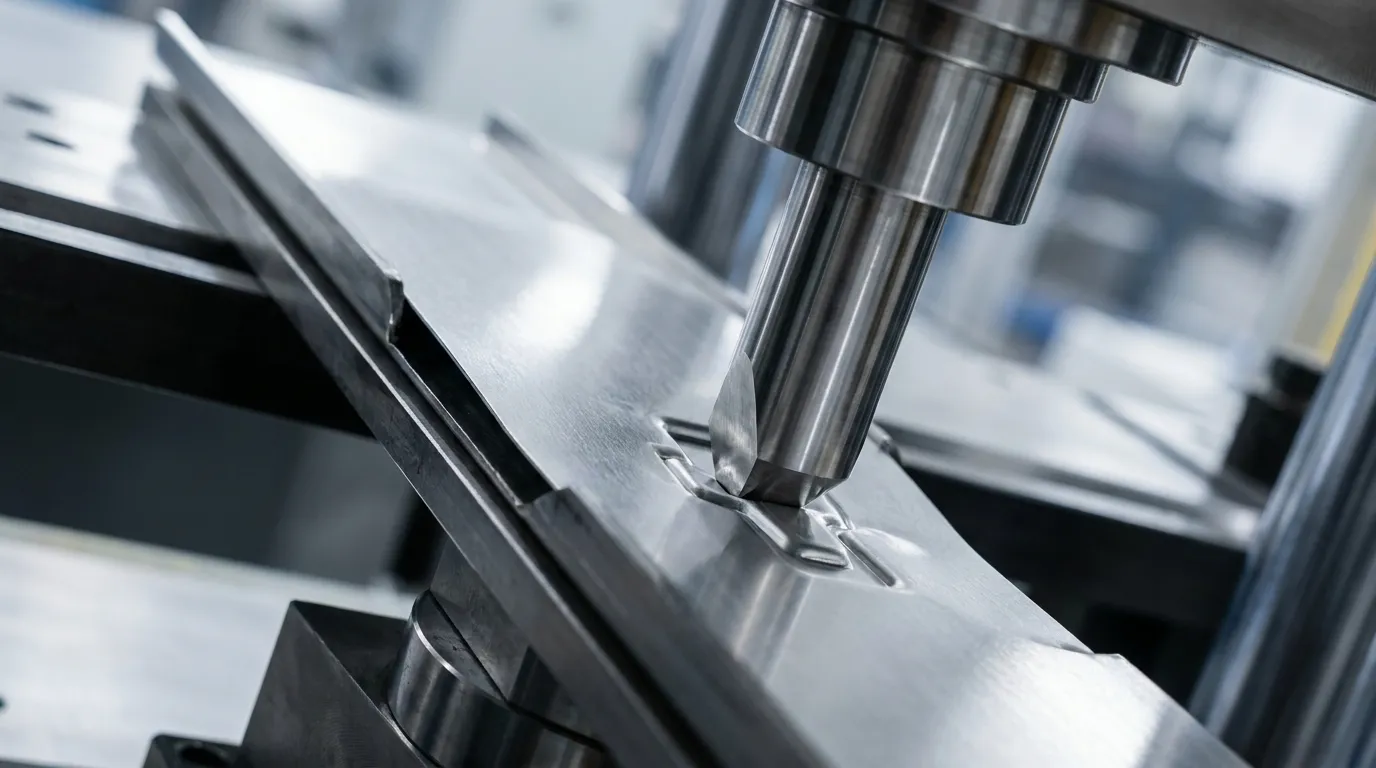
Progressive die stamping feeds a continuous metal strip through a series of stations inside a single die set. Each station performs a distinct operation, such as blanking, punching, bending or coining, while the part remains attached to the carrier strip. A finished part ejects on every press stroke once the die is running.
Progressive die stamping maintains dimensional consistency across thousands or millions of cycles through pilot pins and fixed multi-station tooling. That consistency makes it a reliable choice for components that need multiple punched holes, formed ribs and complex bends held in precise positional relationship. The process also excels in high-volume production scenarios where repeatability and speed matter.
Volume and Speed Advantages
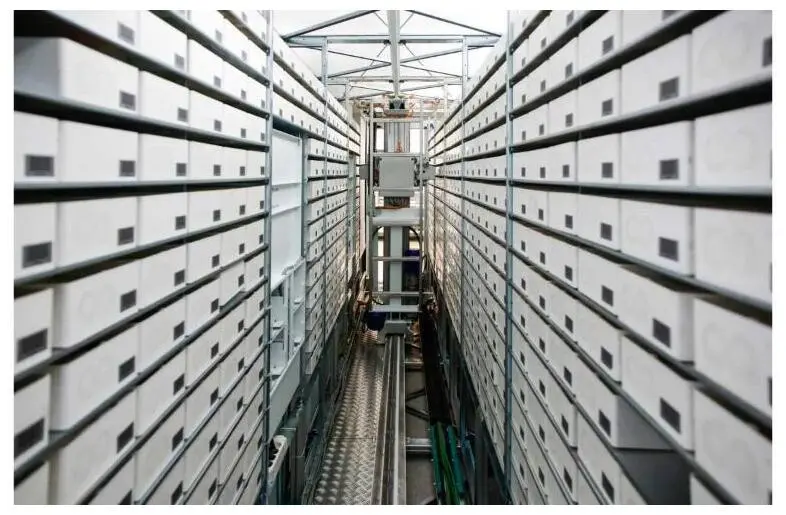
Progressive die stamping is the standard answer for high-volume production of small-to-medium parts with relatively shallow profiles. Presses operate at high speeds, which supports production of many parts per hour once the die is commissioned and debugged.
Typical applications include:
- Terminals and electrical contacts
- Brackets and clips for rack and enclosure systems
- Reinforcement plates and structural tabs
- Data-center cable management hardware
Tooling investment is significant, so progressive stamping becomes cost-effective at higher annual volumes. Simpler parts can sometimes justify the investment at lower volumes when they run across long program lifecycles.
Transfer Die Stamping for Large or Deep Parts
Transfer die stamping blanks the part from the strip at the first station, then moves each individual workpiece mechanically between subsequent stations. Because the part travels free of the carrier strip, tooling can form it from all sides and draw it to greater depths.
Transfer stamping suits large or deep-drawn parts at high volumes where progressive tooling is impractical due to part size or geometry complexity. The process supports more aggressive forming without the constraints of a continuous strip.
Transfer Die Stamping for Larger Components
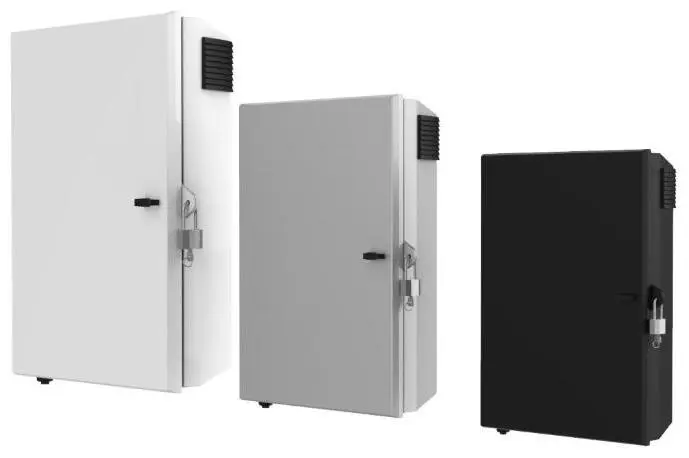
Transfer die stamping is the preferred process when part size, asymmetry or forming depth prevents the workpiece from remaining on a continuous strip. It enables 360-degree forming and deep draws that progressive dies cannot achieve while maintaining alignment between stations.

Common applications include:
- Weatherproof enclosure shells for energy storage and power distribution
- Appliance housings and deep-formed structural panels
- Large automotive and transportation structural components
- Medical device cart frames and equipment housings
Four-Slide Stamping for Multi-Directional Forms
Four-slide stamping uses four horizontally moving tool slides that operate at the same time from different directions to form intricate parts. These slides create multiple bends, twists or contours greater than 90 degrees in one coordinated sequence. Tooling operates from four axes, which allows complex geometry to form in a single pass.
Four-Slide Stamping for Intricate Wire and Strip Parts
Four-slide stamping suits small, complex components where multi-directional forming is required and tooling cost must stay manageable. It works especially well for wire forms, flat springs and electronic contacts while reducing tooling costs and scrap compared with some progressive solutions.
Typical applications include:
- Wire forms and retaining clips
- Flat and torsion springs
- Electrical contacts and connector components
- Small brackets that require bends in multiple planes
The process also accommodates design changes more readily than progressive dies. That flexibility makes it practical for programs with evolving specifications early in the product lifecycle.
Deep Draw Stamping for Hollow Shells
Deep drawing forms a sheet metal blank over a punch into a die cavity to create a cup or box-like shape with depth greater than its diameter. The blank draws radially inward as the punch descends, which produces a seamless hollow shell with consistent wall thickness.
Deep Draw Stamping Compared With Progressive Die
The distinction between deep draw and progressive die stamping centers on geometry. Progressive die stamping excels at flat-to-moderately-formed parts with multiple punched features. Deep draw stamping is the correct process when the finished part requires significant depth relative to its opening dimension, a ratio that progressive tooling cannot achieve.
Deep drawing suits hollow-shell parts such as cans, cups, enclosures and automotive pans at production volumes that justify tooling investment. It supports strong, seamless walls that handle structural and environmental demands.
Typical applications include:
- Cylindrical and rectangular enclosures for electronics and power systems
- Sealed housings for outdoor energy storage deployments
- Medical device instrument trays and containers
- Structural cups and pans for industrial OEM assemblies
Choosing the Right Stamping Process for a Part
Process selection depends on part geometry, production volume, material properties and what happens to the component after stamping. Successful stamping programs rely on robust die design, stamping-aware part design and realistic tolerance specification aligned early in the program.
A practical decision framework covers four areas.
- Part geometry and forming depth. Shallow, multi-featured parts suit progressive dies. Large or asymmetrical parts suit transfer dies. Parts that require multi-directional bends suit four-slide. Parts with significant depth-to-opening ratios require deep draw.
- Production volume. Progressive dies are designed for high-volume production, while single-stage or compound tooling is more economical below that threshold. Volume forecasts should guide tooling investment decisions from the start.
- Material properties. Engineers should evaluate ductility, yield strength, hardness and corrosion resistance together with production needs and final-part performance. Material choice directly affects tooling requirements and process controls. Softer, ductile metals reduce tool wear and extend die life, while high-strength steels and stainless grades require more robust tooling and tighter controls to maintain dimensional consistency.
- Downstream finishing and assembly. Sending drawings for DFM review before tooling lets engineering review feasibility, tolerance, forming, burr and finish risks while changes remain inexpensive. Surface finish requirements, coating chemistry and assembly hardware insertion all influence feature placement and tolerance allocation on the stamped part.
Industry-specific examples show how these factors converge in real programs.
- Data-center rack enclosures typically require progressive die stamping for high volumes of brackets and cable management hardware with tight positional tolerances.
- Energy storage weatherproof cabinets often combine transfer die or deep draw stamping for the shell with progressive-stamped internal hardware.
- Traffic safety structural components demand materials and forming processes that meet durability and load requirements for infrastructure-grade deployments.
- Medical device carts and lab equipment require full traceability from stamped component through finished assembly, with surface finishes compatible with cleaning and sterilization environments.
The most common mistake is skipping this DFM review to protect the schedule, a decision that typically consumes more time in rework than the review would have required.
Why an Integrated U.S. Stamping Partner Reduces Risk
Fragmented vendor bases create structural risk for infrastructure and technology programs. When stamping, finishing and assembly sit with multiple suppliers, each handoff introduces schedule exposure, quality finger-pointing and coordination overhead.
Fabcon manages stamping, powder coat and wet paint finishing, CNC machining and light electromechanical assembly under one roof at manufacturing space across two Southern California facilities. One purchase order covers the full build, from DFM review through final assembly and fulfillment.
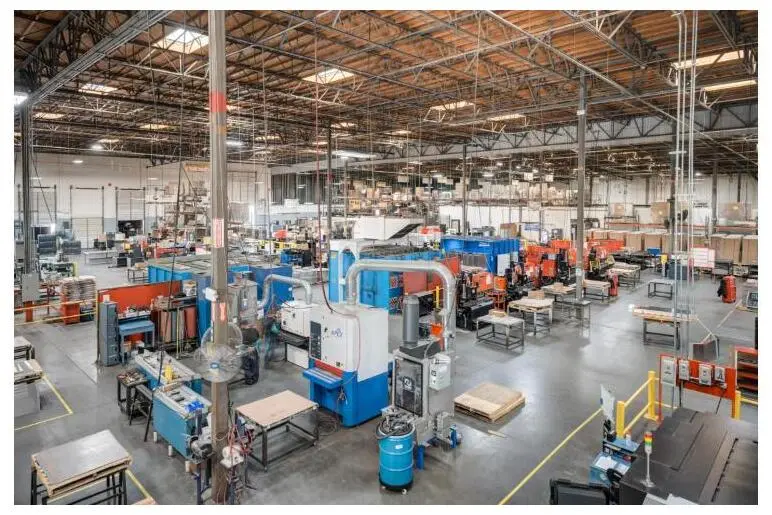
Fabcon holds ISO 9001:2015 and AS9100D certifications with ITAR registration. Cellular manufacturing groups equipment by product family into self-contained cells to achieve short lead times, low work-in-process inventory and strong team ownership. This model supports high-mix programs without the rigidity of large contract manufacturers.
Engineering teams gain DFM collaboration before tooling is cut, prototype-to-production alignment and integrated quality controls with full traceability across every stage of the build. Procurement and operations teams gain a reduced vendor count, simplified sourcing and a single accountable partner for execution consistency.
Frequently Asked Questions
What certifications should a metal stamping supplier hold?
At minimum, ISO 9001:2015 certification establishes a documented quality management system that covers process control, inspection, corrective action and traceability. For aerospace, defense or defense-adjacent programs, AS9100D adds requirements specific to aviation, space and defense manufacturing, including configuration management and risk-based thinking. Programs subject to export control regulations require ITAR registration. For components destined for products that require UL or CSA listing, teams should confirm the supplier’s familiarity with those compliance standards and their ability to support documentation requirements. Fabcon holds ISO 9001:2015, AS9100D and ITAR credentials with integrated quality assurance across fabrication, finishing and assembly.
How does vertically integrated fabrication differ from basic job-shop stamping?
A basic job shop performs stamping operations to print and ships raw stampings. The customer then manages separate vendors for finishing, machining and assembly. Vertically integrated fabrication combines those capabilities under one roof with shared engineering oversight, unified quality controls and a single point of accountability.
The practical difference is fewer purchase orders, fewer inter-vendor handoffs and a manufacturing partner that can identify and resolve integration issues before they become field problems. Fabcon’s integrated model covers DFM collaboration, precision sheet metal fabrication, CNC machining, in-house finishing and light electromechanical assembly, all within the same quality system.
Can one partner handle both stamping and light electromechanical assembly?
One partner can handle both stamping and light electromechanical assembly, and combining those capabilities creates a meaningful supply chain advantage. When the fabricator also performs wiring, hardware insertion and component integration, the team that built the enclosure or chassis also understands its tolerances, feature placement and finish requirements.
That shared context reduces assembly errors and removes the coordination overhead of managing separate metal and assembly vendors. Fabcon provides light electromechanical assembly as part of its end-to-end contract manufacturing offering, which supports customers that need a finished, tested assembly rather than a raw stamped component.
What DFM steps reduce the risk of rework from prototype to production?
The most impactful DFM steps occur before tooling is cut. Engineering review of part geometry, material selection, bend radii, hole placement and tolerance allocation at the 70 to 80 percent design completion stage catches issues while changes remain inexpensive.
Material and thickness should lock early because they drive bend radii, forming force, springback behavior and tooling wear. Tolerances should be specified only as tight as function requires, because over-tolerancing raises tooling and inspection costs without improving part performance. Burr direction, grain orientation and downstream coating compatibility should be addressed in the same review.
Fabcon’s engineering and quoting teams collaborate with customer technical teams before production begins. Together they review drawings and manufacturing requirements to refine the build before the first press stroke.
Matching Stamping Processes to the Next Program
Progressive die, transfer die, four-slide and deep draw stamping each serve distinct part geometries, volume ranges and forming requirements. Matching the process to the part from the start, with DFM input before tooling is committed, separates programs that scale cleanly from those that accumulate rework and vendor complexity.
Fabcon brings stamping process knowledge, integrated finishing and light electromechanical assembly together under one roof, with the certifications and traceability that infrastructure and technology programs require. From prototype through production, one partner manages the full journey.