
Last updated: August 26, 2026
Grounding-first Design: Key Takeaways for Rackmount Enclosures
- Grounding belongs in the DFM stage, not as a late installation task, to avoid rework and compliance gaps.
- Early definition of grounding requirements, material selection and masking locations prevents late nonconformances and improves first-pass yield.
- Continuous metal-to-metal contact paths, appropriate hardware and panel bonding strategies maintain low-impedance connections through powder coat.
- Verification methods such as ground bond testing and FAI documentation confirm performance before production ramp and support quality monitoring.
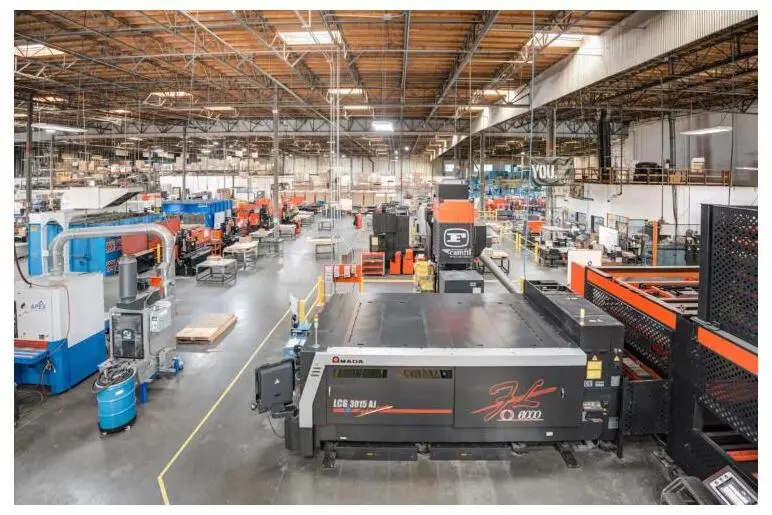
- Fabcon’s vertically integrated facilities and DFM engineering expertise provide a single accountable partner for custom rackmount enclosures; start your project with integrated grounding design.
The Problem: Fragmented Grounding Decisions Create Cost and Risk
Late grounding decisions create conflict between fabrication and assembly. The fabrication team applies powder coat uniformly. The assembly team then discovers coated surfaces at every intended grounding point. Field remediation through grinding, scraping or adding bonding jumpers adds labor, introduces inconsistency and often fails to meet the contact-area requirements of NEC 250.12, which requires removal of nonconductive coatings at grounding contact surfaces or use of fittings rated to penetrate them.
Fragmented supply chains intensify this risk. When fabrication, finishing and assembly sit with different vendors, no single party owns the grounding path from raw material to tested enclosure. Nonconformances then surface at integration, and the resulting disputes delay production ramp. Preventing this fragmentation starts with a single step: extracting grounding requirements before any fabrication decisions are made.
Step 1: Define Grounding Requirements and Constraints Up Front
Grounding requirements must be extracted from drawings, specifications and RFQ packages before DFM review begins. Key inputs include applicable standards, conductor sizing per NEC Table 250.122, enclosure voltage class and any UL or CSA listing obligations.
Outputs from this step include manufacturing routers that flag grounding contact zones, inspection plans with resistance acceptance criteria and alignment between engineering and supply chain on masking locations, hardware callouts and test requirements. Early definition of these constraints prevents late stud-location changes and incomplete tolerance stack-ups. Those two issues rank among the most common causes of grounding nonconformances in production.
Step 2: Match Enclosure Materials and Finishes to Grounding Strategy
Material and finish choices set the boundaries for every later grounding decision. Aluminum offers higher electrical conductivity than steel, while steel provides stronger magnetic field shielding. This material choice determines which finishing processes are viable and constrains the contact path design in Step 3. Aluminum is lighter and easier to machine, but anodizing creates an electrically insulating oxide layer that weakens EMI shielding at seam lines, screw seats and grounding points unless those areas are masked or locally stripped.
Steel requires corrosion protection, and paint, powder coating and rust on steel act as insulators. The finishing plan must therefore define grounding contact zones from the start so those areas remain conductive. Standard powder coating does not conduct electricity and behaves as an electrical insulator with resistivity typically ranging from 1012 to 1016 ohm-centimeters, comparable to glass or ceramic. Specifying finish type, thickness and masking requirements at the material selection stage, not after drawings release, determines whether grounding paths survive the coating process and remain compatible with the hardware choices in Step 4.
Step 3: Build Continuous Metal-to-Metal Contact Paths Before Coating
Every panel interface, door frame and chassis joint that must carry fault current or provide EMI continuity needs a defined metal-to-metal contact path. Tolerance stack-ups at mating surfaces must be analyzed to confirm that contact pressure holds across the production population, not just the nominal design.
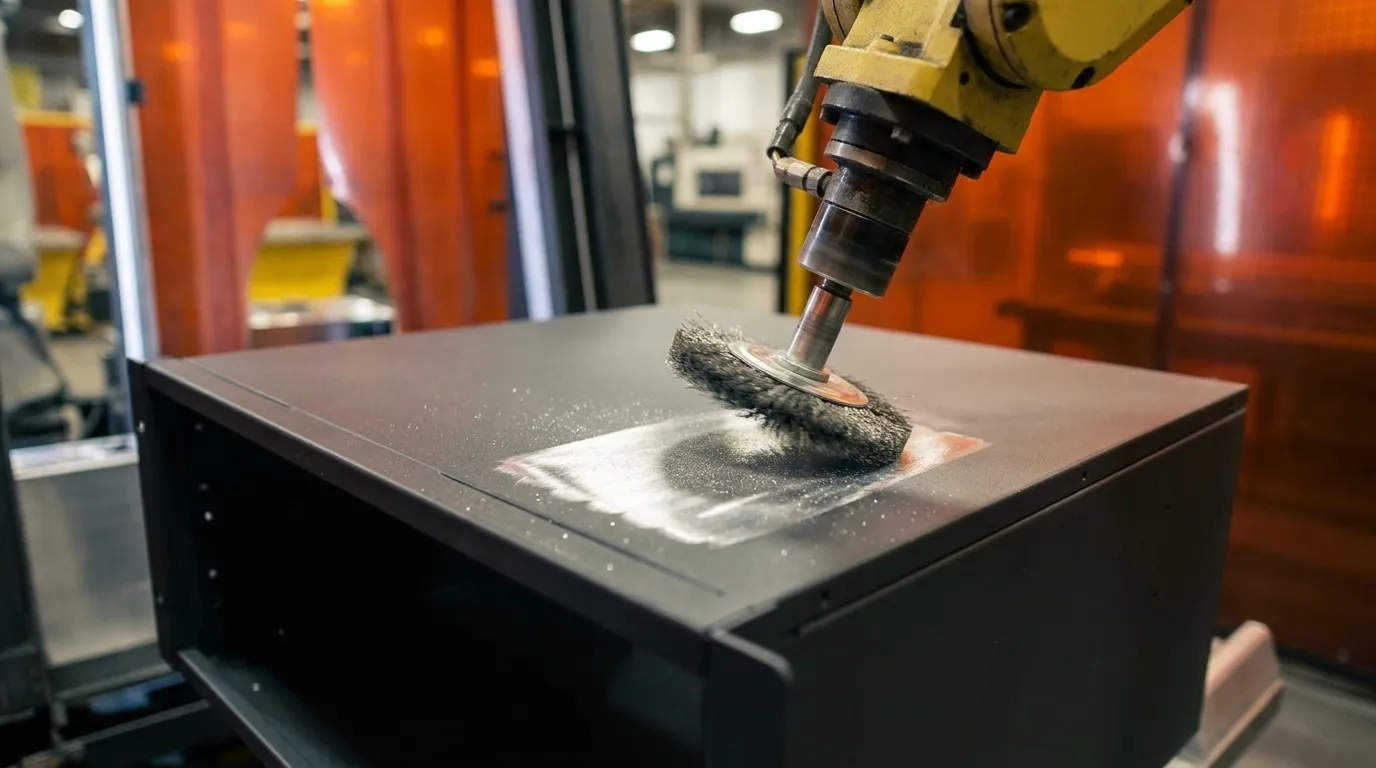
Masking locations must appear on fabrication drawings with dimensions and inspection criteria. Grounding contact points on powder-coated electrical enclosures require bare metal surfaces for low-impedance connections. These areas must be masked during coating or the cured powder coating must be removed afterward by grinding or scraping. Masking before coating provides more repeatable results and lower labor than post-coat removal, which makes it the preferred DFM approach for mid-volume programs.
EMI shielding effectiveness on powder-coated metal enclosures depends on metal-to-metal contact at panel joints, door frames and seams. That contact can be achieved through masking, star washers or conductive EMI gaskets on bare-metal surfaces. Seam and joint design must account for gasket compression, screw spacing and surface flatness so contact holds across thermal cycles.
Request a DFM review that includes grounding path analysis.
Step 4: Specify and Locate Grounding Hardware During DFM
Hardware selection and placement must be resolved during DFM, not during assembly. NEC 250.8(A) lists permitted grounding and bonding connection methods. Sheet-metal screws do not qualify as an approved method for grounding or bonding conductors to an enclosure, and reviewers enforce this rule during UL 508A evaluations of industrial control panels.
Accepted hardware per NEC 250.8(A) includes:
- Machine screws in tapped holes engaging at least two full threads
- Thread-forming machine screws meeting the two-thread engagement requirement
- Listed lugs, ground bars and pressure connectors
- Exothermic welding
External-tooth SEMS screws, which combine a machine screw and captive external-tooth washer, provide reliable metal-to-metal contact through powder-coat finishes without a separate paint-scraping step. For locations where masking is impractical, these screws offer a cost-effective production solution.
Once hardware is selected, installation parameters must be locked down. Torque values must be specified on drawings and enforced during assembly. NEC 110.14 mandates application of manufacturer-specified torque values during ground lug installation to maintain mechanical integrity and prevent high-resistance connections over time. For enclosures destined for harsh environments, material selection matters as much as torque. Tinned copper ground bus bars are recommended for coastal, humid, corrosive or outdoor-rated enclosures because tin plating resists oxide film formation that raises contact resistance over time.
Ground bus bars should be mounted to ensure solid metal-to-metal contact with the enclosure. The enclosure mounting face must have coatings removed at the contact area before the bar is installed. With fixed hardware in place, the next challenge involves maintaining continuity to parts that move.
Step 5: Bond Doors and Removable Panels with Dedicated Paths
Hinged enclosure doors that carry devices, operator interfaces or disconnects require a dedicated bonding jumper. Hinges do not provide a reliable low-impedance ground path because paint, grease and mechanical wear disrupt metal-to-metal contact over time.
Flexible braided bonding straps provide the standard solution for removable doors and panels. Strap length, attachment points and connector type must be specified in the drawing package. Doors must be bonded to the body with a flexible braided strap, and the back panel, metallic conduits and all equipment grounds must terminate at a single verified grounding point.
Verification points for removable parts must be defined before production ramp. Removable parts such as panel doors should achieve low-impedance continuity to the PE bus. An ohmmeter check confirms this continuity and removes any reliance on hinges.
Step 6: Tie the Enclosure to Earth Ground and Plan Verification Points
The protective-earth (PE) busbar serves as the central reference point for the enclosure grounding system. It forms the node where the contact paths from Step 3, the hardware from Step 4 and the panel bonding from Step 5 converge. Every industrial control panel requires a dedicated PE bus bar, typically a copper bar bolted directly to the back plate with short, low-impedance connections. A 1-metre run of 6 mm² green-yellow wire has measurable inductance, while a 100 mm run or direct bolt-down has far less.

EGC termination must comply with NEC 250.4(A)(5) and 250.96. These sections require all non-current-carrying metal parts that could become energized to connect to an effective fault-current path with electrically continuous low-impedance bonding. UL 467-listed lugs provide secure terminations on enclosures.
Measurement methods must be defined in the inspection plan. The resistance of each grounding connection on an electrical enclosure should remain low. Continuity is verified on every enclosure using a low-resistance ohmmeter or ground bond tester that applies a test current and measures voltage drop. Verification points must be physically accessible and identified on assembly drawings so production operators can test without interpretation.
Step 7: Document and Validate Grounding from Prototype Through Ramp
Grounding performance must be confirmed at first article inspection before production ramp begins. PFMEA and APQP elements should treat grounding continuity as a critical characteristic, with control plans that specify test frequency, equipment calibration requirements and accept or reject criteria.
IEEE Std 81-2025 outlines practical test methods for measuring the electrical characteristics of grounding systems. These methods cover safety considerations, resistance or impedance of the ground system and verification of grounding system integrity. Applying these methods at FAI establishes a documented baseline for production comparison.
First-pass yield tracking for grounding continuity should be integrated into the production dashboard from the first production lot. This tracking enables trend analysis. Patterns in continuity failures by assembly station, operator or hardware lot provide early warning of process drift before nonconformances accumulate. These trends are only actionable when the baseline is well documented. Grounding strategy, critical contact points, coated versus bare-metal areas and parts requiring repeatable continuity must be defined early in the mechanical design stage and documented in the drawing package along with approved conductive hardware, torque values, corrosion-protection methods, assembly sequence and test limits.
Discuss enclosure grounding requirements with the Fabcon engineering team.
Common Grounding Challenges in Rackmount Programs
Three challenges appear consistently in mid-volume rackmount programs when grounding does not receive attention at DFM.
The first challenge involves incomplete tolerance stack-ups at panel interfaces. When mating surface flatness and fastener preload are not analyzed together, contact pressure at grounding joints falls below what is needed for consistent low-impedance paths across the production population. Mitigation requires GD&T callouts for contact surfaces and specification of minimum clamp force in the assembly router.
The second challenge involves late stud-location changes. Engineering changes after powder coat tooling is set require either re-masking or post-coat grinding. Both options add cost and introduce process variation. Freezing stud locations before finishing release prevents this issue.
The third challenge involves underestimated test needs. Programs that do not budget for ground bond testing equipment and calibration at the production cell discover the gap during FAI. Including test equipment in the capital plan during DFM review removes this delay.
Measuring Success and Exploring Advanced Grounding Techniques
Programs that integrate grounding at DFM track performance through grounding continuity first-pass yield, on-time FAI delivery and nonconformance rate at assembly. These metrics provide a direct line of sight from fabrication decisions to compliance outcomes.
For programs scaling beyond initial production volumes, digital-twin simulation of the enclosure grounding network can identify impedance hot spots before tooling is committed. Supplier mask integration, where the powder coat vendor receives masking specifications as part of the standard work package rather than as a separate communication, reduces variation at the finishing stage and supports consistent results across production lots.
Frequently Asked Questions
What NEC and UL requirements apply to grounding custom rackmount enclosures?
NEC Article 250 governs grounding and bonding for metal enclosures in industrial electrical installations. Key sections include NEC 250.4(A)(5), which requires an effective fault-current path for all non-current-carrying metal parts that could become energized, and NEC 250.96, which requires all metallic parts in the distribution system to be bonded to the equipment grounding conductor system. NEC 250.12 addresses coating removal at contact surfaces, as discussed in Step 1. NEC 250.8(A) lists permitted connection methods, excluding sheet-metal screws. For UL compliance, UL 467 covers grounding and bonding equipment, and UL 2703 evaluates bonding components for their ability to establish and maintain low-impedance paths under fault-current and environmental stress conditions. Programs targeting UL 508A listing for industrial control panels must satisfy all of these requirements as part of the panel review process.
How do designers maintain low-impedance paths through powder coat finishes?
Three approaches see regular use in production, and the best choice depends on geometry and program volume. Selective masking before powder coat provides the most reliable method. Contact zones remain protected during coating, which leaves bare metal at every grounding point. Where masking is impractical, external-tooth star washers or SEMS screws with captive serrated washers cut through the cured coating when fastened and establish metal-to-metal contact without a separate grinding step.
Post-coat grinding or scraping forms a third option but adds labor and introduces process variation. For EMI-critical seams and door frames, conductive EMI gaskets installed on bare-metal surfaces provide continuous contact across the joint. Resistance at each grounding connection must be verified against the acceptance criteria in the inspection plan, typically not exceeding 0.1 ohm per IEC 61439.
What hardware ensures reliable panel bonding on removable doors?
As noted in Step 5, hinges alone cannot serve as the ground path. Flexible braided bonding straps are the standard solution for removable doors and panels. The strap must be sized to carry the expected fault current, attached at both ends with listed hardware engaging at least two threads and routed to avoid mechanical interference with door travel.
Green hex-head thread-forming grounding screws are commonly used at the attachment points. Continuity from the door to the PE bus must be verified at FAI and included in the production inspection plan, with an acceptance threshold typically under 1 ohm.
How should ground busbars be integrated during DFM for aluminum and steel enclosures?
The busbar must be located and mounted during DFM, not added during assembly. For both aluminum and steel enclosures, the mounting face must have coatings removed at the contact area before the bar is installed. Insulating standoffs are prohibited when the bar must bond to the enclosure.
The busbar should be positioned to minimize conductor run lengths from equipment grounding points and reduce impedance in the fault path. For aluminum enclosures, anodizing at the mounting face must be locally stripped or masked because the anodized layer is electrically insulating. For steel enclosures in corrosive or humid environments, tinned copper busbars are preferred because tin plating resists oxide film formation that raises contact resistance over time. The bonding jumper connecting the busbar to the enclosure must be sized to match the largest equipment grounding conductor landing on the bar.
What verification methods confirm grounding performance before production ramp?
Ground bond testing using a low-resistance ohmmeter or dedicated ground bond tester provides the standard method for verifying continuity at each grounding connection. The tester applies a defined test current and measures voltage drop to calculate resistance. Acceptance criteria come from IEC 61439 for the grounding connections and from the program-specific inspection plan for door and panel bonding.
At FAI, every grounding point on the enclosure should be measured and documented against the acceptance threshold. IEEE Std 81-2025 provides additional test methods for evaluating grounding system integrity, including current injection testing for both new and existing installations. Production control plans should specify test frequency, equipment calibration intervals and the disposition process for units that fall outside acceptance limits. First-pass yield data from grounding continuity testing should feed the production dashboard to support ongoing process monitoring.
Conclusion
Grounding in custom rackmount enclosures functions as a fabrication decision, not an installation task. The seven-step sequence above, from requirements definition through production validation, turns grounding from a post-powder-coat problem into a designed-in characteristic that supports first-pass yield, UL and NEC compliance and EMI performance at scale.
Fabcon’s vertically integrated facilities bring fabrication, finishing and assembly under one roof with DFM engineering embedded from the first review. That structure removes the vendor handoffs where grounding nonconformances often originate and gives mid-volume programs a single accountable partner from prototype through production ramp.
Connect with Fabcon to align enclosure design and grounding strategy from day one.