
Key Takeaways
- One-stop data center enclosure suppliers deliver racks or cabinets with integrated power, cooling, containment, cable management and monitoring from a single accountable partner.
- Standard catalog enclosures support predictable, low-density deployments. Custom fabrication supports non-standard dimensions, high-density AI workloads, liquid cooling and unique structural needs.
- Custom fabrication partners need in-house sheet metal fabrication, CNC machining, finishing and electromechanical assembly to avoid vendor handoffs and coordination overhead.
- Liquid cooling for AI workloads requires enclosure features such as manifold mounting, blind-mate couplings, leak detection and structural reinforcement that engineers design in from the start.
- Fabcon is a US-based, vertically integrated precision sheet metal fabrication and electromechanical assembly partner that serves as a one-stop solution for custom data center enclosures. Explore Fabcon’s custom enclosure capabilities.
Major One-Stop Data Center Enclosure Brands
Major one-stop data center enclosure suppliers span a broad OEM brand tier. Each covers some combination of rack hardware, power, cooling, containment, cable management and monitoring.
- Schneider Electric / APC (NetShelter SX, NetShelter SV, NetShelter Open Architecture): The Schneider NetShelter portfolio covers standard and custom full, half and wall rack enclosures, rack PDUs at multiple metering tiers, hot and cold aisle containment, KVM and console access and NetBotz environmental and security monitoring. The EcoStruxure platform extends to AI-focused ORv3 and MGX racks with liquid cooling integration.
- Rittal (RiMatrix, IT Racks): Rittal offers modular IT infrastructure systems including standard server racks, climate control units, power distribution and monitoring. The RiMatrix platform targets preconfigured, modular data center deployments.
- nVent / SCHROFF: nVent SCHROFF produces standard and ruggedized enclosures, subracks, chassis, cabinets, backplanes, power supplies and thermal management accessories for IT and industrial environments, meeting IEC 60297-3-x and IEEE standards.
- Vertiv (VR Rack, OneCore): The Vertiv VR Rack family is a standardized rack line designed for rapid deployment in high-density environments. It supports servers, storage, switches, PDUs and UPS systems, with cable management and airflow management accessories. Cooling and containment systems sit in separate Vertiv product lines.
- Eaton (SmartRack, Paramount): Eaton’s rack portfolio includes SmartRack enclosures and Paramount configure-to-order enclosures paired with rack PDUs, UPS systems and Brightlayer power management software, plus cable management and airflow accessories.
- Chatsworth Products / CPI (ZetaFrame): The CPI ZetaFrame cabinet system targets high-density deployments. It includes integrated cable management, airflow management and power distribution options and supports hot aisle containment systems.
- Enconnex (InfiniRack): The Enconnex InfiniRack platform is a configured-to-order data center cabinet with extensive configuration options. It includes integrated dual PDU channels for power distribution, airflow accessories, custom aisle containment solutions and features for high-density deployments.
- Flex: Flex operates as a large-scale contract manufacturer and infrastructure solutions provider. It offers rack and enclosure systems alongside broader supply chain and integration services for data center OEMs, including configuring racks and enclosures through value-added fulfillment and logistics services.
Most of these suppliers are OEM brands whose catalogs cover standard SKUs. When a standard SKU does not fit because of non-standard dimensions, high-density AI workloads, liquid cooling or unique containment requirements, the buyer moves into the custom fabrication and integration layer. The rest of this guide focuses on that layer.
Fabcon occupies a distinct position in this landscape. Fabcon is a full-service US precision sheet metal fabrication and assembly partner that manufactures custom metal parts, enclosures and mechanical assemblies. Its vertically integrated capabilities span in-house design, engineering, testing, fabrication, machining, electromechanical assembly, finishing, fulfillment and logistics, which supports one-stop custom-fabricated, integrated data center enclosures. Review Fabcon’s enclosure manufacturing services.
Rack Manufacturing Tiers In Data Center Programs
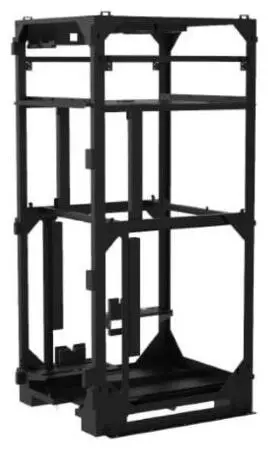
Racks for data centers come from two main tiers. OEM catalog manufacturers build standard rack SKUs. Custom fabrication and integration partners build racks, cabinets, chassis and structural frames to print and integrate them with power, cooling and cabling.
One-stop data center enclosure suppliers operate in both models. The custom fabrication tier delivers racks that are fabricated, finished, wired and assembled as single integrated units. Typical product types include cabinets and enclosures, chassis and racks, components, brackets and metal parts, plus structural frames and fixtures.
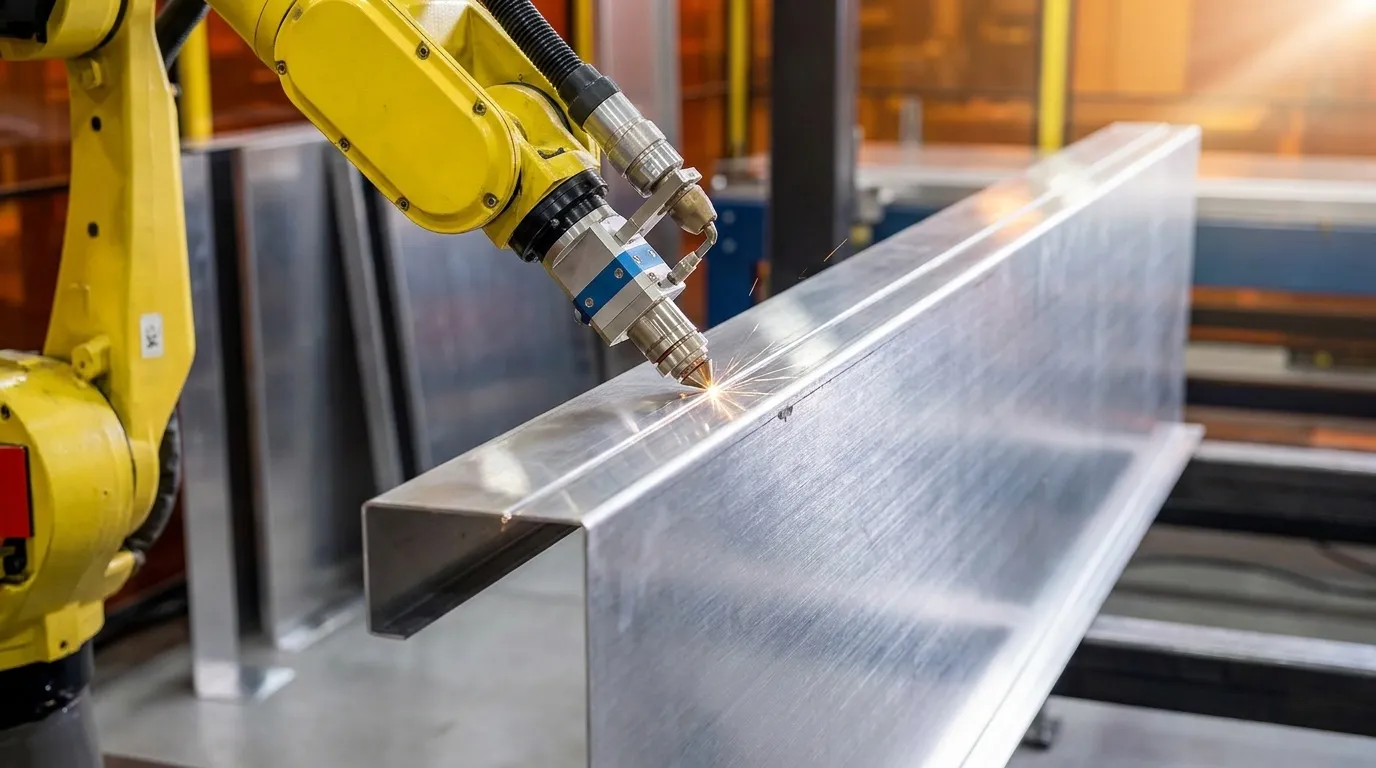
Manufacturing a data center rack relies on precision sheet metal fabrication, including laser cutting, CNC punching, forming, welding and finishing. It also uses CNC machining for tight-tolerance structures such as U- or L-shaped enclosures, racks and chassis that require hardware insertion or pressure testing. In-house finishing capabilities such as powder coat, wet paint, screen printing, CARC military-grade finishing and mil-spec coating complete the enclosure before assembly.
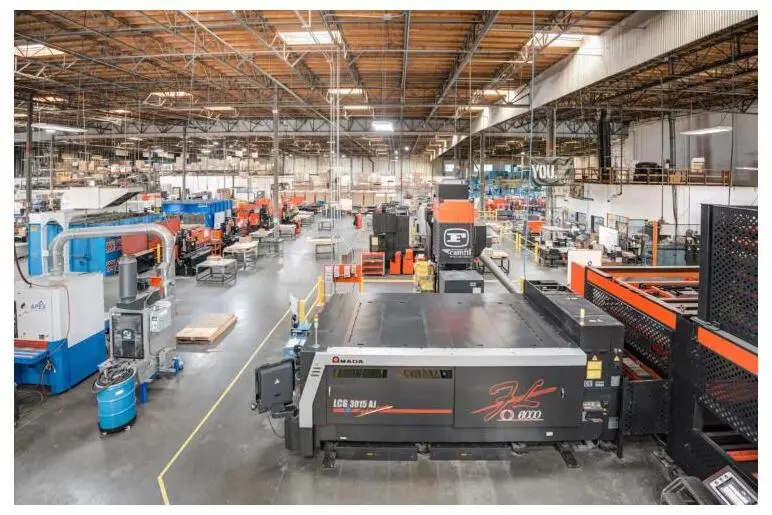
Fabcon combines these processes in-house, so racks and enclosures are produced in the same environment as the machined components that support them. Tolerance stack-up in tall assemblies is the single most common failure mode in rack fabrication. Internal machining improves the fit and dimensional accuracy of complex systems and removes the coordination overhead of separate machine shops. Discuss an integrated rack build with Fabcon.
What One-Stop Data Center Capability Includes
One-stop status rests on a specific capability set. The following list outlines the core requirements.
- Rack and enclosure fabrication: In-house sheet metal fabrication and CNC machining, not outsourced to a job shop. At the OEM brand tier, the enclosure is a catalog product. At the custom fabrication tier, the enclosure is built to print.
- Power (PDU and UPS): OEM brands typically offer integrated PDU and UPS product lines. Custom fabrication partners integrate power distribution components into the enclosure during assembly rather than shipping them separately.
- Cooling (air and liquid): OEM brands offer cooling accessories and liquid cooling options. Custom fabrication partners build enclosures that accommodate manifolds, blind-mate connections, containment and structural support for heavier liquid-cooled components.
- Containment: Hot aisle and cold aisle containment systems appear as accessories from OEM brands. Custom fabrication partners design containment into the enclosure structure from the start.
- Cable management: Standard cable management accessories are catalog items at the OEM tier. Custom fabrication partners integrate cable routing into the enclosure design during DFM collaboration.
- Monitoring: Environmental and power monitoring often appears as a software and hardware add-on at the OEM tier. Custom fabrication partners can integrate monitoring hardware into the enclosure during electromechanical assembly.
- Custom fabrication and electromechanical assembly: This capability separates a one-stop partner from a catalog reseller. A catalog reseller can quote a rack, a PDU and a containment kit. A one-stop partner owns fabrication, finishing and electromechanical assembly of the enclosure itself, which removes vendor handoffs and quality disputes.
For buyers, this structure means fewer POs, one accountable partner, reduced coordination overhead and clearer quality ownership across the finished enclosure. DFM and prototyping handled by the same shop that runs production avoids repeated engineering work and lost process knowledge when fabrication is split across vendors.
Fabcon illustrates this one-stop model. One partner handles fabrication, finishing and assembly. One PO covers the enclosure. One accountable partner supports faster turnarounds and simplified sourcing. Fabcon’s vertically integrated model spans engineering support, fabrication, finishing and final assembly, including light electromechanical assembly such as wiring and component integration. See how Fabcon manages full enclosure programs.
Standard And Custom Data Center Enclosures
Standard catalog enclosures support predictable, low-density, standard form-factor deployments where off-the-shelf dimensions, mounting patterns and thermal assumptions match the workload. Custom-fabricated, integrated enclosures become necessary when any of the following conditions apply.
- Non-standard rack dimensions or mounting patterns that catalog SKUs cannot accommodate
- High-density or AI workloads that exceed catalog thermal and power assumptions
- Unique cable management or containment requirements that standard accessories cannot address
- Integration of power and cooling components into a single enclosure structure
- Structural or environmental requirements, including ruggedization, NEMA ratings or mil-spec finishing, that catalog SKUs do not meet
The custom path follows a defined sequence. Teams collaborate on DFM, review drawings, tolerances and materials, create manufacturing routers and work instructions, then move through fabrication, finishing and electromechanical assembly into prototype-to-production scaling. DFM feedback typically involves small, targeted adjustments rather than redesigning the enclosure from scratch. Percentage savings from DFM often increase on lower-volume runs because fixed costs spread across fewer parts.
Fabcon manages this path end to end. Its in-house engineering and quoting teams work with the client technical team before production begins to improve manufacturability, reduce rework and speed development. Start a custom enclosure review with Fabcon.
Cooling-Driven Enclosure Requirements For High-Density And AI Loads
High-density and AI workloads are reshaping enclosure requirements. Liquid cooling was once optional or niche. It now functions as a baseline requirement for many high-density AI systems. The industry conversation has shifted from whether to adopt liquid cooling to how to standardize it.
According to DataBank, air cooling becomes inefficient beyond about 20 kW per rack. Other sources place the practical air-cooling limit higher and note that it depends on workload, economics and ambient conditions. These limits can create unpredictable hot spots and higher failure rates. Uptime Institute places the upper limit for air-only cooling at roughly 40 to 60 kW per rack. Above that range, liquid cooling becomes mandatory.
Liquid-cooled enclosures require specific design features. These include manifold assemblies with defined mounting brackets and frame stiffness requirements. Blind-mate quick-disconnect couplings need local structural reinforcement and hand-working clearance. Cooling hose routing must account for bend radius and abrasion protection. Leak-detection hardware, drip collection and condensation-control strategy also play essential roles. These liquid-cooled interface requirements must be resolved before rack release, not retrofitted after fabrication.
The Open Compute Project ORv3 Blind Mate Manifold Specification defines the mechanical envelope, misalignment tolerances and flow requirements for the server-sled-to-rack-manifold interface. This specification makes blind-mate compatibility a design constraint at the enclosure level. ORv3 also defines a centralized 48V DC busbar architecture for rack-level power distribution, which requires enclosures to accommodate busbar geometry alongside liquid cooling manifolds.
Hot Aisle Containment
Hot aisle containment systems direct exhaust air from server rear panels into a contained hot aisle and prevent recirculation into cold aisles. For custom enclosure builds, teams engineer containment into the structural system rather than adding it later. Enclosure height, depth and door geometry all affect containment performance.
Modular Data Center Enclosures
Operators increasingly rely on prefabrication and factory integration to reduce on-site work and compress deployment timelines. Modular enclosure systems that arrive pre-integrated with power, cooling and cabling reduce field labor and accelerate commissioning.
Fabcon builds modular, rack-mounted enclosures and structural systems that simplify cooling, cable management and integration for hyperscale and edge deployments. Electromechanical assembly and finishing sit under one roof. Review Fabcon’s modular enclosure experience.
How To Assess A Custom Enclosure Fabrication Partner
The following framework covers evaluation criteria that separate capable custom fabrication and integration partners from low-complexity job shops and rigid large contract manufacturers.
DFM Collaboration
Early engineering involvement reduces rework, improves cost efficiency and confirms that designs can be built at scale. A DFM review covers materials and every bend, hole, weld, fastener and finish against the realities of laser cutting, CNC punching, press brake forming, welding, powder coating and assembly. Fabcon engineering and quoting teams collaborate with the client technical team before production, reviewing drawings, tolerances and materials to create manufacturing routers and work instructions tuned for the floor.
In-House Finishing
Complete in-house finishing, including powder coat, wet paint, screen printing, CARC military-grade finishing and mil-spec coating, plus mechanical assembly such as hardware insertion and product fulfillment, improves cosmetic standards and reduces post-production handling. Partners that outsource finishing introduce a vendor handoff that affects schedule and quality consistency.
Electromechanical Assembly
Light electromechanical assembly, including wiring and component integration, forms the build-to-print plus light assembly capability that distinguishes Fabcon from low-complexity job shops. Many metal fabrication shops lack this capability, which forces buyers to manage a separate wiring vendor and the related handoff delays.
Certifications And Compliance
ISO 9001:2015 and AS9100D certified quality systems govern the build. NRTL marks such as UL and ETL carry identical legal weight for Authorities Having Jurisdiction. ITAR registration is required for builds that involve manufacturing defense articles or furnishing defense services related to controlled technical data. Handling controlled technical data alone does not automatically require registration. ISO 9001:2015 certification signals audited process discipline for quoting, engineering changes, fabrication, inspection, corrective action and traceability. For data center buyers, these certifications provide full traceability for every part and support liability management in infrastructure-critical deployments.
Prototype-To-Production Scaling
Agile production cells that adapt to changing volumes, mixed SKUs and evolving bills of material support mid-volume programs without the high minimums and long onboarding of large contract manufacturers. Fabcon flexible manufacturing cells enable scaling from prototype through production while remaining responsive to program changes.
Supply Chain And Logistics
JIT delivery, fulfillment and logistics support reduce vendor count and complexity. One partner for fabrication, finishing and assembly means one PO and one accountable partner across the finished enclosure. Coordinate fabrication and logistics with Fabcon.
US-Based One-Stop Enclosure Suppliers
Domestic sourcing delivers advantages that offshore supply chains cannot match. These include shorter and more reliable supply chains, reduced risk of offshore delays, easier communication and collaboration and made-in-America accountability for infrastructure-critical deployments. The US data center buildout is radiating demand through factory supply chains, and buyers that rely on offshore fabrication face compounding lead time and logistics risk as domestic capacity tightens.
Data center-related companies are leasing industrial space for equipment development, server testing and hardware storage across major US markets. This activity reflects the depth of the domestic supply chain buildout. For enclosure buyers, a US-based fabrication partner reduces exposure to offshore delays and simplifies quality oversight.
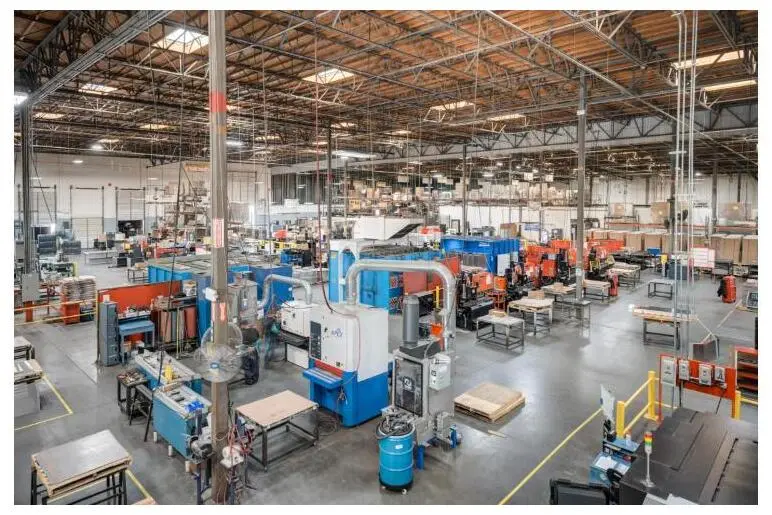
Fabcon is a US-based data center enclosure supplier. Its Southern California facility in Santa Ana provides 220,000 square feet of vertically integrated manufacturing space. The US footprint supports data center buyers with in-house design, engineering, testing, fabrication, machining, electromechanical assembly, fulfillment and logistics and customer support under one roof. That integration accelerates launches, reduces risk and supplier complexity and improves supply chain simplicity and lead time reliability. Connect with Fabcon’s Santa Ana team.
Buyer Checklist For One-Stop Enclosure Shortlists
The following questions give buyers a structured framework for evaluating prospective one-stop data center enclosure suppliers.
- Which capabilities are in-house versus partnered, specifically fabrication, finishing and electromechanical assembly?
- Does the supplier hold ISO 9001:2015, AS9100D, ITAR, UL and CSA certifications, and can it provide documentation?
- How does DFM collaboration work, and at what point in the program does it begin?
- What finishing capabilities are available in-house, including powder coat, wet paint, mil-spec coating and CARC?
- Can the supplier perform light electromechanical assembly including wiring and component integration?
- How does the supplier scale from prototype to production, and what are the minimum volume requirements?
- Where is the manufacturing facility located, and does the supplier offer JIT delivery and logistics support?
- What traceability and quality documentation comes with every build?
Fabcon satisfies this full checklist. One partner handles fabrication, finishing and assembly. The company maintains ISO 9001:2015 and AS9100D certifications, ITAR registration and UL and CSA compliance. Its US-based Santa Ana, California facility uses agile production cells that scale from prototype through production without the rigidity of large contract manufacturers. Request a program review from Fabcon.
Frequently Asked Questions
Who Are The Major Suppliers For Data Centers?
Major data center enclosure suppliers include Schneider Electric / APC, Rittal, nVent / SCHROFF, Vertiv, Eaton, Chatsworth Products / CPI, Enconnex and Flex. These OEM brands cover standard rack and enclosure SKUs with integrated power, cooling, containment and monitoring options. For custom-fabricated, integrated enclosures, Fabcon operates as a vertically integrated US precision sheet metal fabrication and assembly partner serving data center infrastructure buyers.
Who Manufactures Racks For Data Centers?
Racks for data centers come from OEM catalog brands that produce standard SKUs and from custom fabrication and integration partners that build racks, cabinets, chassis and structural frames to print. Custom fabrication partners combine precision sheet metal fabrication, CNC machining, in-house finishing and electromechanical assembly to deliver racks that are fabricated, finished, wired and assembled as single integrated units.
Who Manufactures Containerized Data Centers?
Containerized and modular data center manufacturers include Schneider Electric, Vertiv, Rittal and specialized modular data center integrators. These systems typically combine prefabricated enclosures, power distribution, cooling and monitoring into deployable units. Custom fabrication partners such as Fabcon manufacture the structural enclosures, chassis and mechanical assemblies that modular data center integrators incorporate into their systems.
What Does One-Stop Mean For A Data Center Enclosure Supplier?
A one-stop data center enclosure supplier provides the rack or cabinet plus integrated power, cooling, containment, cable management and monitoring from a single accountable partner. For custom builds, it also means that fabrication, finishing and electromechanical assembly of the enclosure occur in-house, which removes vendor handoffs, reduces PO count and provides clear quality ownership across the finished system.
When Is A Custom Data Center Enclosure Required?
A custom enclosure becomes necessary when deployments involve non-standard rack dimensions or mounting patterns, high-density or AI workloads that exceed catalog thermal and power assumptions, unique cable management or containment requirements, integration of power and cooling components into a single enclosure or structural and environmental requirements that standard catalog SKUs cannot meet. Under these conditions, a custom fabrication and integration partner provides the appropriate sourcing path.
How Do Liquid Cooling Requirements Affect Enclosure Selection?
Liquid cooling requires enclosure features that air-cooled racks do not include. These features include manifold mounting provisions, blind-mate quick-disconnect couplings with structural reinforcement, cooling hose routing with bend radius and abrasion protection, leak-detection hardware, drip collection and condensation-control provisions. Teams must resolve these requirements at the design stage, not through retrofit. Enclosure partners that support liquid-cooled deployments need the capability to fabricate and integrate these features into the structural system before finishing and assembly.
Which Certifications Should A Data Center Enclosure Fabrication Partner Hold?
Buyers should look for ISO 9001:2015 for quality management system discipline and traceability, AS9100D for aerospace-grade process rigor, ITAR registration for programs involving controlled technical data and UL and CSA compliance for safety certification recognized by Authorities Having Jurisdiction. These certifications provide documented quality controls, full traceability and support for liability management in infrastructure-critical deployments.
How Should Buyers Evaluate A Custom Enclosure Fabrication Partner?
Evaluation should cover six areas. These include DFM collaboration capability and timing, in-house finishing options such as powder coat and mil-spec coating, electromechanical assembly capability including wiring and component integration, certifications held and documentation available, prototype-to-production scaling approach and minimum volume requirements and US manufacturing footprint with logistics and fulfillment support. Partners that own all of these capabilities in-house remove the vendor handoffs that drive schedule delays and quality disputes.
Why Source One-Stop Enclosure Suppliers In The United States Or California?
US-based sourcing provides shorter and more reliable supply chains, reduced exposure to offshore logistics delays, easier engineering collaboration and made-in-America accountability for infrastructure-critical programs. California-based suppliers such as Fabcon offer proximity to West Coast data center deployments, responsive support and a domestic manufacturing footprint that simplifies compliance documentation and quality oversight.
Conclusion And Next Steps
The OEM brand tier answers which brand supplies the rack. The custom fabrication and integration tier answers how to build and integrate a custom enclosure on schedule. A one-stop data center enclosure supplier owns fabrication, finishing and electromechanical assembly of the enclosure itself. That ownership removes vendor handoffs, reduces PO count and concentrates quality accountability across the finished system.
Key decision points for buyers remain clear. Standard catalog enclosures support predictable, low-density, standard form-factor deployments. Custom-fabricated, integrated enclosures become necessary when dimensions, density, cooling or structural requirements exceed catalog capabilities. Air cooling supports deployments below the density threshold where liquid becomes mandatory. Liquid-cooled deployments require enclosure features such as manifolds, blind-mate couplings, leak detection and structural reinforcement that engineers design in from the start.
Next steps include assessing internal rack and cooling specifications, verifying supplier certifications and in-house capabilities against the checklist above and engaging a custom fabrication partner before finalizing enclosure design. Early DFM collaboration reduces rework and shortens the path from prototype to production.
Fabcon is a US-based, vertically integrated precision metal fabrication and electromechanical assembly partner with 220,000 square feet of manufacturing space, ISO 9001:2015 and AS9100D certifications, ITAR registration and a Santa Ana, California facility. The company focuses on mid-volume programs that need the sophistication of a large contract manufacturer without the rigidity, high minimums or long onboarding. Schedule a data center enclosure consultation with Fabcon.