
Last updated: July 6, 2026
Key Takeaways
- Industrial powder coating on complex welded metal assemblies depends on integrated control of fabrication, pretreatment and finishing for uniform coverage and long-term durability.
- Pretreatment processes such as abrasive blasting and zinc phosphate conversion coatings support adhesion and corrosion resistance on multi-plane frames and enclosures.
- Faraday-cage effects in recessed geometries can be reduced with robotic spray systems, high-throw powder formulations and precise voltage and angle tuning.
- Effective masking strategies protect threads, mating surfaces and functional features, which prevents assembly failures and supports clean post-coating results.
- Partnering with an integrated single-source manufacturer like Fabcon removes supply-chain handoffs, reduces risk and supports consistent quality from fabrication through final assembly.
Industrial Powder Coating Requirements for Complex Metal Assemblies
Powder coating on complex metal assemblies extends far beyond surface aesthetics. Engineers and procurement teams assess coating systems through three primary performance lenses: protection against corrosion, chemicals, moisture and UV; electrical function including dielectric strength or controlled conductivity; and thermal performance including adhesion under heat and temperature cycling.
Meeting these performance requirements depends on precise surface preparation calibrated to the specific substrate and fabrication process. When fabrication and coating are managed by separate vendors, surface preparation knowledge stays siloed. The coater does not know the alloy composition, the machining oils used or the weld geometry details. That gap produces adhesion failures, rework and delayed shipments. Integrating fabrication, coating and assembly under one partner closes that gap at the process level.
Pretreatment and Surface Preparation for Long-Term Coating Performance
Pretreatment forms the foundation of any durable powder coat. Surface blasting to the correct anchor profile for structural powder coats is non-negotiable. Finishing engineers who know the exact alloy composition and machining oils used in fabrication can calibrate a multi-stage cleaning process to each substrate.
Zinc phosphate and iron phosphate conversion coatings are standard pretreatment chemistries for welded steel assemblies. Abrasive blasting removes mill scale, weld spatter and surface oxides that chemical cleaning alone cannot address. In-house pretreatment with multi-stage chemical cleaning and abrasive blasting, calibrated to the specific substrate fabricated on-site, removes the flash-rust risk that occurs when raw parts ship to third-party coaters.
For data center and energy storage enclosures, corrosion-resistant coatings should be validated to ASTM B117 salt spray testing. Performance depends on multi-stage zinc phosphate or zirconium-based pretreatment systems. That validation remains reproducible only when pretreatment and fabrication share the same quality system.
Managing Faraday-Cage Effects on Intricate Welded Geometries
The Faraday cage effect occurs when electrostatic charge concentrates on exterior edges and repels powder from recessed areas, including inside corners, deep channels, blind pockets and internal webs. On complex welded assemblies, this effect produces thin or bare spots that fail corrosion testing and require rework.
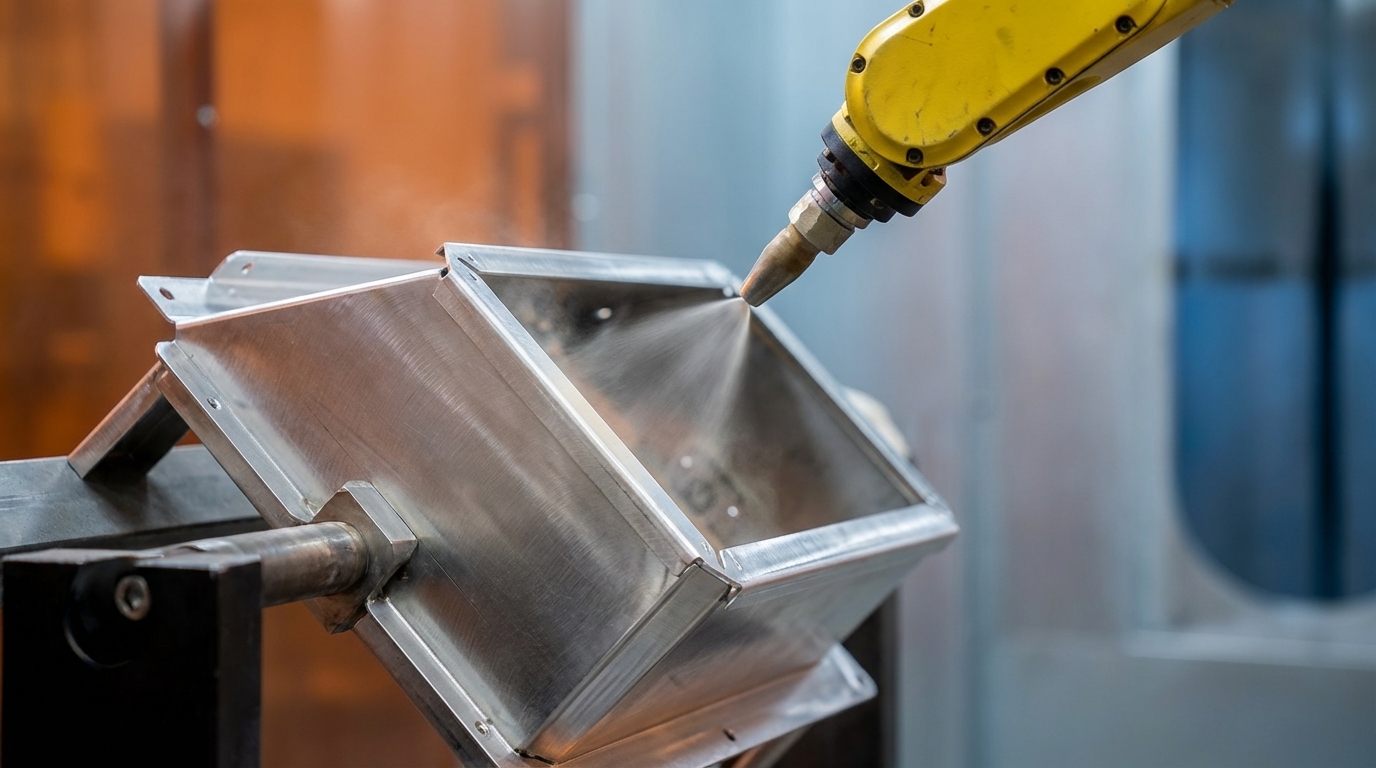
Production teams overcome the Faraday cage effect on complex weldments at scale with cobot or robotic spray systems that can angle the gun precisely into the geometry. Coaters also apply modified spray techniques, auxiliary charging electrodes or fluidized bed coating methods to improve coverage, since no single solution works for every complex geometry.
High-throw powder formulations extend electrostatic penetration into recessed areas and reduce the voltage differential that causes bare spots. Careful tuning of voltage, spray angle and powder feed rates supports consistent results across high-mix production programs.
Masking Approaches for Threads, Mating Surfaces and Functional Features
Complex assemblies include functional surfaces that must remain coating free, including threaded holes, precision bores, mating interfaces and connector ports. Coating buildup on these features causes cross-threading, misalignment and assembly failures downstream.
Silicone dual washer pull plugs and dual flange pull plugs provide coverage for both lead-in and exit threads on through holes and support easy installation and removal during powder coating preparation. Silicone tapered plugs with molded handles and EPDM tapered plugs mask blind threaded holes and compress for a tight fit across various diameters and lengths to prevent coating buildup.
On data center rack assemblies and EV structural frames, high-temperature masking tape protects large mating flanges and cable management slots. Teams should perform fit testing with part samples when masking multiple thread sizes or varying part dimensions to avoid coating defects on intricate metal assemblies. Post-coating inspection must confirm that all plugs are removed cleanly with threads fully visible and undamaged.
2026 Powder Technologies for Large Weldments and Heat-Sensitive Builds
Powder chemistry now addresses the specific demands of large welded structures and heat-sensitive assemblies. FlexCURE technology provides an extended curing window and supports lower-temperature curing or increased line speeds for metal energy-sector components. Lower cure temperatures reduce thermal stress on large weldments and protect pre-installed hardware.
Modern formulations improve edge coverage on complex geometries and reduce the likelihood of corrosion or premature coating degradation in vulnerable areas of EV, data center and energy storage components. Powder coating is solvent free and emits virtually zero VOCs, which keeps it compliant with EPA regulations and aligned with international environmental standards.
Large structural weldments act as massive heat sinks. Standard ovens create cold spots that leave portions undercured and cause premature delamination. Uniform heat distribution across the entire part geometry is required for reliable results. Oven capacity and airflow design therefore serve as critical selection criteria when teams evaluate a coating partner for large-format assemblies.
Process Sequence for Uniform Coverage on Complex Assemblies
Uniform coverage on complex welded metal assemblies follows a disciplined sequence. Each step depends on the one before it.
- DFM review: Teams evaluate part geometry for Faraday cage risk zones, drainage holes and masking access before fabrication begins.
- Substrate preparation: Teams execute the abrasive blasting and multi-stage cleaning sequence described above, matched to the alloy and fabrication process.
- Conversion coating: Teams apply the appropriate pretreatment chemistry based on substrate and performance requirements to support adhesion and corrosion resistance.
- Masking: Teams install silicone plugs, pull plugs and high-temperature tape on all threads, bores and mating surfaces before parts enter the spray booth.
- Electrostatic application: Robotics-assisted or cobot spray systems with tuned voltage, gun angle and feed rates penetrate recessed geometries and support uniform film build.
- Curing: Parts run through an oven sized for the assembly thermal mass, using low-temperature or extended-window cure profiles where heat-sensitive components are present.
- Inspection and demask: Teams verify film thickness, adhesion and salt spray compliance, then remove all masking materials and confirm functional surfaces are clean and undamaged.
Integrated Fabrication-Coating-Assembly for Supply-Chain and Quality Gains
The fastest way to reduce supply chain risk and compress manufacturing lead times for OEMs is to work with an integrated, single-source manufacturer that performs primary fabrication, secondary operations and finishing in a single facility.
OEMs that consolidate metal forming, finishing and sub-assembly under one supplier gain a single point of accountability and tighter process control across fabrication, welding, powder coating and assembly operations. In-house secondary operations performed in the same facility as forming reduce waste and lead time by removing transit delays between vendors and the associated risk of part damage.
For data center rack programs, vertical integration of metal fabrication and powder coating at a single U.S. facility removes third-party handoffs, reduces freight costs and supports consistent quality control for large-scale rollouts that require uniform finishes on racks and enclosures. For EV infrastructure frames, battery enclosures and thermal management brackets often incorporate complex geometries with internal surfaces, tight radii and blind pockets that require proper spray technique, part orientation and gun angle to avoid overcoated edges or undercoated recesses. That challenge is best managed when the fabricator and coater share the same engineering team.
For energy storage enclosures and traffic safety structures, vertical integration provides unified accountability under PPAP standards. A single quality lab oversees both weld structural integrity and coating thickness, which prevents blame shifting between fabricator and coater.
Get a quote and consolidate fabrication, coating and assembly under one accountable partner.
Scorecard for Evaluating Integrated Powder-Coating Partners
Selecting an integrated fabrication-coating-assembly partner requires evaluation of capabilities across the full production sequence, not just the coating step.
In-house pretreatment: The partner must operate its own multi-stage chemical cleaning and abrasive blasting lines. Outsourced pretreatment breaks the substrate knowledge chain and reintroduces flash-rust risk.
Oven capacity for large frames: Teams should confirm that the curing oven accommodates the largest assembly in the program. Undersized ovens force disassembly into weaker sub-assemblies or produce cold spots that cause delamination.
DFM collaboration depth: Early DFM reviews by an integrated partner can remove custom tooling lead times, reduce complex machine setups and swap long-lead components for standard alternatives before production begins. A partner that engages at the design stage reduces rework across the entire program.
Quality certifications: ISO 9001:2015 certification establishes a documented quality management system. AS9100D certification adds aerospace-grade traceability and process control requirements applicable to any high-stakes infrastructure program. Both certifications should cover fabrication and finishing under the same quality system.
Scalable mid-volume production: The partner must support prototype quantities and scale to mid-volume production without rigid minimums or lengthy re-onboarding. Domestic metal fabrication partners reduce dependency on overseas logistics and improve delivery timelines, production predictability and response to demand changes.
Light electromechanical assembly: For programs that include wiring harnesses, hardware insertion or component integration, the partner must perform assembly in the same facility. Shipping coated assemblies to a separate integrator reintroduces handling damage and scheduling risk.
Frequently Asked Questions
Does integrating fabrication and powder coating under one partner increase program cost?
Total program cost serves as the relevant metric, not piece-part price. Separate vendors for fabrication, coating and assembly generate freight charges, redundant incoming inspection holds, rework from transit damage and administrative overhead across multiple purchase orders. An integrated partner removes those costs. Programs with complex welded assemblies often see significant total-cost benefits because coordination needs across separate vendors increase for those parts.
Can an integrated partner scale from prototype to mid-volume production without rigid minimums?
Fabcon is purpose built for this transition. Agile production cells adapt to changing volumes, mixed SKUs and evolving bills of materials without the high minimums or long re-onboarding cycles associated with large contract manufacturers. Prototype builds use the same quality system and process documentation as production runs, so the transition becomes a volume change, not a process restart.
What if an existing metal fabrication supplier is already qualified?
Most metal fabrication shops stop at sheet metal. They do not operate in-house powder coating lines, perform light electromechanical assembly or provide DFM collaboration that spans fabrication and finishing together. Qualifying Fabcon as a single integrated source reduces vendor count, removes handoff risk and provides a single point of accountability for quality and delivery across the full assembly.
How does Fabcon maintain coating quality across high-mix programs with varying geometries?
Fabcon engineering and finishing teams review part geometry during DFM and identify Faraday cage risk zones, masking requirements and pretreatment needs before production begins. ISO 9001:2015 and AS9100D certified quality systems govern every stage of the build and provide full traceability and consistent process documentation across all part numbers in a high-mix program.
Next Step: Simplify Complex Assembly Programs with One Partner
Complex metal assemblies for data center infrastructure, EV frames, energy storage enclosures and traffic safety structures demand consistent pretreatment, precise masking, Faraday-cage-aware application and curing systems sized for large weldments. Managing those requirements across separate fabrication, coating and assembly vendors creates avoidable risk at every handoff.
Fabcon delivers all of those capabilities under one roof at two U.S. facilities, backed by ISO 9001:2015 and AS9100D certifications and 45 years of precision fabrication experience. One partner. One quality system. Full accountability from raw material through finished assembly.