
Last updated: July 8, 2026
Key Takeaways
- Fragmented vendor models for fabrication and powder coating create handoff delays, quality disputes and schedule misalignment for infrastructure manufacturers.
- Vertically integrated partners consolidate laser cutting, forming, welding, in-house powder coating and assembly under one roof, which removes logistics steps and communication gaps.
- Buyers should validate partners through certifications like ISO 9001:2015, AS9100D, ITAR registration, PCI 4000 and full part traceability to support infrastructure-grade compliance.
- Early design-for-manufacturability reviews by integrated teams prevent coating issues on mating surfaces and reduce costly downstream rework.
- Infrastructure manufacturers in the Southwest can reduce vendor risk and improve lead-time reliability by partnering with Fabcon for integrated fabrication and finishing services.
How Vertically Integrated Fabrication and Finishing Reduces Risk
A vertically integrated fabrication and finishing partner consolidates laser cutting, forming, welding, in-house powder coating and mechanical assembly under one roof. This structure removes the logistics step of shipping fabricated parts to an outside coater. It also closes the communication gap between the engineer who designs the part and the coater who finishes it.
For infrastructure OEMs, the practical benefit is one purchase order covering fabrication, finishing and assembly. Quality ownership stays with a single partner. Change orders move through one system rather than several separate vendors. That structure reduces vendor handoff delays and quality disputes that often slow fragmented supply chains.
Explore how Fabcon’s integrated model eliminates vendor handoffs for infrastructure programs.
How an Integrated Fabrication and Coating Partner Operates
An integrated partner engages engineering teams before production begins. Design-for-manufacturability review covers tolerances, material selection, weld placement and coating specifications at the same time. Specifying powder coating requirements such as color, gloss, texture, film thickness, masking and uncoated surfaces during design and quoting prevents coating buildup issues that affect fit, assembly and mating surfaces.
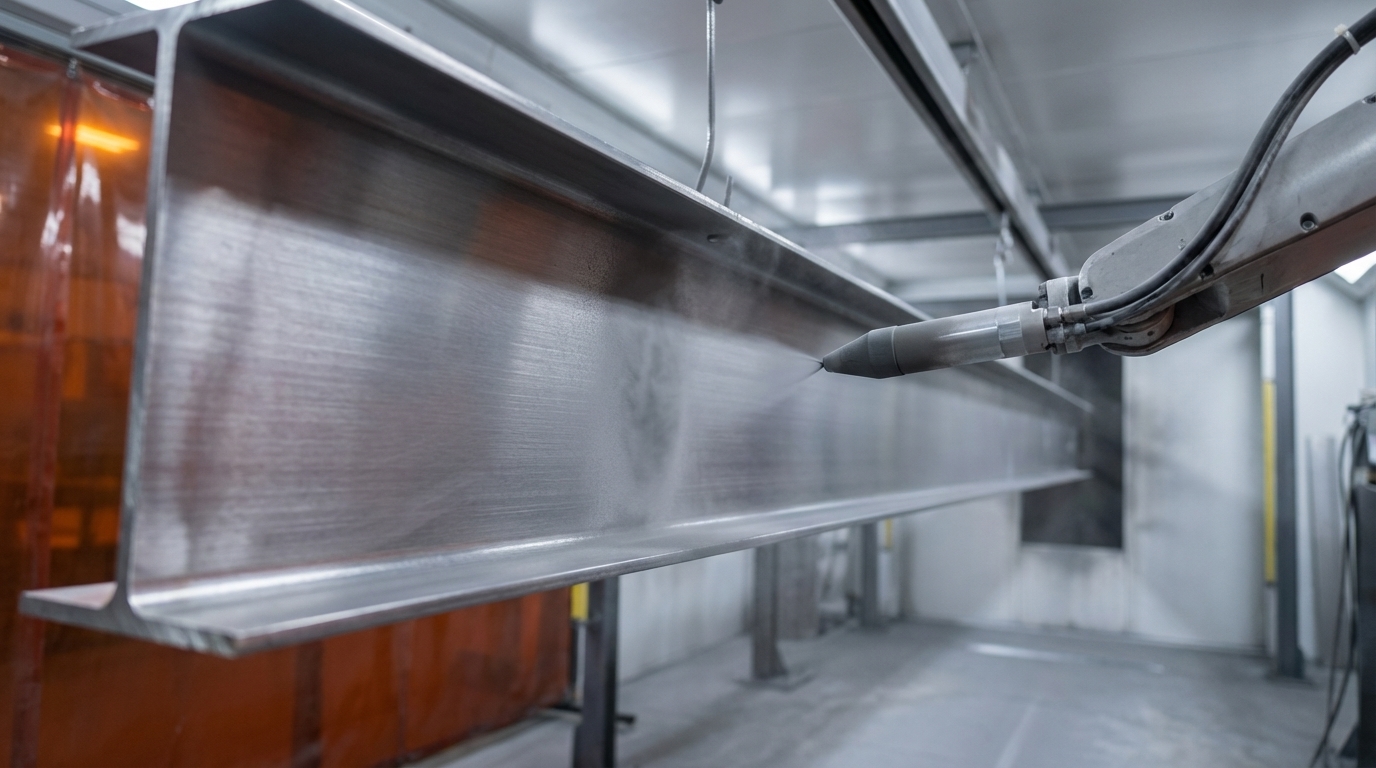
After fabrication, parts move directly into the finishing line without leaving the facility. In-house powder coating allows components to move from fabrication and hardware insertion into finishing without an additional supplier, transport step or communication handoff. Assembly follows finishing in the same controlled environment, which maintains dimensional accuracy and cosmetic standards through the final build stage.
Key Validation Signals for Infrastructure-Grade Partners
Evaluating an integrated partner requires more than a capabilities list. Buyers sourcing for infrastructure programs need documented evidence of process control and compliance. The following signals indicate a partner prepared to meet infrastructure-grade requirements.
- ISO 9001:2015 certification covering the full manufacturing system, not just fabrication
- AS9100D certification for programs that require aerospace-grade traceability and process discipline
- ITAR registration for defense-adjacent infrastructure work
- Full part traceability from raw material receipt through finished assembly, supported by serialization and documented inspection records
- PCI 4000 certification for OEMs that apply powder coatings internally, which confirms integration of coating processes with pretreatment, application, curing, production flow and quality management systems
- UL and CSA compliance for electrical enclosures and utility equipment
- Documented change-control processes that carry engineering revisions across fabrication, coating and assembly without version mismatches
Aligning Design with Manufacturing and Coating
Design-to-manufacturing disconnect often drives cost in infrastructure programs. When a fabricator and a coater operate independently, neither team has full visibility into how the other process affects the finished part. Coating buildup on threaded inserts, masked grounding points and mating surfaces often appears late, after parts have already been fabricated and shipped.
An integrated partner resolves this risk with DFM review before quoting. Engineering and production teams evaluate drawings together and flag coating-sensitive features early. That front-loaded DFM collaboration, described earlier, reduces rework and keeps prototype-to-production transitions predictable.
Consolidating Vendors for Simpler Sourcing
Centralizing fabrication and finishing under one supplier reduces the hidden multipliers of logistics and quality risk that increase total cost of ownership. For supply chain teams that manage high-mix infrastructure programs, vendor consolidation also reduces administrative load. Fewer supplier qualifications, fewer incoming inspections and fewer points of failure in the delivery chain result.
The one-PO model is operationally significant because it consolidates accountability. A single contract governs scope, quality standards and delivery terms across fabrication, powder coating and assembly, which reduces the coordination overhead of multiple vendor agreements. This unified ownership structure also removes a common pain point, since disputes over which vendor caused a defect become irrelevant when one partner owns the entire build.
Maintaining Coating Quality and Regulatory Compliance
Thermoset powder coatings account for most of the global powder coatings market. Their durability, corrosion resistance and permanent hardened finish suit structural steel and infrastructure components. Selecting the right formulation for outdoor utility enclosures, traffic-safety poles or structural frames requires coating knowledge that connects directly with fabrication knowledge.
Standalone coaters apply what customers specify. Integrated partners advise on specification and connect it to part design. That distinction matters for large part powder coating in Southwest climates, where UV exposure, thermal cycling and moisture demand formulations matched to the service environment. Quality management systems that span fabrication and finishing help coating thickness, adhesion and surface preparation meet program requirements across production runs.
Scaling Production with Flexible Capacity
Infrastructure programs rarely scale in a straight line. Prototype volumes shift to pilot runs, then move into production quantities that change with project awards or regulatory timelines. Large contract manufacturers handle scale but often impose high minimums and rigid onboarding. Small job shops handle low volumes but lack finishing and assembly infrastructure to support growth.
Integrated mid-tier partners use flexible production cells that adapt to changing volumes and mixed SKUs without program restarts. This structure supports infrastructure OEMs that move from prototype to mid-volume production while maintaining responsiveness that large contract manufacturers often cannot match.
See how Fabcon’s flexible production cells support programs from prototype to mid-volume production.
Improving Lead-Time Reliability with In-House Coating
Secondary finishing steps such as powder coating often drive lead time because many shops outsource them. When fabrication and coating operate in the same facility, parts move between processes on internal schedules instead of third-party queues.
Lead-time reliability also depends on communication. When a fabrication delay occurs, an integrated partner can adjust the coating schedule internally. When a standalone coater receives parts late, the delay can compound through a separate queue. Internal integration reduces that exposure and gives program managers more accurate delivery visibility.
Comparing Vendor Models for Infrastructure Programs
Low-complexity job shops handle basic sheet metal fabrication efficiently. These transactional, build-to-print operations stop at the metal. They do not provide DFM collaboration, in-house powder coating or assembly. Infrastructure OEMs that use them must manage separate vendors for every downstream step, which distributes quality accountability and extends total program lead time.
Large global contract manufacturers offer scale and sophisticated infrastructure but often require high minimum volumes, long onboarding cycles and rigid program structures. They suit high-volume, stable programs. Infrastructure OEMs with high-mix, evolving bills of material or mid-volume requirements often find that large contract manufacturers cannot adapt without added overhead cost and schedule impact.
Mid-tier integrated partners occupy the space between those extremes. They provide engineering collaboration, in-house finishing and assembly and flexible production cells without the minimums or rigidity of large contract manufacturers. For corrosion-resistant powder coating utilities and structural infrastructure programs in the Southwest, that combination addresses sourcing challenges that job shops and large contract manufacturers leave unresolved.
Risks, Limitations and Due-Diligence Checklist
Integrated partners do not fit every program. Programs with extremely high volumes may benefit from dedicated lines at large contract manufacturers. Programs that require only simple sheet metal with no finishing or assembly may find a job shop sufficient. Buyers should evaluate fit carefully before committing to a transition.
Due diligence for an integrated fabrication and finishing partner should cover the following areas.
- Facility capacity: square footage, equipment redundancy and current utilization compared with program volume requirements
- Coating line specifications: oven size, pretreatment chemistry and capability for large part powder coating in Southwest program dimensions
- Change-control process: how engineering revisions move from design through fabrication, coating and assembly without version mismatches
- Quality system documentation: ISO and AS9100D certificates, audit history and traceability records available for review
- Site visit: direct observation of production flow, finishing line and assembly area to confirm integration claims
- Reference programs: evidence of comparable infrastructure programs such as enclosures, structural frames and utility equipment completed at similar volumes
- Transition support: documented onboarding process for transferring existing programs without disrupting active production schedules
Frequently Asked Questions
What infrastructure components benefit most from integrated fabrication and powder coating?
Integrated fabrication and powder coating suits components that require structural precision and durable surface protection. Enclosures, structural frames, traffic-safety poles and brackets, utility equipment housings and data center racks all benefit from alignment between fabrication tolerances and coating specifications. Components with tight mating surfaces, grounding requirements or complex masking needs gain the most from DFM collaboration that addresses coating requirements before production.
What certifications matter most for infrastructure-focused powder coating partners?
Infrastructure OEMs should require ISO 9001:2015 as a baseline quality management certification that covers the full manufacturing system. Programs with defense or aerospace adjacency benefit from AS9100D certification and ITAR registration. For powder coating, PCI 4000 certification confirms that coating processes integrate with pretreatment, curing and quality management systems for OEMs that apply coatings internally. UL and CSA compliance supports electrical enclosures and utility equipment. Full part traceability documentation that covers raw material, fabrication, coating and assembly supports audit requirements in utilities, energy and telecom sectors.
How complex is a transition from fragmented vendors to an integrated partner?
Transition complexity depends on program maturity and documentation quality. Programs with complete drawings, bills of materials and defined coating specifications transfer more smoothly. Integrated partners with engineering teams can review existing documentation, identify gaps and run DFM analysis before production. The transition typically includes a qualification run to validate tolerances, coating adhesion and assembly fit before full production transfer. Buyers should request a documented onboarding process and reference programs of similar complexity.
Can an integrated partner support both prototype and production volumes without high minimums?
Mid-tier integrated partners that use flexible production cells can support programs from prototype through mid-volume production without the high minimums that large contract manufacturers often require. The key differentiator is production cell flexibility, which allows small quantities of multiple SKUs without retooling or setup costs that make low-volume runs uneconomical. Buyers should confirm that a partner’s cell structure and scheduling system can support the volume range and mix variability of the program.
What powder coating formulations suit outdoor infrastructure in Southwest climates?
Outdoor infrastructure in Southwest climates faces UV exposure, high ambient temperatures and thermal cycling that degrade standard powder coatings faster than moderate climates. Thermoset formulations with super-durable polyester resins are commonly specified for structural and utility applications that require long service life and color retention. Corrosion-resistant primer systems applied before topcoat are standard for steel substrates in outdoor service. An integrated partner with coating engineering capability can recommend formulations matched to the service environment, substrate and performance requirements of each program.
When an Integrated Partner Delivers the Most Value
An integrated fabrication and finishing partner delivers the most value when a program requires consistent quality across fabrication, coating and assembly. DFM collaboration helps prevent downstream rework. Lead-time reliability improves when third-party finishing queues no longer control schedules. Vendor consolidation also supports supply chain priorities when scaling flexibility matters more than raw volume capacity.
The evaluation framework stays simple. If a program involves structural or enclosure components that require corrosion-resistant powder coating for utilities or infrastructure applications, and the current vendor model uses separate fabricators, coaters and assemblers, the total cost of that fragmentation in delays, quality disputes and coordination overhead often exceeds the cost of consolidation.
Fabcon is a vertically integrated precision metal fabrication and finishing partner that operates from manufacturing space across two Southern California facilities. Founded in 1977, Fabcon holds ISO 9001:2015 and AS9100D certifications and maintains ITAR registration. In-house capabilities span laser cutting, forming, welding, CNC machining, powder coating, wet paint and electromechanical assembly. All work occurs under one roof on one purchase order with full traceability from raw material through finished assembly.
Infrastructure manufacturers in the Southwest that source fabrication and powder coating for structural steel infrastructure, enclosures, traffic-safety components and utility equipment can engage Fabcon from prototype through mid-volume production without high minimums or rigid onboarding. Start the conversation about fabrication and finishing requirements.