
Key Takeaways
- Electromechanical assembly integration combines electrical components, wiring, mechanical enclosures and control systems into deployment-ready units that keep U.S. infrastructure and technology projects on schedule.
- Early ECAD/MCAD co-design, DFM collaboration and vertically integrated manufacturing reduce costly late-stage changes and improve traceability for regulated industries.
- One-roof capabilities in fabrication, finishing, wiring and testing remove vendor handoffs, compress lead times and strengthen quality accountability across the build.
- ISO 9001:2015, AS9100D and ITAR certifications, combined with agile production cells, position partners to support aerospace, defense, data center, EV and energy storage programs from prototype through mid-volume.
- Fabcon supports electromechanical assembly programs with integrated fabrication, finishing and testing under one U.S. roof.
ECAD/MCAD Co-design for Early Cost Control
Electromechanical integration starts before a single part is cut. Electrical CAD and mechanical CAD teams work from a shared model so enclosure geometry, PCB placement, connector routing and thermal management align from the start.
Seventy to 80 percent of a product lifecycle cost is set during early design decisions, so early co-design carries the greatest influence on program outcomes. When ECAD and MCAD teams operate in silos, tolerance stack-ups, connector accessibility conflicts and cable routing errors surface late, at a cost that can be ten times higher to correct during assembly than during design review.
A vertically integrated partner embeds DFM collaboration at this stage. Fabcon engineering and quoting teams review drawings, tolerances and materials before production begins, then generate manufacturing routers and work instructions aligned with the production floor. For aerospace and defense programs, this phase also incorporates AS9100D traceability requirements and ITAR documentation controls.
Hardware Interconnection Within the Four-Phase Flow
Once the co-designed model is validated, the next phase converts electrical and mechanical specifications into physical connections. Cable and wire harness assembly provides the interconnections in electromechanical systems, routing power and signals between PCBs, displays, power supplies, sensors, motors and external interfaces. Controlled processing, crimp validation and continuity testing act as standard quality gates at this phase.
DFM collaboration during interconnection focuses on reducing unique connector and cable types, improving cable manufacturability and designing assemblies that avoid force-fitting or field rework. Recognized DFM topics between OEMs and EMS providers include tolerance stack-ups, connector accessibility and component availability.
When fabrication, wiring and harness work share one facility, engineering feedback loops close faster. Issues caught at the interconnection stage do not require shipping parts between vendors or waiting on third-party schedules.
Component Mounting That Reflects Co-design Decisions
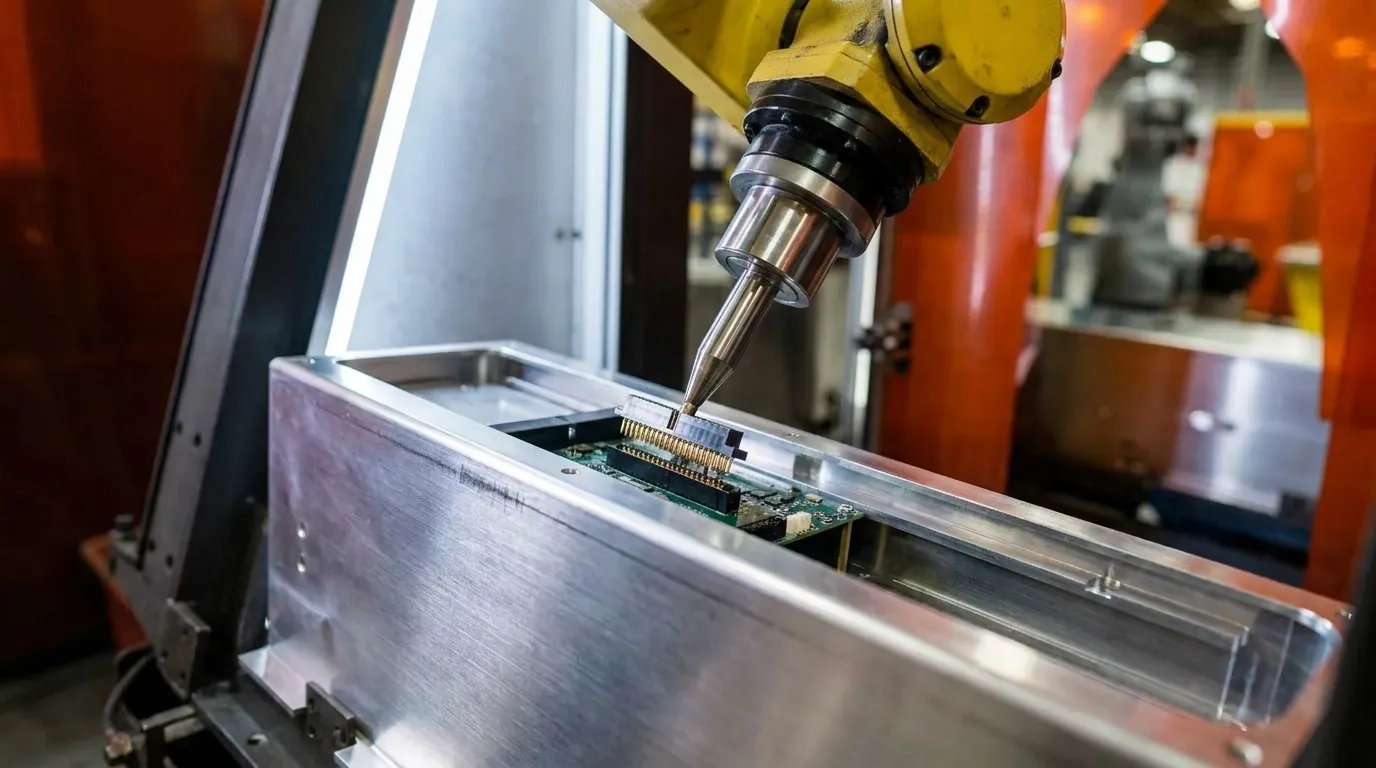
Key production activities in electromechanical assembly include torque-controlled fastening, precision mechanical assembly and integration of switches, relays, sensors and control components. Component mounting translates the co-designed model into a physical assembly that meets dimensional, thermal and vibration requirements.
Effective assembly design applies DFA principles including minimizing part count, making parts self-locating and controlling tolerance stack-up early. For high-mix programs, these principles reduce changeover complexity and support consistent output across varying SKUs.
In-house CNC machining supports this phase directly. When machined components for enclosures, racks and chassis are produced in the same facility as the sheet metal and assembly work, dimensional accuracy improves and the coordination overhead of managing separate machine shops disappears.
Testing and Validation of Integrated Assemblies
With components mounted and interconnected, the assembly moves into validation. A two-stage testing cycle consisting of ICT followed by FCT reduces costly failures before the product reaches the final recipient, with ICT measuring electrical parameters and FCT validating operation under simulated real-world conditions.
System-level validation for infrastructure applications may also include high-potential testing, grounding verification, ingress protection testing and vibration resistance checks. Validation steps include labeling, identification and documentation for traceability, plus functional testing and quality verification to ensure compliance and performance.
Fabcon maintains an ISO 9001:2015 and AS9100D certified quality management system with integrated QA spanning the entire build. Every stage generates traceable documentation that satisfies regulatory requirements in medical device, aerospace and defense programs.
Electromechanical Integration in Infrastructure Projects
The four-phase integration process applies across infrastructure sectors, each with distinct requirements for enclosure design, interconnection complexity and compliance. The following examples show how co-design, interconnection, mounting and validation address sector-specific challenges.
Data center enclosures require modular, rack-mounted structures that integrate cable management, power distribution and thermal systems. Highly modularized data center projects achieve schedule reductions of 30% to 50% compared to conventional projects through off-site fabrication and integrated assembly. Fabcon supports this model with in-house fabrication, finishing and electromechanical assembly for enclosures and structural systems.
EV charging cabinets demand weatherproof enclosures with integrated power electronics, wiring harnesses and control interfaces. Compliance with UL and CSA standards sets the baseline, and single-PO accountability reduces the coordination risk that fragmented vendor models introduce.
Traffic safety structures combine precision sheet metal fabrication with hardware integration for control cabinets, signal housings and roadside enclosures. Durability, dimensional consistency and compliance with infrastructure-grade specifications drive partner selection in this segment.
Energy storage systems require enclosures with electromechanical integration for battery management, power conversion and thermal control. Box build integration under one roof consolidates mechanical integration with thermal management systems and final high-potential and grounding tests to achieve required ingress protection and vibration resistance.
Selecting an Electromechanical Assembly Integration Partner
Certification scope acts as a baseline filter. ISO 9001:2015 confirms a documented quality management system. AS9100D extends that framework to aerospace and defense requirements, adding risk management, configuration control and first-article inspection disciplines. ITAR registration is mandatory for programs involving controlled defense-related technical data. Rising demand for secure ITAR-compliant defense production has redirected electronics contracts to domestic EMS plants.
In-house finishing and light assembly capabilities determine whether a partner delivers a complete, compliant product or only a fabricated shell. Partners with powder coat, wet paint, mil-spec coating, hardware insertion and wiring under one roof remove the handoffs that introduce quality risk and schedule variance.
Agile production cells matter for mid-volume, high-mix programs because they avoid the constraints of both large contract manufacturers and small job shops. Large contract manufacturers typically require high minimum volumes and long onboarding cycles, which limits suitability for programs with variable demand. Job shops lack the engineering depth for DFM and cannot manage complex system integrations, which leaves a capability gap. A partner with flexible manufacturing cells fills this middle ground and adapts to changing volumes, mixed SKUs and evolving bills of materials without the overhead rigidity of either extreme.
Single-PO accountability simplifies program management. Hybrid and turnkey frameworks in the U.S. EMS market are advancing as OEMs seek single-invoice solutions covering materials, assembly and regulatory documentation.
Common Integration Challenges and Integrated Solutions
Design-to-manufacture disconnects occur when engineering teams finalize drawings without input from the manufacturing floor. The result is rework, quoting delays and designs that cannot scale. Early DFM collaboration, where manufacturing engineers review tolerances and materials before drawings are frozen, closes this gap. The DFM collaboration described earlier directly addresses this disconnect, because the cost-reduction opportunity identified during co-design becomes actionable when production teams review designs before release.
Fragmented supply chains force program managers to coordinate separate vendors for metal fabrication, coatings, wiring and assembly. Each handoff introduces schedule risk and dilutes quality accountability. Siloed responsibility across multiple vendors creates extended timelines and finger-pointing when issues arise. One-roof integration removes these handoffs by design and concentrates responsibility with a single accountable partner.
Scaling inflexibility affects programs moving from prototype to mid-volume production. Rigid production lines cannot accommodate BOM changes or volume fluctuations without costly retooling or minimum-order penalties. Agile production cells built for high-mix programs support this transition without the constraints of large contract manufacturers.
One-Roof Integration Benefits for Program Teams
One-roof integration consolidates fabrication, finishing, wiring and assembly under a single accountable partner. This approach reduces vendor handoffs and improves quality traceability across all build stages. Cross-functional DFM review occurs before production begins. The partner manages end-to-end execution instead of requiring customer coordination across multiple vendors.
Explore how Fabcon integrated capabilities apply to upcoming electromechanical assembly programs.
Frequently Asked Questions
What is the difference between a job shop and a vertically integrated electromechanical assembly provider?
A job shop typically handles a single process, such as sheet metal cutting, forming or welding, and builds to print without engineering input or downstream assembly capability. A vertically integrated provider manages fabrication, finishing, wiring and assembly under one roof, with engineering teams that collaborate on DFM before production begins. The practical difference appears in vendor count, accountability and the ability to deliver a complete, compliant product rather than a component that requires further integration elsewhere.
What does AS9100D certification mean for an electromechanical assembly program?
AS9100D is the aerospace and defense quality management standard that builds on ISO 9001:2015 with additional requirements for risk management, configuration control, first-article inspection and counterfeit-part prevention. For program managers in aerospace, defense and adjacent sectors, AS9100D certification confirms that a manufacturer quality system meets the documentation, traceability and process control disciplines those industries require. Many defense and aerospace supply chains treat AS9100D as a baseline requirement.
How does integrated finishing and assembly affect total program risk?
Integrated finishing and assembly reduce total program risk by keeping the quality record continuous. When finishing and assembly occur at separate facilities, each transfer introduces schedule uncertainty, handling damage risk and a gap in quality traceability. If a defect is discovered after the product has moved between vendors, root-cause analysis becomes a negotiation rather than an internal investigation. Integrated finishing and assembly reduce handling events and give a single partner accountability for the complete build, which compresses both resolution time and program risk.
What industries benefit most from electromechanical assembly integration?
Industries with complex enclosures, regulatory compliance requirements and mid-volume production programs gain the most benefit. Data centers, energy storage, EV infrastructure, traffic safety, medical devices, aerospace and defense and industrial OEM manufacturing all share a need for precision fabrication combined with wiring, hardware integration and validated testing. These sectors also face the design-to-manufacture disconnects and scaling challenges that one-roof integration directly addresses.
How does reshoring affect electromechanical assembly partner selection?
Reshoring trends increase domestic demand for integrated assembly partners. Federal investment through the Infrastructure Investment and Jobs Act, Inflation Reduction Act and CHIPS Act has catalyzed domestic manufacturing capacity, and OEMs are consolidating supply chains around U.S.-based partners to reduce geopolitical risk and meet domestic-content requirements. A U.S.-based vertically integrated partner with certified quality systems and ITAR registration is positioned to support these programs without the supply chain exposure of offshore or multi-country vendor networks.
Conclusion: Integrated Electromechanical Assembly Under One Roof
Electromechanical assembly integration follows a four-phase process of ECAD/MCAD co-design, hardware interconnection, component mounting and testing and validation, where the quality of each phase depends on coordination between the ones before it. Fragmented vendor models introduce handoffs that erode that coordination. One-roof integration, early DFM collaboration and certified quality systems form the evaluation criteria that separate capable partners from transactional suppliers.
Fabcon brings fabrication, finishing and electromechanical assembly together under one U.S. roof, with ISO 9001:2015, AS9100D and ITAR credentials supporting programs from prototype through mid-volume production. Engineering teams seeking to reduce vendor complexity, improve DFM outcomes and scale with confidence have a direct path forward.