
Key Takeaways
- Data center cabinet design must address rising rack densities driven by AI workloads, which demand advanced structural, thermal and electrical engineering.
- Standards such as EIA-310-E and IEC 60297 define critical mounting interfaces, while UL 2416 and Telcordia GR-63-CORE guide safety and seismic performance.
- Key design factors include welded or bolted frames, high-perforation doors for airflow, liquid cooling provisions and well-planned cable management pathways.
- Manufacturing relies on vertically integrated processes, including DFM review, CNC cutting, robotic welding, powder coating and final electromechanical assembly.
- Partner with Fabcon for custom data center cabinet design and manufacturing that scales from prototype to production.
Data Center Cabinet Fundamentals, Definitions and Standards
A data center cabinet is a precision metal enclosure that houses servers, networking equipment and power distribution units in a standardized 19-inch rack format. It provides structural support, thermal management, cable routing and physical security for critical IT infrastructure.
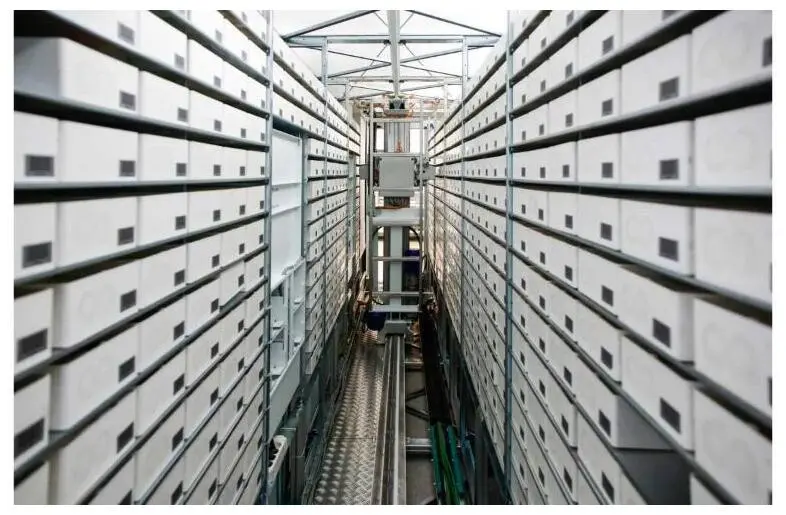
Two standards define how equipment mounts inside a cabinet and shape the dimensions engineers must follow.
- EIA-310-E defines the 19-inch (482.6 mm) rack mounting interface, a rack unit (1U) height of 44.45 mm (1.75 in) and a repeating hole spacing pattern of 0.625 in, 0.625 in and 0.500 in every 3U. The horizontal distance between vertical mounting rails is 18.312 in (465.1 mm), which distinguishes nominal rack width from actual rail-to-rail spacing.
- IEC 60297 covers the same 482.6 mm mechanical structure but specifies only equipment mounting interface dimensions, not cabinet outer width or depth. Outer dimensions remain configurable to project requirements.
Common cabinet heights are 42U (73.5 in internal), 45U and 48U (84 in internal). After accounting for PDUs and cabling, usable space is typically several rack units less than the nominal height. Typical static load ratings for 42U cabinets range from 2,000 to 3,000 lbs (907–1,361 kg), while dynamic ratings are lower. That distinction matters whenever a populated rack is repositioned.
The difference between a cabinet and a rack is functional. Cabinets are enclosed with doors and side panels, which enables directed airflow, IP40+ protection and physical security compliance. Open-frame racks offer unrestricted airflow but no dust or physical security protection. Wall-mount enclosures (typically 6U–18U) suit branch offices and wiring closets.
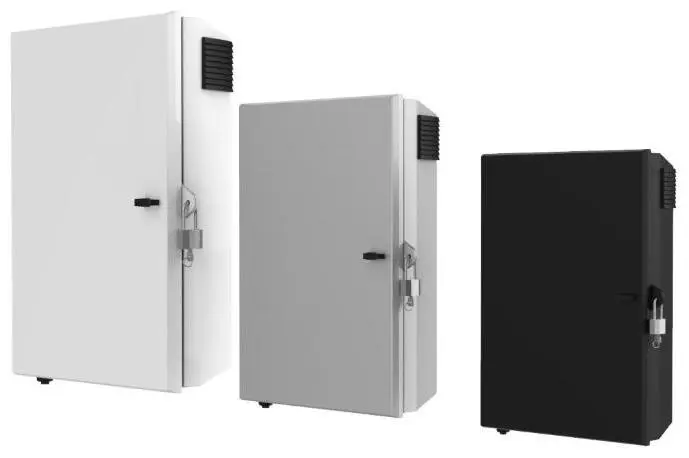
Discuss custom cabinet design that meets EIA-310 and IEC 60297 standards.
With the standards established, the next step is translating them into practical design decisions.
Key Design Considerations for Data Center Cabinets
Early cabinet design decisions determine thermal performance, structural reliability and manufacturability at scale. Each core factor benefits from explicit engineering attention.
Structural Integrity
Frame construction affects load paths, shipping volume and serviceability. A welded frame delivers direct load-transfer paths and minimizes field-assembly joints, while a bolted frame reduces freight footprint but makes fastener torque control and joint slip critical structural considerations. Material thickness should match actual load cases, with heavier gauges reserved for uprights, crossmembers, mounting rails and base reinforcement plates.
Thermal Management
High-density deployments may require front and rear cabinet doors with up to 80% open perforation to maintain adequate cold-aisle to hot-aisle airflow, though standard-density cabinets typically use 64-70% open area. Door open-area percentage is a geometric metric, not a thermal acceptance metric. Two doors both rated at 70% open area can deliver significantly different pressure-drop performance depending on hole geometry, louver depth, filter media and stiffener ribs.
Full hot-aisle or cold-aisle containment has demonstrated 20-40% cooling power reduction at typical enterprise densities. Per ASHRAE 90.4, this typically reduces PUE by 0.1 to 0.3 points. ASHRAE Technical Committee 9.9 recommends a server inlet temperature of 18–27 °C. Every unused rack unit without a blanking panel can raise inlet temperatures measurably through hot-air recirculation.
Liquid cooling integration adds specific design requirements. Manifold assemblies need mounting brackets, frame stiffness requirements and clearance zones; quick-disconnect couplings need local structural reinforcement and hand-working clearance; and leak-detection hardware needs base-tray geometry and drainage provisions.
Thermal performance also depends on how cables are routed, since poor cable management can block airflow.
Cable Management
TIA-568 specifies a minimum cable bend radius of 4x the cable diameter for copper and 10–20x for fiber. Exceeding these limits degrades signal quality. Vertical and horizontal pathways should be designed into the cabinet, not retrofitted. Power and data cables require physical separation to limit electromagnetic interference.
Power Distribution
Zero-U vertical PDU mounting preserves rack unit space, which matters when every U counts. Because colocation and compliance frameworks require redundancy, dual A+B feeds should each support the full load independently. Designing PDU load at 80% of rated capacity leaves headroom for startup power spikes.
Accessibility
Enclosed cabinets require a minimum 36-inch aisle clearance for door swing, and removable side panels with front-and-rear door access make maintenance practical in populated environments. Because drawings can miss real-world obstructions, service access should be verified after the cabinet is placed in its final position.
High-density AI and GPU deployments push these requirements further. GPU-based systems introduce higher power densities, unique thermal profiles and increased weight loads that extend beyond standard rack dimensions and mounting approaches. These factors drive wider footprints, deeper cabinets and reinforced base structures.
Bring DFM questions to Fabcon’s engineering team early in a data center cabinet program.
How Data Center Cabinets Are Manufactured Step by Step
Data center cabinet manufacturing spans multiple precision disciplines. Fabcon performs a broad range of steps in-house across vertically integrated facilities, including design, engineering, testing, fabrication, machining, electromechanical assembly, fulfillment and logistics.
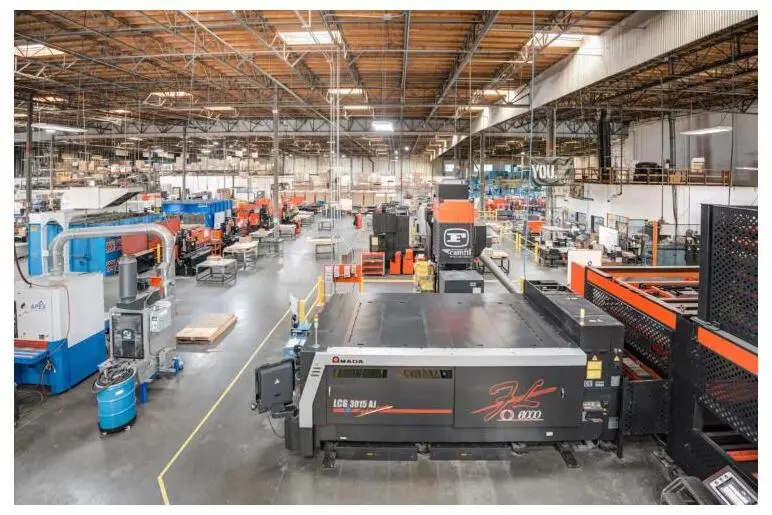
- Design and Engineering: Fabcon’s engineering and quoting teams review drawings, tolerances and materials before production begins. DFM review identifies manufacturability issues, refines designs for the production floor and creates manufacturing routers aligned to actual process capabilities.
- Material Selection: Material choice is driven by load requirements, environment and finish. Cold-rolled steel (SPCC) provides cost-effective rigidity for load-bearing frames. Galvanized steel (SGCC) adds corrosion resistance for selected sub-components. Stainless steel 304 or 316 suits corrosive environments, while aluminum 5052 reduces weight for applications where mass is a constraint.
- Cutting: CNC laser cutting controls hole tolerances within tight limits for mounting holes, ventilation patterns and connector windows. CNC punching handles high-volume panel production efficiently.
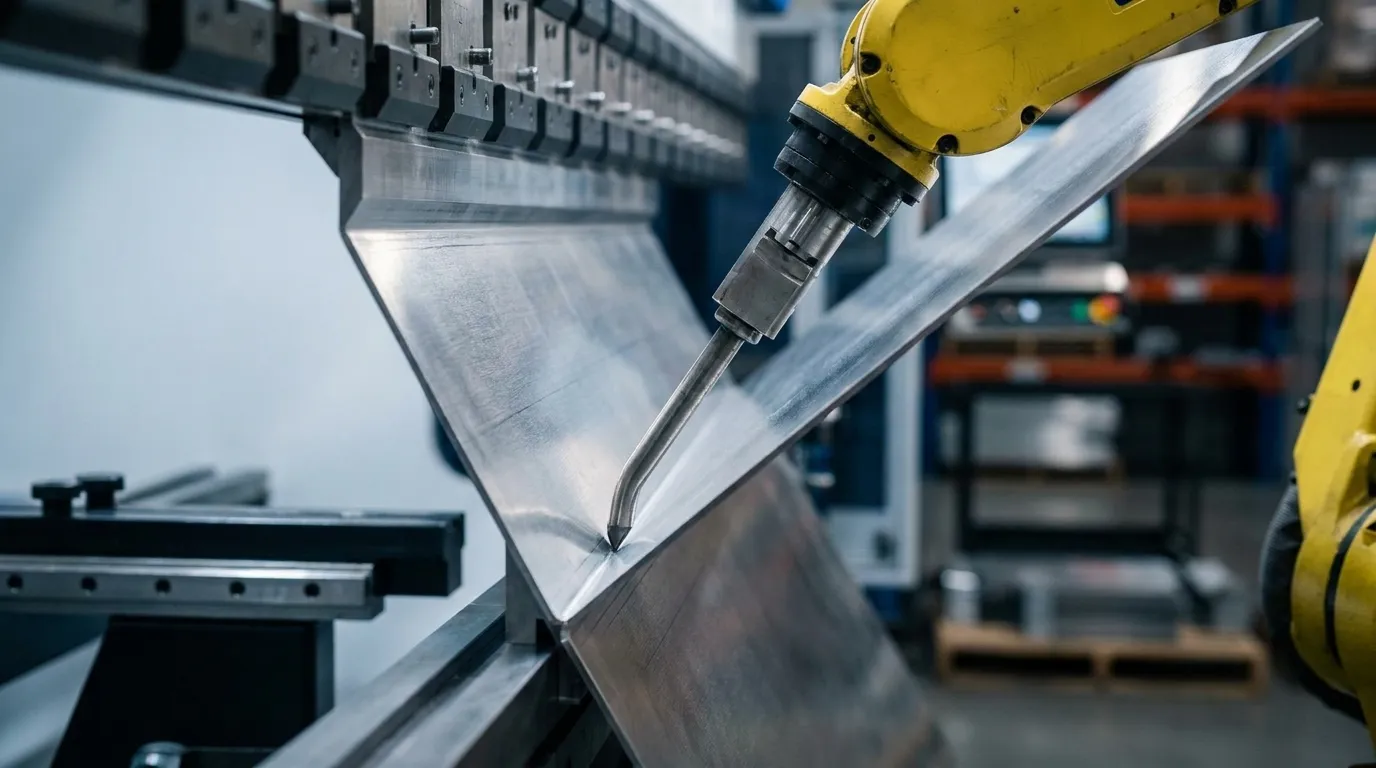
- Forming: CNC press brakes and folders create structural components, including frame uprights, crossmembers and door skins. Supplier performance targets include front-rail coplanarity within 1 mm and frame squareness with diagonal difference within 3 mm.
- Welding and Assembly: Robotic MIG welding is used for high-volume rack frames, while TIG welding handles visible seams on front doors and trim. Hardware insertion, including cage nuts, studs and grounding points, is completed at this stage.
- Finishing: Powder coating is applied at controlled dry-film thickness for durability and cosmetic consistency. Threaded areas, grounding points and label zones are masked before coating to maintain hardware fit and electrical continuity. Screen printing supports branding requirements.
- Final Assembly: Doors, panels, cable management systems, PDUs and optional electromechanical components, including wiring and fans, are integrated. Factory-built enclosures with aligned cable management, PDU bracketry and rail kits reduce installation time significantly compared to on-site cabinet assembly.
- Quality Control: Dimensional inspection, load testing and compliance checks occur before shipment. A static-load hold test maintains rated load for a minimum of one hour, followed by a functional check of doors, latches, panels and rail kits. Compliance with UL 2416 and Telcordia GR-63-CORE seismic requirements is verified where specified.
Request end-to-end manufacturing support for a data center cabinet program.
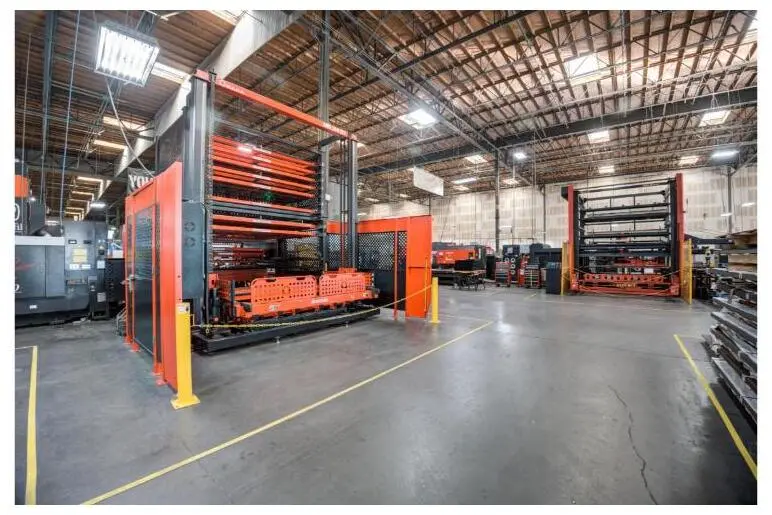
Understanding the manufacturing process clarifies when a standard cabinet will suffice and when a custom design is required.
Custom vs. Off-the-Shelf Data Center Cabinets: How to Decide
Off-the-shelf cabinets work well when requirements align with standard configurations, such as fixed 42U × 600 mm × 1,000 mm dimensions, standard load capacity, minimal customization and fast availability. These cabinets suit private internal labs, staging environments and deployments where standard equipment fits without modification.
Custom cabinets become necessary when standard configurations cannot meet project requirements. Common drivers include:
- Non-standard depth for GPU servers, which are often 1,100–1,200 mm deep, exceeding standard cabinet internal depth
- Higher static load ratings required for dense AI and storage deployments
- Liquid cooling integration, including manifolds, quick-disconnects and leak detection, that must be engineered into the cabinet structure
- Seismic compliance for Zone 4 installations in California and similar environments
- Branding, color and labeling requirements for customer-facing or colocation deployments
- Wider 800 mm footprints to accommodate large cable bundles and high-amperage PDUs in AI deployments
Cost and scalability both point toward custom cabinets at scale. Custom racks cost more upfront than off-the-shelf options, but for deployments of 10 or more racks or uncommon environments, the premium is generally absorbed into the first equipment refresh cycle. Factory-built purpose-designed enclosures with aligned cable management, PDU bracketry and rail kits expedite installation compared to on-site builds.
Scalable custom designs can incorporate spare U-space, higher power distribution capacity and liquid cooling provisions that support future growth without retrofit. Off-the-shelf cabinets lack this level of forward engineering.
Many engineering teams now adopt a hybrid sourcing strategy that combines off-the-shelf hardware with custom-manufactured components. This approach balances performance, thermal efficiency and supply chain resilience. Fabcon supports both paths, with DFM expertise and vertical integration for custom programs at any scale.
Explore custom cabinet solutions for specific deployment requirements.
Working with a Manufacturing Partner for DFM, Prototyping and Scaling
The manufacturing partner selected for a data center cabinet program determines whether design intent survives contact with the production floor. Fragmented supply chains, with separate vendors for sheet metal, finishing and assembly, introduce handoff delays, quality disputes and coordination overhead that compress timelines and inflate total cost.
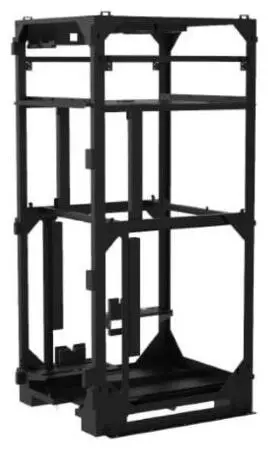
Early DFM collaboration removes the most expensive category of problems, which are designs that cannot be built as specified. Fabcon’s engineering and quoting teams work together from the start, reviewing drawings, tolerances and materials to create manufacturing routers optimized for the production floor. Issues identified during DFM review cost a fraction of the same issues discovered after tooling is cut or production has begun.
Prototype-to-production alignment also matters. Fabcon supports quick-turn prototypes and scales to mid-volume production using agile production cells that adapt to changing volumes, mixed SKUs and evolving bills of materials. Large contract manufacturers require high minimums and long onboarding cycles, so they cannot offer this flexibility. Low-complexity job shops lack integrated finishing and assembly, so they cannot either.
One accountable partner for fabrication, finishing and assembly means one point of contact, one quality system and one production schedule. That structure prevents the finger-pointing that occurs when a dimension is out of tolerance.
Partner with Fabcon for DFM collaboration and scalable production.
Quality and Compliance in Data Center Cabinet Manufacturing
Data center infrastructure must meet regulatory and compliance requirements that flow directly into cabinet specification and manufacturing. Fabcon’s quality management system follows ISO 9001:2015 and AS9100D certified systems, which support stringent testing and full traceability.
Relevant certifications and standards include:
- ISO 9001:2015 — quality management system governing every stage of the build
- AS9100D — aerospace-grade quality standard for mission-critical programs that require strong process control and traceability
- ITAR Registration — required for defense-related manufacturing programs
- UL 2416 — North American IT enclosure safety standard covering structural integrity, fire-escape compliance and grounding
- CSA Compliance — Canadian safety standards for cross-border deployments
- Telcordia GR-63-CORE — seismic Zone 4 requirements for cabinets deployed in high-seismic environments
Colocation, financial services and healthcare deployments face additional compliance obligations. PCI-DSS requires physical access controls around cardholder data systems. SOC 2 auditing expects lockable cabinet doors. HIPAA-covered entities must implement physical safeguards. These safeguards include a facility security plan that documents physical access controls and maintenance records for repairs and modifications to physical security components. Covered entities must implement these measures if reasonable and appropriate, or document an equivalent alternative. Enclosed cabinets are effectively required for most compliance frameworks and colocation agreements.
Fabcon’s integrated QA spans fabrication, finishing and assembly, with documented inspection records and material traceability at every stage. Buyers can request test reports covering dimensional inspection, load testing and coating quality.
Request compliant manufacturing support for a data center cabinet project.
Future Trends in Data Center Cabinet Design
Several converging trends are reshaping what data center cabinets must do and how they must be built. These trends reinforce one another, since higher density drives liquid cooling adoption and modular, intelligent designs.
Higher Density
Forecasts put average rack densities near 40 kW within a few years, with the newest AI systems reaching substantially higher levels. Cabinets must support wider and deeper footprints, reinforced base structures and higher static and dynamic load ratings to accommodate these deployments.
Liquid Cooling Integration
Liquid can absorb roughly 3,200 times more heat per unit volume than air, which makes it the dominant thermal management approach for high-density AI racks. Direct-to-chip cooling can remove roughly 70–90% of a rack’s heat at the source, with residual heat handled by conventional airflow. These liquid cooling provisions, described earlier, are becoming standard features rather than optional add-ons.
Edge Computing
Edge computing deployments are a key demand driver for modular cabinets because standardized micro-data center pods can be rapidly assembled, scaled and transported to remote locations with minimal on-site engineering. Pre-configured, factory-tested enclosures reduce deployment risk at remote sites where skilled labor is limited.
Sustainability
The push for sustainability in network cabinet design has led to the adoption of low-energy materials and advanced airflow designs, making cabinets an integral part of green IT strategies. Liquid cooling systems that enable waste heat reuse and closed-loop designs that minimize water consumption are gaining traction alongside improved PUE metrics.
Modular and Intelligent Designs
Modern network cabinets incorporate smart temperature controls, remote monitoring and automated alerts, with integrated intelligent PDUs and environmental sensors as a first line of defense against downtime. Modular building blocks that scale with changing requirements are replacing fixed configurations in hyperscale and edge environments.
Fabcon’s DFM expertise and flexible production cells allow the company to adapt as these trends mature, unlike large contract manufacturers that struggle to respond to evolving program requirements.
Plan future-ready data center cabinets with Fabcon’s custom manufacturing.
Frequently Asked Questions
What Is the Difference Between a Data Center Cabinet and a Rack?
A data center cabinet is an enclosed structure with doors and side panels that provide directed airflow, physical security and IP-rated protection. A rack may be open-frame, with no enclosure, which offers unrestricted airflow but no dust protection or physical security. Enclosed cabinets are required for most compliance frameworks, including PCI-DSS and SOC 2, and for hot-aisle or cold-aisle containment strategies. Open-frame racks remain appropriate for private internal labs and staging environments where security and containment are not required.
Who Manufactures Data Center Cabinets?
Manufacturers range from low-complexity job shops that handle basic sheet metal to large global contract manufacturers. Job shops typically lack the engineering depth for DFM collaboration and cannot manage integrated finishing, wiring or electromechanical assembly. Large contract manufacturers offer scale but require high minimum volumes and long onboarding cycles that make them unsuitable for mid-volume, high-mix programs. Fabcon occupies the middle ground as a vertically integrated partner with in-house engineering, fabrication, finishing and assembly for programs that require precision, agility and a single accountable partner.
How Are Data Center Cabinets Made?
The process moves from DFM review and material selection through cutting, forming, welding, finishing and final assembly, with quality control before shipment. Fabcon performs all of these steps under one roof. See the step-by-step manufacturing section above for details.
What Standards Apply to Data Center Cabinets?
The key standards are EIA-310-E and IEC 60297 for mounting interfaces, UL 2416 for safety, Telcordia GR-63-CORE for seismic requirements, ASHRAE TC 9.9 for thermal guidelines and TIA-568 for cable bend radius. See the definitions and standards section above for details.
When Should Custom Cabinets Be Chosen Over Off-the-Shelf?
Custom cabinets are the right choice when standard configurations cannot meet project requirements, such as non-standard depth, higher load ratings, liquid cooling integration, seismic compliance, branding needs or wider footprints. Off-the-shelf cabinets suit standard deployments with conventional equipment. See the comparison section above for more detail on this decision.
Conclusion: Choosing a Partner for Data Center Cabinet Design and Manufacturing
Data center cabinet design and manufacturing connects structural engineering, thermal management, cable routing, power distribution and compliance into a single manufactured product. Successful programs require more than a build-to-print vendor.
The complete lifecycle, from EIA-310 and IEC 60297 standards through DFM review, precision fabrication, finishing, assembly and quality control, benefits from a partner that controls every step under one roof. As noted earlier, fragmented supply chains add delays and cost.
Fabcon delivers end-to-end capability, including in-house engineering and DFM collaboration, precision sheet metal fabrication, certified welding, powder coating, electromechanical assembly and scalable production across 220,000 sq ft of vertically integrated manufacturing space. ISO 9001:2015, AS9100D and ITAR registration provide a strong compliance foundation for mission-critical programs.
The next step is a conversation with a manufacturing partner. Contact Fabcon for a consultation, request a quote or schedule a facility tour to see the capabilities firsthand.
Get a quote from Fabcon today for custom data center cabinet design and manufacturing.